
VRF and VRV systems · Offices, medical offices, schools, hotels and multifamily buildings
VRF system repair and installation in Essex County, New Jersey
Repair, service and installation of commercial VRF heat pump and heat recovery systems in Essex County, New Jersey, and in Morris and Union counties. The work serves office buildings, medical offices, schools, houses of worship, hotels, and mixed-use and multifamily buildings. MDL Electric Cooling & Heating holds both a New Jersey master HVACR license and an electrical contractor license. The refrigerant side and the power side are one request.
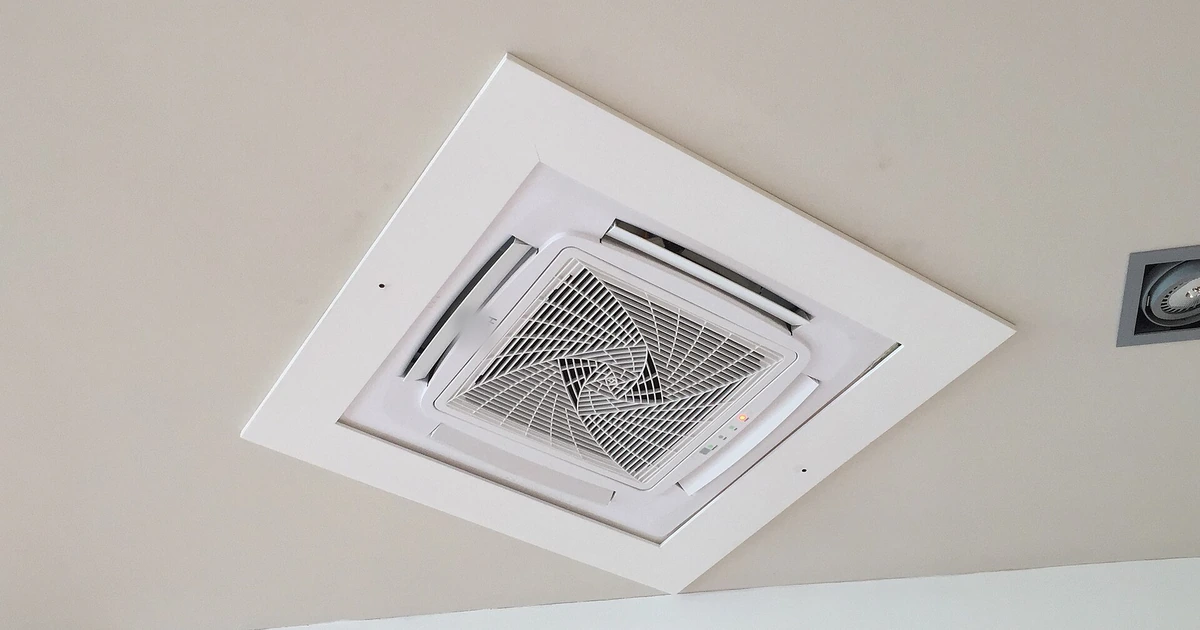
Photo: a four-way ceiling cassette in a shop in Nuoro, Italy, 2024 (Air fans, Wikimedia Commons, CC0), cropped, brand label blurred. VRF systems use indoor units of this kind; the photo does not show which system feeds it. Shown for illustration, not an MDL job.
What MDL does
VRF repair, service and installation, with the refrigerant and the wiring under one licensed contractor.
The work. MDL repairs, services and installs commercial VRF systems. That covers heat pump systems, which heat or cool every zone at once. It also covers heat recovery systems, which can heat some rooms while cooling others (how each works).
Who it is for. Owners, property managers, facility directors and boards of office buildings, medical offices, schools, houses of worship, hotels, and mixed-use and multifamily buildings. Some already run VRF; others are planning a system (planning a new system).
Why both licenses matter. A VRF outdoor unit has two sides: its refrigerant circuit, and a power circuit with a disconnect in sight of the unit. New Jersey's HVACR board says a master HVACR contractor may not replace a disconnect box or disconnect switch. MDL holds both licenses (the electrical side).
Start here. MDL works from 4 Harrison Avenue in West Orange. Call 973.809.2339 or use the request form. A photo of the outdoor unit nameplate and the error code on the controller help most (what to send).
RepairError codes traced through the refrigerant circuit, the controls and the power supply.
ServiceChecks on the outdoor units, the indoor units, the drains and the control wiring.
InstallationNew systems and replacements, with the permit or notice New Jersey requires.
PowerCircuits, disconnects, voltage and phase balance at every outdoor unit.
How VRF works
One outdoor unit, refrigerant piping, and many indoor units that each hold their own temperature.
These points come from DOE laboratory reports: PNNL's VRF report for the GSA (December 2012) and NREL's VRF report (November 2023). Knowing which type a building has tells a technician which parts to expect.
- Variable-speed compressors. The outdoor unit holds two or more compressors. At least one is inverter-controlled and variable-speed, which PNNL says is rated at much higher part-load efficiency.
- Many indoor units per outdoor unit. PNNL says 60 or more indoor units can run from one outdoor unit. Their combined capacity can exceed the outdoor unit's, because rooms rarely peak together.
- Piping instead of ducts. Indoor fan coil units connect to the outdoor unit with refrigerant piping. They mount on the wall, at the floor or in the ceiling as cassettes, or hide above the ceiling with ducted grilles.
- Individual control. The ASHRAE Handbook definition, as NREL quotes it, requires capacity in three or more steps. Indoor units are controlled individually over shared piping and a communications network.
- Cold-weather heating. PNNL notes that some manufacturers report up to 70% of rated heating capacity at -7°F. Below a system's operating range, a full backup heat source may be needed.
- Defrost. With two outdoor units, PNNL says one can keep conditioning the building while the other defrosts its coil.
Scroll sideways to see the whole table.
| Question | Heat pump VRF | Heat recovery VRF |
|---|---|---|
| Modes at one time | All indoor units heat, or all cool | Some zones heat while others cool |
| Extra device | None between the outdoor and indoor units | A branch controller, also called a heat recovery unit, routes liquid or gas refrigerant to each zone |
| Pipes to the branch device | Not applicable | Two or three, depending on the manufacturer |
| Where it fits | Buildings whose zones need the same mode at the same time | Buildings where some rooms need cooling while others need heating; ORNL saw that split in its test building |
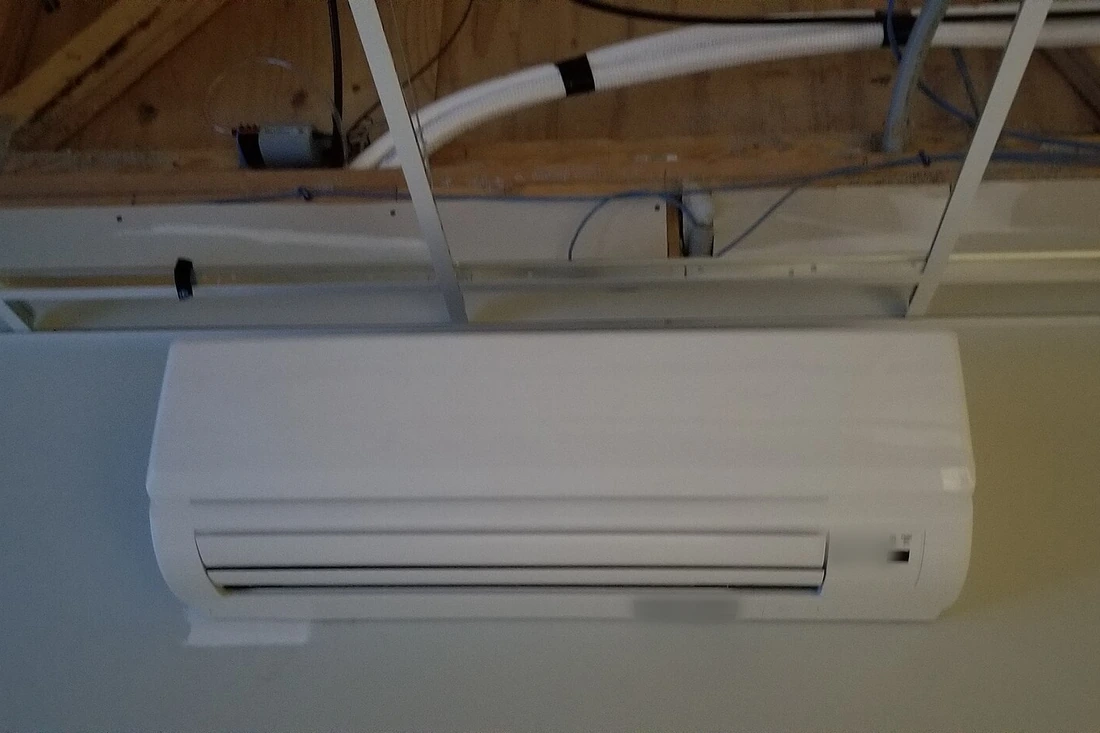
- Each indoor unit has an address. The outdoor unit talks to every indoor unit over a communication cable. One manufacturer's manual says automatic addressing must run again after an indoor unit circuit board is replaced.
- Each indoor unit drains. Service manuals tie drain errors to the drain pump, the float switch and the drain line. A blocked drain can show up as an error code before any water appears.
- The branch controller is a part too. On heat recovery systems it sits between the outdoor unit and the indoor units and sends each zone the refrigerant its mode needs.
- Many units, one refrigerant circuit. The indoor units share piping back to the outdoor unit. For HFC leak repair, EPA counts each independent circuit as one appliance.
Repair
When the controller shows a code: what the manuals list as causes, and where MDL looks first.
Codes differ by manufacturer, so the code list for the installed system applies. The examples below come from one manufacturer's outdoor unit service manual and a DOE Building America field study (June 2025).
Scroll sideways to see the whole table.
| What the building sees | What the manual or study says | What MDL checks |
|---|---|---|
| Indoor units show a communication error | The indoor unit has received no signal from the outdoor unit for more than 5 minutes; causes include wrong communication or power wiring, a board failure and duplicate addresses | Communication cable, shield, terminations, polarity where required, unit addresses and boards |
| A room will not hold its setting | An indoor air temperature sensor that is disconnected or shorted: check the wiring, then the board connection, then the thermistor | Sensor wiring, connectors and the thermistor itself |
| A drain or overflow code | The drain pump or float switch may be malfunctioning; check the drain line for obstructions | Pump, float switch, drain line and its pitch |
| The compressor or inverter trips | The inverter driver detects overcurrent on a compressor phase; listed causes include under-voltage, a defective expansion valve restricting flow, and overcharge | Supply voltage under load, the electronic expansion valves, the charge and the inverter board |
| The outdoor unit will not start | One or more of the three incoming power lines is missing at the main outdoor unit | Each phase from the panel through the disconnect to the unit terminals |
| Weak heating or cooling with a repeating code | In the DOE study, one system logged error 1202 several times a week; a common cause of that code is low refrigerant charge | Pressures, temperatures and a leak search at brazed and flare joints |
| An expansion valve is suspected | Valve noise can be confirmed by touching the valve body with a screwdriver and listening | Valve operation, coil and wiring before any part is replaced |
- Write down the code. Note the code, the unit address on the controller, and which rooms are affected.
- Note recent power events. One manufacturer calls for phase-loss protection where reversed phase, phase loss or momentary blackouts are possible.
- Leave the terminal blocks alone. Another manufacturer warns that 208/230-volt power on the transmission terminals "would destroy the entire system."
- Leave the refrigerant circuit closed. Federal rules require EPA Section 608 certification to service equipment that could release refrigerant (refrigerant rules).
The electrical side
The outdoor unit's nameplate sets the wire, the breaker and the disconnect.
New Jersey's electrical subcode is the National Electrical Code 2023, with Tentative Interim Amendments (N.J.A.C. 5:23-3.16(a)1). Article 440 covers air-conditioning equipment. The manufacturer's installation manual adds limits of its own.
Scroll sideways to see the whole table.
| Requirement | What the code or manual says | Where it comes from |
|---|---|---|
| Minimum circuit ampacity | The nameplate must show the minimum supply circuit conductor ampacity; wire size is chosen from it | NEC 440.4(B); LG manual |
| Maximum overcurrent protection | The nameplate shows the maximum branch-circuit protective device rating, and the breaker may not exceed it. One single-phase 208/230-volt model lists a 20 A maximum and a 19.8 A minimum circuit ampacity | NEC 440.4(B); Mike Holt; Daikin RXTQ36 table |
| Disconnect | Within sight from, and readily accessible from, the equipment; "within sight" means visible and not more than 50 feet away. Each outdoor unit gets a dedicated fused disconnect or breaker | NEC 440.14; Mike Holt; LG manual |
| Voltage | Supply may not vary more than 10% from rated voltage: 187 to 253 V for 208-230 V units, 414 to 528 V for 460 V units | LG manual |
| Phase balance | Imbalance between phases of 2% or less; above that, one manual says unit life is reduced | LG and Mitsubishi manuals |
| Phase loss | A field-supplied phase-loss protection circuit where reversed phase, phase loss or momentary blackouts are possible | LG manual |
| Grounding | The inverter unit must be grounded to reduce electrical noise and release leakage current from the case | Daikin manual; LG manual |
| Communication wiring | Two-core shielded cable; power wiring at least 2 inches away and never in the same conduit; never connect main power to the transmission terminal block | Mitsubishi and LG manuals |
- Indoor units have power too. One manual allows several indoor units and heat recovery units on one breaker where code permits, with a service switch at each.
- Each outdoor module is wired on its own. Another manual calls for dedicated power supplies and individual wiring for each outdoor module.
- No power factor capacitor. One manual warns against adding a capacitor for power factor correction to an inverter unit; it can overheat.
- Where the HVACR license stops. The NJ HVACR board says a master HVACR contractor may not replace a disconnect. Its rule limits replacement wiring from an existing disconnect to equipment of 25 tons or less on systems of 240 volts or less (rules).
- Added units add load. MDL's panel and capacity page and commercial electrician page cover the rest of the building's power.
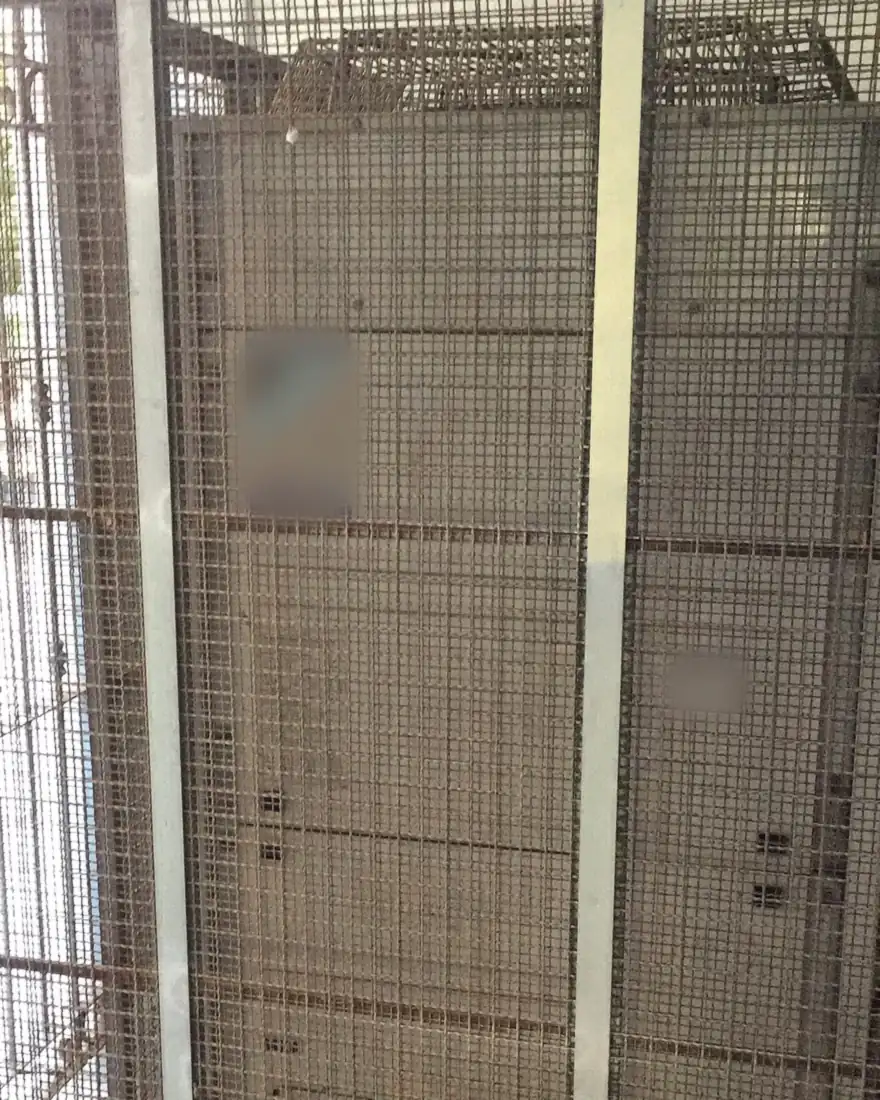
Refrigerant rules
What the 2025 to 2028 refrigerant rules mean for a VRF repair or a new VRF system.
From U.S. EPA's Technology Transitions restrictions table (updated August 28, 2026), its HFC frequent questions, the May 26, 2026 Federal Register rule and the SNAP substitutes list. All were read November 16, 2026.
- New systems. New VRF systems are limited to refrigerants with a global warming potential under 700. VRF equipment made or imported before January 1, 2026 may be installed until January 1, 2027, or January 1, 2028 for projects with a building permit approved before October 5, 2023.
- No extension. EPA's May 2026 rule says it "is not extending the installation date" for VRF equipment made or imported before January 1, 2026.
- Which VRF counts. EPA's VRF category covers water-source VRF of any capacity and air-source VRF of 65,000 Btu per hour or more.
- Repairs continue. EPA says existing systems can keep being repaired, including replacing a condensing unit or compressor. Components used to repair existing systems are not restricted.
- The new refrigerants. EPA's SNAP list for residential and light commercial air conditioning lists R-32 (GWP 675) and R-454B (GWP 470). Both are ASHRAE class A2L, acceptable with use conditions.
- No conversions. EPA says mildly flammable refrigerants such as R-32 or R-454B may not go into systems that were not designed for them.
- Who may handle refrigerant. Technicians who maintain, service or repair equipment that could release refrigerant must hold EPA Section 608 certification. Since January 1, 2018 that includes most substitute refrigerants, including HFCs.
- Leak repair for HFCs. From January 1, 2026, EPA's leak repair rules apply to appliances with 15 pounds or more of an HFC refrigerant. Each independent circuit counts as a separate appliance. Residential and light commercial air conditioning is excluded, and EPA's questions page does not say how that applies to VRF.
A2L refrigerant in occupied rooms: detection, shut-off valves and charge limits
- The equipment standard. UL 60335-2-40 is the U.S. and Canadian safety standard for heat pumps and air conditioners. Its fourth edition was published December 15, 2022 (UL Solutions).
- Charge limits follow the room. UL 60335-2-40 bases refrigerant charge limits on the minimum occupied volume of the room the equipment serves.
- Detection. UL tells inspectors to expect a built-in refrigerant detection system on equipment with more than a 4-pound charge. It typically starts mitigation within 15 seconds at 25% of the lower flammability limit (UL, October 21, 2024).
- Shut-off valves. UL says valves that stop refrigerant flow are typically required for units with multiple indoor coils, such as VRF equipment.
- Building design. An official ASHRAE interpretation says Standard 15 permits mechanical ventilation or safety shut-off valves when an A2L system's charge exceeds the permissible charge (IC 15-2022-11).
Energy use
What DOE national laboratory studies measured, including where VRF saved less.
Seven findings from Oak Ridge (ORNL), Pacific Northwest (PNNL) and NREL reports and a DOE Building America study. Each names its comparison, because the baseline decides the result.
- 30%, 37% and 47% in cooling. ORNL compared a 12-ton VRF system with the existing rooftop VAV reheat system in a 3,200-square-foot test office. Cooling-season savings were 30%, 37% and 47% at 100%, 75% and 50% load (ORNL/TM-2016/364).
- 60%, or 33% against a gas boiler. An earlier ORNL model of the same building put VRF at about 60% less energy. With outdoor-air reset and hot-water reheat from an 80% gas boiler on the baseline, savings fell to 33% of HVAC source energy (ORNL/TM-2015/225).
- 51.1% national average in simulation. ORNL simulated small and medium offices in 12 U.S. locations. Weighted HVAC energy savings averaged 51.1%, from 39.7% in Miami to 68.0% in San Francisco (ORNL/TM-2016/386).
- 34% and 45% in energy cost. PNNL concluded VRF can save 34% of HVAC energy cost against VAV with hot-water reheat or constant volume with gas heat. Against VAV with electric reheat, the figure was 45%. PNNL also noted a lack of field-verified savings data (PNNL-21548).
- 16% across the building stock. NREL modeled VRF heat recovery across U.S. commercial buildings and found 16% total site energy savings. Heating electricity rose 24% as natural gas heating fell 53% (NREL/TP-5500-86103).
- 48% to 52% in two cold-climate hotels. NREL's survey of published studies cites two hotels where VRF saved about 48% to 52% of HVAC energy over traditional systems. NREL also notes some case studies found VRF less efficient than advertised (NREL/TP-5500-86103).
- Twice the capacity needed. In three new New York City multifamily buildings, cooling output stayed below 33% of installed capacity for 96% of summer hours. The study found capacity twice what was needed, with efficiency dropping at lower loads (DOE Building America, June 2025).
For a New Jersey building that heats with a gas boiler today, finding 2 is the closer comparison. Finding 5 shows the electric heating load that replaces the gas, and that load reaches the building's electrical service.
New systems and replacements
Planning a VRF installation: the decisions that set the scope, and what the price data says.
A replacement of outdoor units of like capacity and a new system are different jobs under New Jersey's code (rules). Either way, these choices come first.
- Heat pump or heat recovery. Rooms that need cooling while others need heating point toward heat recovery, as ORNL's test building showed.
- Size from the loads. The New York study above found systems twice the size needed, with efficiency falling at low loads.
- A2L safety. A new system on R-32 or R-454B brings detection, shut-off valves and room charge limits into the design.
- Electrical capacity. Each outdoor unit needs its own disconnect and correctly sized circuit, and electric heat replaces gas heat.
- Controls. PNNL says most, if not all, VRF systems can talk to an energy management system through open protocols including BACnet, an ASHRAE, ANSI and ISO standard.
Commissioning steps the installation manuals require
- Braze under nitrogen. One manual says brazing without a nitrogen flow leaves oxide film that harms valves and compressors. Another calls for a dry nitrogen purge of at least 3 psig.
- Pressure test. One manual calls for 550 psi of nitrogen with no pressure drop over 24 hours. Another steps through 150 psig for 5 minutes and 300 psig for 15 minutes, then 550 psig for 24 hours with bubble solution on every joint.
- Evacuate. One manual calls for at least 2 hours down to 500 microns, then a 1-hour hold with no rise. Another warns not to power the units first, because the expansion valves can close and isolate parts of the piping.
- Why it matters. Contractors told NREL that poor purging of refrigerant lines was the most common problem they found in the field. PNNL notes that finding leaks is difficult.
Scroll sideways to see the whole table.
| Publisher and date | Published figure | What the publisher says about it |
|---|---|---|
| Terrapin Construction Group April 22, 2026 | $24 to $38 per square foot installed | The upper range applies to heat recovery VRF in cold climates and buildings that need dense zoning |
| PickHVAC May 24, 2026 | $2,500 to $6,500 per ton installed | A per-ton example among other commercial system types |
| PNNL for the GSA December 2012 | $24 per square foot total; $3.00 per square foot more than alternatives | Assumptions in a federal portfolio analysis, now more than a decade old |
- Cost grows with floor area. NREL heard from manufacturers that, because VRF is modular, cost rises linearly with floor area in larger buildings.
- Service life. PNNL found no definitive VRF service-life data and assumed 15 years. A contractor's 2026 table lists 18 to 22 years.
New Jersey rules
Permits, licenses and who may touch which wires on a New Jersey VRF job.
Read November 16, 2026 from the Uniform Construction Code, N.J.A.C. 5:23-2 (published through August 17, 2026), the HVACR licensing act and the NJ HVACR board's answers. The town's construction office applies the code to a specific job.
Scroll sideways to see the whole table.
| Job or question | What the rule says | Citation |
|---|---|---|
| Repair a VRF system | "Repair of air conditioning equipment and systems" is ordinary maintenance: no permit, inspection or notice | N.J.A.C. 5:23-2.7(c)5.iv |
| Repair or replace controls | Repair or replacement of control devices for heating and air conditioning equipment is ordinary maintenance | N.J.A.C. 5:23-2.7(c)5.v |
| Replace outdoor units of like capacity | Replacing air conditioning units and condensing units with new appliances of like capacity is minor work: notice before work begins, and a permit | N.J.A.C. 5:23-2.17A(a) and (c)3; 2.14(b)2 |
| New system or added equipment | Installing or altering regulated equipment without first filing an application and obtaining a permit is unlawful | N.J.A.C. 5:23-2.14(a) |
| Who may do the work | Electrical and HVACR work only by persons licensed for it; the permit application names each contractor's license number | N.J.A.C. 5:23-2.15(b)2 and 2.15(b)2.i |
| Electrical code | The National Electrical Code 2023, with Tentative Interim Amendments, is New Jersey's electrical subcode | N.J.A.C. 5:23-3.16(a)1 |
| HVACR license | No one may work as a Master HVACR contractor unless licensed; HVACR contracting includes installation, maintenance, service and repair | N.J.S.A. 45:16A-7; P.L. 2007, c.211, section 2 |
| Wiring limits for an HVACR license | A Master HVACR licensee may not do wiring above 30 volts except replacement installations; the board says a master HVACR contractor may not replace a disconnect; replacement wiring from an existing disconnect is limited to equipment of 25 tons or less per piece on systems of 240 volts or less | N.J.S.A. 45:16A-28; N.J.A.C. 13:32A-1.2 |
What to send
Before the visit: what a building manager can send, and what happens next.
Photos taken from the floor or the roof walkway are enough. Do not open electrical panels, outdoor unit covers or ceiling units to get them.
01
System type
Heat pump or heat recovery if known, how many outdoor units, and roughly how many indoor units.
02
Outdoor nameplate
Brand, model, serial number, voltage, phase, minimum circuit ampacity and maximum overcurrent rating.
03
The code
The error code and unit address on the controller, and which rooms or floors are affected.
04
What changed
A power outage, a tripped breaker, electrical work, renovation, roof work or a new tenant layout.
05
Controls
Wall controllers, a central controller, or a building automation system that reads the VRF system.
06
Access
Roof or yard access, ceiling access in occupied rooms, hours, and who approves the work.
- Scope first. MDL confirms the service boundary after seeing the building and the equipment.
- Permits when the code requires them. Repairs are ordinary maintenance; replacements and new systems are not (rules).
- No published prices. The cost depends on what failed, the access and the number of units.
Where MDL works
VRF service across Essex, Morris and Union counties.
MDL works from 4 Harrison Avenue in West Orange. The towns below have their own MDL service-area page. Include the exact address and ZIP code so coverage can be confirmed for the building.
Morris County
Union County
VRF service
A VRF system showing codes, short of capacity or due for replacement? Send the details.
Call or send the form with the address, the outdoor unit nameplate, the error code and the affected rooms. The form opens with Commercial Heating / HVAC chosen.
VRF questions
Answers on how VRF works, faults, refrigerant, cost, permits and brands.
Each answer draws on the sources listed below. MDL publishes no prices; the cost answer quotes published figures with their dates.
What is a VRF system?
VRF stands for variable refrigerant flow. One outdoor unit with variable-speed compressors serves many indoor units through refrigerant piping. PNNL's report for the GSA says one outdoor unit can serve 60 or more indoor units. Each indoor unit keeps its own zone at its own setting. MDL repairs, services and installs these systems in commercial buildings in Essex, Morris and Union counties.
How does a VRF HVAC system work?
The outdoor unit has at least one inverter-driven, variable-speed compressor. PNNL says these are rated at much higher part-load efficiency than constant-speed systems. Refrigerant piping links the outdoor unit to indoor fan coil units, and each one controls its own zone. A heat pump system runs every indoor unit in heating or every one in cooling. A heat recovery system adds a branch controller, so some rooms can heat while others cool.
What is the difference between VRF and VRV?
They are the same technology. VRV is one manufacturer's trademarked name for it, and other manufacturers call it VRF. The repair, service and code questions on this page apply under either name.
Does VRF require ductwork?
Not to heat and cool the rooms. Indoor units connect to the outdoor unit by refrigerant piping. PNNL notes that indoor units come in ductless and ducted form: wall, floor and ceiling cassette units, or concealed units ducted to grilles. Fresh air is separate: PNNL says outdoor air has to be provided separately, typically by a dedicated outside air system.
What is the difference between a heat pump and a heat recovery VRF system?
A heat pump VRF system runs all its indoor units in one mode at a time, heating or cooling. A heat recovery system can heat some zones while cooling others. It uses a branch controller between the outdoor unit and the indoor units, with two or three pipes depending on the manufacturer. In ORNL's test building, some zones needed cooling while others needed heating. ORNL said a heat recovery system is likely to resolve that comfort risk.
What usually goes wrong with a VRF system?
One manufacturer's service manual lists communication errors between units, failed temperature sensors, drain pump and float switch faults, and inverter or compressor overcurrent. It also lists electronic expansion valve problems and a missing phase on the power supply. A DOE field study found one system logging an error several times a week; a common cause of that code is low refrigerant charge. MDL traces each code on the refrigerant side and the power side.
Can an R-410A VRF system still be repaired?
Yes. EPA says existing systems can continue to be repaired, including replacing a major component like a condensing unit or compressor. EPA's restrictions apply to installing new field-assembled systems, not to components used for repairs. An R-410A system that was not designed for R-32 or R-454B cannot be switched to them. EPA says mildly flammable refrigerants may not be used in systems that were not designed for them.
How much does a VRF system cost?
MDL does not publish prices, and this page lists none of its own. Terrapin Construction Group, a commercial general contractor, puts typical 2026 VRF installs at $24 to $38 per square foot (April 22, 2026). PickHVAC, a cost-guide site, lists $2,500 to $6,500 per ton installed (May 24, 2026). Both were read November 16, 2026. Terrapin says heat recovery systems in cold climates and buildings with dense zoning reach the upper range.
What is the life expectancy of a VRF system?
PNNL's report for the GSA found no definitive information on VRF service life. It assumed 15 years, the same figure ASHRAE gives for unitary DX equipment. A commercial general contractor's 2026 table lists 18 to 22 years. Installation quality matters too: contractors told NREL that poor purging of refrigerant lines was the most common problem they found in the field.
Does VRF work need a permit in New Jersey?
Repair of air conditioning equipment and systems is ordinary maintenance under N.J.A.C. 5:23-2.7(c)5.iv: no permit, inspection or notice. Replacing air conditioning units and condensing units with new appliances of like capacity is minor work under N.J.A.C. 5:23-2.17A(c)3. That means notice before work begins, and a permit. A new system or added equipment needs a permit first under N.J.A.C. 5:23-2.14(a). The local construction office applies the code to the specific job.
Does MDL work on a specific VRF brand?
MDL's pages do not publish a brand list, and this page does not add one. The manuals cited here are quoted only for what each manufacturer says about its own equipment. Send the brand, model and serial number from the outdoor and indoor unit nameplates with the request. MDL confirms the service boundary after seeing the building and the equipment.
Which towns does MDL cover for VRF service?
MDL works from 4 Harrison Avenue in West Orange. It covers Essex County towns including Montclair, Bloomfield, Livingston, Maplewood and South Orange. In Morris County it covers Morristown and Chatham. In Union County it covers Summit, Union and Rahway. Send the exact address and ZIP code so coverage can be confirmed for the building.
Sources
The reports, rules and manuals behind this page.
All read November 16, 2026. Manufacturer manuals are cited for what each says about its own equipment, not as a list of brands MDL services.
- PNNL-21548, Variable Refrigerant Flow Systems (Pacific Northwest National Laboratory for the GSA Green Proving Ground, December 2012): how VRF works, indoor unit types, outdoor air, cold-weather capacity, BACnet, flare fittings, 34% and 45% cost savings, cost and service-life assumptions.
- NREL/TP-5500-86103 (National Renewable Energy Laboratory, November 2023): heat pump and heat recovery types, branch controller pipes, the ASHRAE definition, stock-wide savings, the cold-climate hotel studies, field performance and cost scaling.
- ORNL/TM-2016/364 (Oak Ridge National Laboratory, August 2016): measured cooling-season savings of 30%, 37% and 47%.
- ORNL/TM-2015/225 (Oak Ridge National Laboratory, June 2015): modeled savings of about 60%, falling to 33% against a gas-boiler reheat baseline; the comfort finding on heat recovery.
- ORNL/TM-2016/386 (Oak Ridge National Laboratory, August 2016): 12-location simulation, 51.1% national weighted HVAC energy savings.
- Humidity and Variable Refrigerant Flow Operation in Multifamily Buildings (DOE Building America final technical report, Steven Winter Associates, June 2025): oversizing, low-load efficiency, the 1202 error case.
- LG Multi V 5 outdoor unit service manual (SM_MultiV_5_OutdoorUnits_09_18, distributor copy): error codes and their listed causes.
- LG Multi V 5 with LGRED outdoor unit installation manual (IM_MultiV5_LGRED_OutdoorUnits_11_24): disconnects, voltage, phase balance, phase loss, communication wiring, addressing, pressure and evacuation steps.
- Mitsubishi Electric Y-Series outdoor unit installation manual (WT06580X02, distributor copy): shielded transmission cable, dedicated power, phase balance.
- Daikin VRV IV-S installation manual (3P591321-11G): transmission terminals, grounding, nitrogen brazing, the 550 psi test, evacuation, the RXTQ36 circuit table.
- Mitsubishi Electric, "What is heat recovery?" (October 30, 2026): heat pump systems run one mode at a time; branch circuit controllers.
- Manufacturer page on the VRV name (no date shown): VRV and VRF are two terms for the same technology.
- U.S. EPA, Technology Transitions HFC restrictions by sector (updated August 28, 2026): the 700 GWP limit, VRF installation dates, repair components.
- U.S. EPA, frequent questions on the HFC phasedown (updated November 16, 2026): VRF subsector scope, repairs, conversions, HFC leak repair from January 1, 2026.
- Federal Register, May 26, 2026 (document 2026-10387): the VRF installation date was not extended.
- U.S. EPA SNAP, substitutes in residential and light commercial air conditioning and heat pumps (updated March 19, 2026): R-32 and R-454B listings.
- U.S. EPA, Section 608 technician certification (updated November 16, 2026): who needs the certification.
- UL Solutions, updated requirements for refrigerant detection systems (no date shown): UL 60335-2-40, its fourth edition and room-based charge limits.
- UL Solutions, inspecting refrigerant detection systems (October 21, 2024): the 4-pound guide, 15-second mitigation, shut-off valves on VRF.
- ASHRAE interpretation IC 15-2022-11 (approved September 9, 2024): ventilation or shut-off valves as A2L mitigation.
- NFPA 70 public-input report, Article 440 (reproducing NEC 2023 text): 440.4(B) nameplate marking and 440.14 disconnect location.
- Mike Holt, air-conditioning equipment under the 2023 NEC (no date shown): breaker not above the nameplate maximum; "within sight" is 50 feet.
- N.J.A.C. 5:23-2, Uniform Construction Code (NJ Department of Community Affairs, published through August 17, 2026): ordinary maintenance, permits, licensed work, minor work.
- N.J.A.C. 5:23-3.16, electrical subcode (NJ Department of Community Affairs, published through August 17, 2026): NEC 2023 as New Jersey's electrical subcode.
- P.L. 2007, c.211, the HVACR licensing act (N.J.S.A. 45:16A): licensing and the 30-volt wiring limit.
- N.J.A.C. 13:32A-1.2 (Justia copy, current through June 16, 2025): the Master HVACR definition and the replacement wiring limits.
- NJ HVACR board, frequently asked questions (last modified October 9, 2026): a master HVACR contractor may not replace a disconnect.
- Terrapin Construction Group, commercial HVAC cost per square foot (April 22, 2026): VRF installed cost per square foot and a typical life range.
- PickHVAC, commercial HVAC installation and replacement cost estimates (May 24, 2026): VRF installed cost per ton.
- MDL's commercial HVAC page (this site): the license wording and the EPA VRF dates this page repeats.
- Ceiling cassette in a Nuoro shop (photo by Air fans, 2024, Wikimedia Commons, CC0): the hero photo, cropped, brand label blurred. Not an MDL job.
- Canaan Valley National Wildlife Refuge split air system unit (photo by the U.S. Fish and Wildlife Service, 2020, Wikimedia Commons, public domain): the wall unit photo, cropped, labels blurred. Not an MDL job.
- VRF outdoor unit in Nuoro (photo by Air fans, 2024, Wikimedia Commons, CC0): the outdoor unit photo, cropped, brand labels blurred. Not an MDL job.


About this page
Who wrote it, and what it does not claim.
MDL Electric Cooling & Heating wrote this page. MDL is a licensed electrical contractor and master HVACR contractor at 4 Harrison Ave, West Orange (NJ Electrical Business Permit #34EB01606200; NJ Electrical Contractor #34EI01606200; NJ Master HVACR Contractor #19HC00308200), working across Essex, Morris and Union counties. Every figure was read from the sources above on November 16, 2026. No figure here is an MDL price, and the page names no brand MDL services.
Related pages
Where VRF work connects to the rest of the building
All of MDL's building services are listed on the commercial services page.
Commercial HVAC service
Heating, cooling and boiler service for a business or managed property, with VRF as one system type.
Learn moreCommercial boiler replacement cost in New Jersey
Weighing a boiler replacement against a VRF retrofit? Published replacement figures with their sources.
Learn moreHeat trace installation
Freeze protection for water and drain piping in the building's unheated spaces.
Learn moreHeat pump repair
Single-system heat pumps: ice, cold air, heat strips and the breaker behind them.
Learn moreDuctless mini-split installation
One or a few rooms on a mini-split rather than a building-wide VRF system.
Learn moreCommercial electrician
Circuits, panels and troubleshooting for the rest of the building's power.
Learn moreRequest service
Send MDL the service, town, and best callback number.
Use the form for planned service or call for urgent electrical, heating, or cooling help.