
Heat trace · Pipe freeze protection for commercial and apartment buildings
Heat trace installation in Essex County, New Jersey
MDL Electric Cooling & Heating installs heat trace for commercial and apartment buildings in Essex County, New Jersey, and in nearby Morris and Union counties. Heat trace is the electric cable that keeps water, sprinkler and grease lines from freezing or clogging. MDL is a licensed New Jersey electrical contractor, so the cable, its protected circuit, the controller and the permit are one request.
The short answer
Heat trace is a heating cable fastened along a pipe, under its insulation, on its own protected circuit.
What MDL does. MDL installs heat trace on the piping of commercial and multifamily buildings. That means domestic water lines, fire sprinkler lines, drain and grease waste lines, tanks and roof drains. The job covers the cable, its circuit, the controller, the caution labels and the test record. MDL confirms the scope after seeing the building and the piping.
Who this page is for. Facility and property managers, multifamily owners, restaurants, schools, warehouses and medical buildings in Essex County. MDL also covers Morris and Union counties (towns).
Why it is electrical work. The National Electrical Code treats heat tracing as a continuous load that needs ground-fault protection of equipment. New Jersey requires a permit and a licensed contractor for the new wiring (the circuit and the rules).
Start here. MDL works from 4 Harrison Avenue in West Orange. Call 973.809.2339 or use the request form. Send the lines you want protected and photos of the piping.
Domestic waterLines in parking garages, crawlspaces, stairwells and exterior walls.
Fire sprinkler linesWet lines through unheated spaces, with a listed and supervised system.
Grease waste linesRestaurant drain lines kept warm enough for the grease to keep flowing.
Tanks and roof drainsVessels under Article 427 of the electrical code; roof drains under Article 426.
Where it is needed
New Jersey winters keep unheated spaces below freezing for weeks, not hours.
NOAA's 1991–2020 climate normals for its North Jersey airport weather station (USW00014734) show how long the cold lasts. A pipe in an unheated garage or stairwell sees much of it.
- 79.9 days a year at or below freezing. That is the average number of days a year when the low reaches 32°F or colder.NOAA normals, annual
- 14.5 days a year that never thaw. On those days the high stays at or below 32°F, so an exposed pipe gets no daytime relief.NOAA normals, annual
- January has the most freezing nights. The normal January low is 25.5°F, and 22.6 January nights reach 32°F or colder. February adds 20.0 such nights, and December 17.5.NOAA normals, monthly
- Cold snaps go deeper. The low falls to 20°F or colder on 20.1 days a year and to 10°F or colder on 3.4 days.NOAA normals, annual
Scroll sideways to see the whole table.
| Line | Where it runs | What the cable holds it at | Control |
|---|---|---|---|
| Domestic water | Parking garages, crawlspaces, stairwells, exterior walls, loading docks | At least 40°F, freeze protection | Ambient or line sensing |
| Fire sprinkler piping | Supply lines, standpipes and branch lines in unheated spaces | At least 40°F, with a system listed for sprinklers | Supervised controller wired to the fire alarm panel |
| Grease waste lines | Restaurant kitchen drains running to the grease interceptor | At least 110°F, flow maintenance | Line sensing, required for grease lines |
| Tanks and vessels | Water and process tanks outdoors or in unheated rooms | Set by the tank's design | Article 427 covers pipelines and vessels |
| Commercial roof drains | Roof drains exposed to snow and ice | Melting snow and ice, not a set pipe temperature | Article 426, exposed systems on roofs and drainage |
Choosing the cable
Self-regulating, constant-wattage or mineral-insulated: the pipe's temperatures pick the cable.
Two temperatures decide it: the one the pipe must hold, and the hottest the cable will ever see with the power off. The figures below are Chromalox's for its own cable families.
Scroll sideways to see the whole table.
| Cable | May overlap | On plastic pipe | Cut to length on site | Hottest exposure, power off | Where it fits |
|---|---|---|---|---|---|
| Self-regulating | Yes | Yes, the low-temperature type only | Yes | 185°F (low-temperature type) | Freeze protection of water and sprinkler lines; grease lines; low to mid temperatures |
| Constant-wattage | No | No | Yes, at a module point | 392°F | Exposure above the low-temperature self-regulating limit; never overlapped |
| Mineral-insulated | No | No | No, built to an exact length | 1,200°F | The highest temperatures; more labor-intensive to install |
- Self-regulating cable turns itself down. Raychem says its output "is reduced automatically as the pipe warms, so there is no possibility of failure due to overheating."Raychem design guide
- It may cross itself. Raychem's commercial cable may be overlapped or installed on plastic pipes without overheating.Raychem data sheet
- Constant-wattage cable never overlaps. Chromalox marks it as a fire hazard: "Do not overlap constant wattage heating cables."Chromalox PJ438
- Every circuit gets a temperature control. Chromalox: "All heating circuits should have temperature controls."Chromalox PJ438
- Series and mineral-insulated cable are engineered. The exact length is designed to give the output, and mineral-insulated cable is more labor-intensive to install.EC&M, Guidry
Controls
The controller decides when the cable runs: by the air temperature or by the pipe's own.
Raychem's installation manual names two ways to switch a circuit, and its design guide says which lines need which.
- Ambient sensing. The controller energizes the circuit when the air drops below the set point. Raychem mounts the device above grade, out of sunlight, where it meets the coldest temperature and the highest wind.Raychem manual, 5.1
- Line sensing. A sensor fastened to the pipe reads the pipe itself. Raychem places it 90 degrees from the cable and at least 3 feet from valves, pipe supports and pumps.Raychem manual, 5.1
- Grease lines need line sensing. Raychem: "Grease waste flow maintenance requires line sensing controllers."Raychem design guide, step 6
- Electronic controllers report trouble. Raychem's electronic controllers use RTD sensors and add built-in ground-fault protection, monitoring and an alarm output.Raychem manual, 5.1
- Running cost, worked out. 100 feet of cable drawing 5 watts a foot uses 0.5 kilowatts. At New Jersey's August 2026 commercial average of 18.71 cents per kWh, that is about 9.4 cents an hour, or about $2.25 for a full day of running.EIA table 5.6.A
Sprinkler lines need more than a thermostat: the controller must report to the fire alarm panel (sprinkler rules).
The circuit
Article 427 of the 2023 electrical code sets the circuit, the ground-fault protection and the labels.
New Jersey enforces the National Electrical Code 2023 (N.J.A.C. 5:23-3.16(a)1). The state's Chapter 4 amendments change only section 406.4(D)(4) and Article 425, so Article 427 applies as published. The section numbers below are as EC&M and IAEI Magazine give them.
- Continuous load, 427.4. Heat tracing counts as a continuous load, so the circuit is sized at 125 percent of it.EC&M, Article 427
- Ground-fault protection of equipment, 427.22. Required on heat tracing. The exception covers only industrial sites with ground-fault alarms, qualified staff and processes that must keep running.IAEI Magazine, 2020
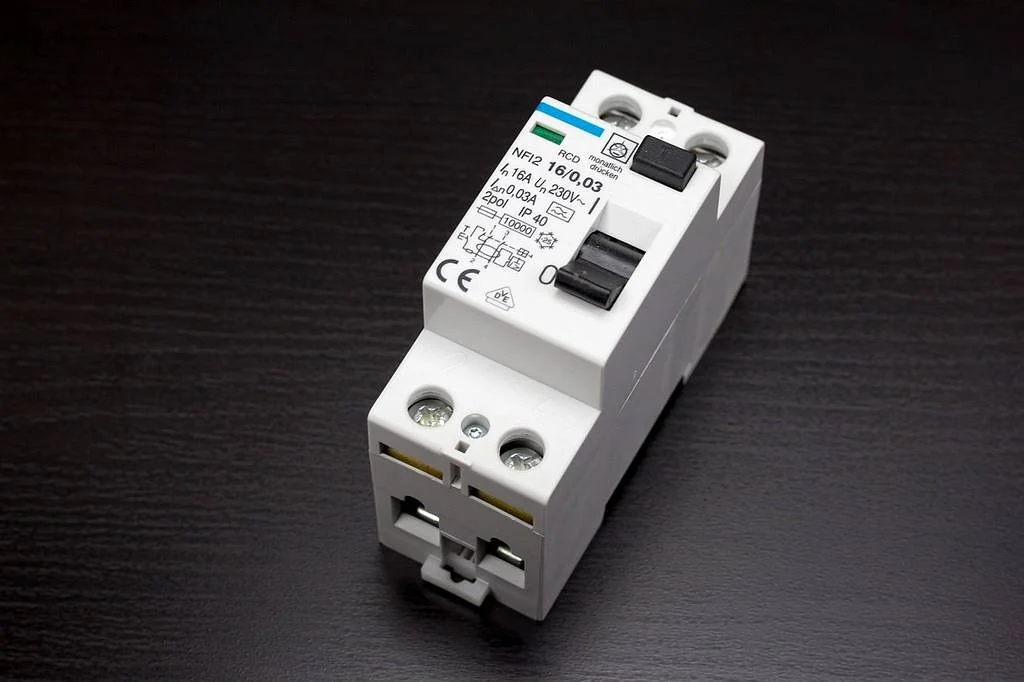
- About 30 mA, not 4 to 6 mA. Personnel GFCIs typically trip at 4 to 6 mA. Heat-tracing equipment protection trips at about 30 mA.EC&M, Guidry
- Why it matters. Raychem warns that arcing from a damaged cable may not trip a conventional breaker. It calls for 30 mA ground-fault protection on each branch circuit.Raychem manual, 4.2 and 4.4
- Labels, 427.13. Caution signs or markings go every 20 feet or less along the pipe. Raychem recommends "Electric Traced" labels every 10 feet, on alternate sides.EC&M, Article 427
- A disconnect that locks, 427.55(A). It must lock open and open every ungrounded conductor. A readily accessible breaker can serve.EC&M, Article 427
- Controls, 427.56. A control without an OFF position, or a remote controller, cannot serve as the disconnect.EC&M, Article 427
Scroll sideways to see the whole table.
| Start-up temperature | 5XLE at 120 volts | 5XLE at 240 volts |
|---|---|---|
| −20°F | 129 feet | 279 feet |
| 0°F | 149 feet | 316 feet |
| 20°F | 176 feet | 364 feet |
| 40°F | 214 feet | 432 feet |
- Long runs mean more circuits. A 600-foot garage loop on 240 volts needs two or more 20-amp circuits by the table above, before any allowance for valves.
- Breaker space counts. Each circuit needs a ground-fault breaker or a controller with ground-fault protection, so spare panel spaces matter.
- Labels go on last. Raychem installs the "Electric Traced" labels along the piping after the insulation is on.
- The rest of the building. MDL's commercial electrician page covers panels, feeders and other circuits in the same building.
Fire sprinkler lines
On sprinkler piping, heat trace becomes part of the fire protection system.
A wet sprinkler line in a cold garage or loading dock has to stay full and ready. NFPA 13, the sprinkler standard, sets conditions on heat tracing that ordinary water lines do not have.
- The usual answers come first. For sprinkler piping in cold areas, NFPA 13 generally points to a dry pipe system, a preaction system or a listed antifreeze solution.UL, 2019
- Heat tracing must be listed for the use. UL lists heat tracing for fire sprinkler piping under its own category, VGNJ. A listing for another use is not enough.UL, 2019
- It must be supervised. NFPA 13 requires controllers with alarm relays connected to the fire control panel.Raychem fire sprinkler guide
- The alarms are specific. UL tests for low and high water temperature, controller failure, ground faults, loss of continuity and loss of supply voltage.UL, 2019
- Not a heated valve room. Per NFPA 13-2019 section 8.3.1.8.2.3, heat tracing does not replace heated enclosures for preaction and deluge valves.Raychem fire sprinkler guide
- Insulation that survives a discharge. UL's listing calls for noncombustible insulation and a protective cover that hold up when sprinklers discharge.UL, 2019
- Check the pipe material. Raychem's commercial system is not UL listed for plastic fire sprinkler pipe.Raychem fire sprinkler guide
The building's sprinkler contractor and fire alarm company are part of this work. Send their names and the alarm panel's location with the request.
Insulation and testing
Insulation goes on over the cable, and the cable is tested before and after it is covered.
The cable only replaces heat the pipe loses through its insulation. Dry, complete insulation is part of the system, not a finishing touch.
- Every traced part is insulated. Raychem: all traced piping, fittings, wall penetrations and branch piping, with properly installed, dry insulation.Raychem manual, 3
- Wet insulation fails. "Uninsulated or wet sections of pipe can result in cold spots or frozen sections."Raychem manual, 3.2
- A worked example. A 2-inch pipe with 1 inch of fiberglass, held at 40°F against −20°F outdoors, loses 3.9 watts per foot.Raychem design guide, step 1
- Fire-resistant materials only. Raychem names fiberglass wrap or flame-retardant foams.Raychem manual, 3.2
- The insulation does not hold the cable. The cable is secured to the pipe by other means (NEC 427.14).EC&M, Article 427
- Low on the pipe. Chromalox places a straight run at the 4 or 8 o'clock position and spirals only where the design calls for it.Chromalox PJ438
The seven insulation resistance tests in Raychem's manual
- Before the cable goes on the pipe. Each reel is checked for jacket damage.
- Before the connection kits are installed.
- Before the thermal insulation goes on.
- After the thermal insulation is on. Raychem adds a circuit length check, a power test and a temperature test at this stage.
- Before start-up (commissioning).
- At each regular system inspection.
- After any maintenance or repair. Each test runs at 500, 1,000 and 2,500 volts DC, and every reading should be above 1,000 megohms.Raychem manual, 6 and 7
Raychem requires the results to be recorded and kept for the life of the system, and the manual and commissioning results go to the owner.
New Jersey rules
A new heat trace circuit is regulated electrical work: permit first, licensed contractor only.
Read November 16, 2026 from the Uniform Construction Code (N.J.A.C. 5:23), NJ Department of Community Affairs, text published through August 17, 2026. Your town's construction office applies it to a specific job.
Scroll sideways to see the whole table.
| Topic | What the rule says | Section |
|---|---|---|
| Electrical code | The National Electrical Code 2023, with Tentative Interim Amendments 70-23-1 through 70-23-13, is New Jersey's electrical subcode. | 5:23-3.16(a)1 |
| State changes | In Chapter 4 the state amends only 406.4(D)(4) and Article 425; Articles 426 and 427 apply as published. | 5:23-3.16(b)5 |
| New circuit | Adding or altering electrical wiring is not ordinary maintenance. | 5:23-2.7(b)6.iii |
| Permit | Installing or altering regulated equipment without first applying and obtaining the permit is unlawful. | 5:23-2.14(a) |
| Who may do it | Electrical work only by persons licensed for it, except a single-family homeowner on his or her own dwelling. | 5:23-2.15(b)2.i |
| Sprinkler piping | Heat tracing must be listed for sprinkler use and supervised through the fire control panel. | NFPA 13 |
Roof drain heating falls under Article 426, which covers exposed melting systems on roofs and drainage systems (426.1(B), per EC&M). MDL's heated driveway cost guide walks through Article 426's rules, so this page does not repeat them.
Cost
What heat trace costs to install and to run, from published figures.
MDL does not publish prices, and no figure here is an MDL price. These are market figures from the sources named in each line, read November 16, 2026. Neither is a New Jersey quote.
- An industrial heat-tracing contractor. Multiservice LLC puts installation at $10 to $50 per linear foot, rising for longer or larger pipes.Multiservice, Jan 17, 2025
- A national cost guide. PICKHVAC gives about $5 to $25 per foot installed, and $5 to $15 for a straightforward pipe run. It assumes a typical home with ordinary access.PICKHVAC, Oct 6, 2026
- Running it. 100 feet of cable at 5 watts a foot, at New Jersey's August 2026 commercial price of 18.71 cents per kWh, costs about $2.25 for each full day it runs.EIA table 5.6.A
What moves a building's number
- Pipe length and size. Bigger pipes lose more heat, and long runs need more circuits.
- Valves, flanges and supports. Each one takes extra cable.
- Insulation. New insulation, or replacing wet insulation, is often part of the job.
- The controller. A simple thermostat costs less than an electronic controller with alarms.
- Power. A new circuit, panel space or a feeder changes the scope.
- Sprinkler lines. A listed system and the fire alarm connection add work and trades.
What to send
Before MDL walks the pipes: the photos and facts that size a heat trace job, and the records it should leave.
Photos and a plain description are enough to start. Do not open electrical boxes or cut insulation to collect them.
01
Cold spaces
Address and ZIP code, building type, and which garages, crawlspaces, stairwells or docks go unheated.
02
Pipe and run
Pipe material and size, rough length, and photos of the run, valves and supports.
03
What each line carries
Domestic water, sprinkler water, grease waste, a tank, or a roof drain.
04
Panel space for new circuits
Where the panel is, a photo of its label, and how many spare spaces it has.
05
Sprinkler and alarm contacts
For sprinkler lines: the sprinkler contractor, the fire alarm company and the panel location.
06
Keys, hours and sign-off
Hours the spaces can be entered, who holds keys, and who approves the work.
What the finished job should leave behind
- A circuit list. Each circuit's breaker, cable type and length.
- The test readings. Insulation resistance at 500, 1,000 and 2,500 volts DC, recorded for each circuit.Raychem manual, 7
- The ground-fault test. Every ground-fault breaker tested to its maker's instructions.
- The controller settings. Set point, sensor type and where the sensor sits.
- Labels on the insulation. "Electric Traced" labels along every traced pipe.
- The manual. The installation manual with the commissioning results, kept for the life of the system.
Where MDL works
Heat trace for buildings in Essex, Morris and Union counties.
MDL works from 4 Harrison Avenue in West Orange. These towns have their own MDL service-area page. Include the exact address and ZIP code so coverage can be confirmed for the building.
Morris County
Union County
Heat trace installation
Planning freeze protection for a garage, a stairwell or a sprinkler line? Call MDL.
Call or send the form with the address, the lines to protect and photos of the piping. The form opens with Commercial Electrical chosen.
Heat trace questions
Answers on cable, circuits, sprinklers, insulation, testing and permits.
Code sections come from EC&M and IAEI Magazine, manufacturer figures from the Raychem and Chromalox manuals, and rules from the New Jersey texts named on this page. MDL publishes no prices.
What does heat trace installation cover?
MDL installs heat trace on the piping of commercial and apartment buildings. That means domestic water lines, fire sprinkler lines in unheated spaces, drain and grease waste lines, tanks and roof drains. The work covers the heating cable and its circuit with ground-fault protection of equipment. It also covers the controller, the caution labels and the test record. MDL confirms the scope after seeing the building and the piping.
Which pipes in a building need heat trace?
Pipes that run through spaces that fall below freezing. In Essex County buildings, those are often parking garages, crawlspaces, stairwells, exterior walls and loading docks. NOAA's 1991 to 2020 normals for its North Jersey airport weather station show 79.9 days a year at or below 32°F. Restaurant grease lines are a different job: Raychem holds them at 110°F or more so the grease keeps flowing.
Should the cable be self-regulating or constant-wattage?
Self-regulating cable lowers its own output as the pipe warms. It can be overlapped, and Chromalox's low-temperature version can go on plastic pipe, with a 185°F limit when the power is off. Constant-wattage cable must never be overlapped. Chromalox rates its version to 392°F with the power off. Mineral-insulated cable handles the highest temperatures and is built to an exact length.
Does heat trace need its own circuit and ground-fault protection?
Yes. NEC 427.22 requires ground-fault protection of equipment on heat tracing. NEC 427.4 treats heat tracing as a continuous load, so the circuit is sized at 125 percent. Breaker makers standardized a 30 mA trip point for equipment protection. Raychem calls for 30 mA ground-fault protection on every heating cable branch circuit, because arcing from a damaged cable may not trip an ordinary breaker.
Can heat trace go on fire sprinkler pipes?
Only a system listed for sprinkler use. UL lists these systems under category VGNJ. NFPA 13 requires the heat tracing to be supervised by controllers with alarm relays connected to the fire control panel. It cannot replace a heated valve enclosure for preaction and deluge valves, per NFPA 13-2019 section 8.3.1.8.2.3 as Raychem quotes it. Name the sprinkler contractor and the fire alarm company in the request.
Why does heat trace need insulation over it?
The cable replaces the heat the pipe loses through its insulation. Raychem's worked example is a 2-inch pipe with 1 inch of fiberglass, held at 40°F against minus 20°F outdoors. That pipe loses 3.9 watts per foot. Raychem warns that uninsulated or wet sections can leave cold spots or frozen sections. Fittings, wall penetrations and branch piping are insulated too.
Can heat trace stay on all the time?
It runs whenever its controller calls for heat. An ambient-sensing controller turns the circuit on when the air drops below the set point. A line-sensing controller reads the pipe itself through a sensor fastened to it. At New Jersey's August 2026 commercial price of 18.71 cents per kWh, 100 feet of cable drawing 5 watts a foot costs about 9.4 cents an hour to run.
How much does heat trace installation cost?
MDL does not publish prices, and this page lists none. The cost section lists two published per-foot ranges with their sources. One comes from an industrial heat-tracing contractor and one from a national cost guide that assumes a home. A building's price depends on pipe length and size, insulation, valves and supports, and the controller. A new circuit and, on sprinkler lines, the alarm connection add to it.
Does heat trace installation need a permit in New Jersey?
A new heat trace circuit is new electrical wiring, which N.J.A.C. 5:23-2.7(b)6.iii keeps out of ordinary maintenance. Regulated work needs an application and a permit first under N.J.A.C. 5:23-2.14(a). Electrical work must be done by persons licensed for it under N.J.A.C. 5:23-2.15(b)2.i. The local construction office applies these rules to a specific job.
How often should heat trace be tested?
Raychem's installation manual lists seven insulation resistance tests. They come before the cable goes on, before the connection kits, before and after the insulation, at start-up, at each regular inspection and after any repair. Each test runs at 500, 1,000 and 2,500 volts DC. Every reading should be above 1,000 megohms, and the results are kept for the life of the system.
What should I send with a heat trace request?
Send the building address and the spaces that are unheated. Add the pipe material, size and rough length, with photos of the piping, valves and supports. Say what each line carries: water, sprinkler water, grease waste or roof drainage. Add a photo of the electrical panel and its spare spaces. For sprinkler lines, name the sprinkler contractor and the fire alarm company. Name who approves the work.
Which towns does MDL cover for heat trace installation?
MDL works from 4 Harrison Avenue in West Orange. It covers Essex County towns including Montclair, Bloomfield, Glen Ridge, Verona, Cedar Grove, Nutley, Belleville, Livingston, Maplewood, South Orange and Short Hills. In Morris County it covers Morristown and Chatham. In Union County it covers Union, Summit, Rahway, Fanwood, Garwood and Kenilworth. Send the exact address so coverage can be confirmed.
About this page
Who wrote this heat trace page, and the limits of what it says.
MDL Electric Cooling & Heating wrote this page. MDL is a licensed electrical contractor and master HVACR contractor at 4 Harrison Ave, West Orange (NJ Electrical Business Permit #34EB01606200; NJ Electrical Contractor #34EI01606200; NJ Master HVACR Contractor #19HC00308200), working across Essex, Morris and Union counties. The code sections, manufacturer figures, climate normals and published prices were read from the sources below on November 16, 2026. The running cost and the circuit readings are our arithmetic on those figures. No figure here is an MDL price, and no manufacturer or publisher named here was asked or paid to appear.
Sources
The code texts, manuals and data behind each heat trace fact.
All read November 16, 2026.
- N.J.A.C. 5:23-3.16, electrical subcode (NJ Department of Community Affairs, published through August 17, 2026): adoption of the 2023 NEC and the state's amendments, which in Chapter 4 touch only 406.4(D)(4) and Article 425.
- N.J.A.C. 5:23-2, Uniform Construction Code, administration and enforcement (NJ Department of Community Affairs, published through August 17, 2026): ordinary maintenance (2.7), permits (2.14), licensed work (2.15).
- EC&M, "Article 427: Fixed Electric Heating Equipment for Pipelines and Vessels" (Mark Lamendola, December 16, 2015): 427.4, 427.13, 427.14, 427.55 and 427.56.
- IAEI Magazine, "Monitoring ground faults of heat trace and snow melt equipment" (January–February 2020): 427.22 and its exception, the 30 mA trip point.
- North Shore Safety, "2023 Code Year: NEC 427": 427.22 ground-fault protection under the 2023 code year. North Shore Safety sells ground-fault equipment.
- EC&M, "Industrial Electric Heat-Tracing Basics" (Eddie Guidry, May 18, 2016): self-regulating, series-resistance and mineral-insulated cable; 4 to 6 mA personnel GFCIs against about 30 mA for heat tracing.
- EC&M, "Article 426: Fixed Outdoor Electric Deicing and Snow-Melting Equipment" (Mark Lamendola, 2015): 426.1(B), exposed systems on roofs and drainage systems.
- Raychem (Chemelex), Pipe Freeze Protection and Flow Maintenance, XL-Trace Edge System design guide (H55838, rev. 2504-1): 40°F and 110°F maintain temperatures, ground-fault warning, line sensing for grease lines, the 3.9 W/ft example.
- Raychem (Chemelex), XL-Trace Edge System installation and operation manual (H58033, rev. 2602): insulation, labels, 30 mA breakers, ambient and line sensing, the seven tests, 1,000 megohms, records.
- Raychem (Chemelex), XL-Trace Edge data sheet (H51349, rev. 2504): overlap and plastic pipe, maximum circuit lengths by breaker and start-up temperature.
- Raychem (Chemelex), Fire Sprinkler System Freeze Protection design guide (H58489, rev. 2504): NFPA 13 listing and supervision, NFPA 13-2019 8.3.1.8.2.3, plastic sprinkler pipe.
- UL, "UL Certified Trace Heating Equipment for Fire Sprinkler Pipes" (April 29, 2019): NFPA 13's default methods, category VGNJ, UL 515A alarms, noncombustible insulation.
- Chromalox, installation instructions, industrial heating cable products (PJ438-26, May 2021) (distributor copy): cable comparison, temperature limits, overlap warning, temperature controls, 4 or 8 o'clock placement.
- NOAA NCEI 1991–2020 annual normals, North Jersey airport station USW00014734: days at or below 32°F, 20°F and 10°F.
- NOAA NCEI 1991–2020 monthly normals, same station: January low and freezing nights by month.
- U.S. EIA, Electric Power Monthly table 5.6.A (data for August 2026, released October 23, 2026): New Jersey commercial price, 18.71 cents per kWh.
- Multiservice LLC, "How Much Does Heat Tracing Cost?" (Preston Kendig, January 17, 2025): installed cost per linear foot.
- PICKHVAC, "Heat Trace Cost Per Foot for Pipes and Roofs" (Rene Langer, October 6, 2026): installed cost per foot, residential assumptions.
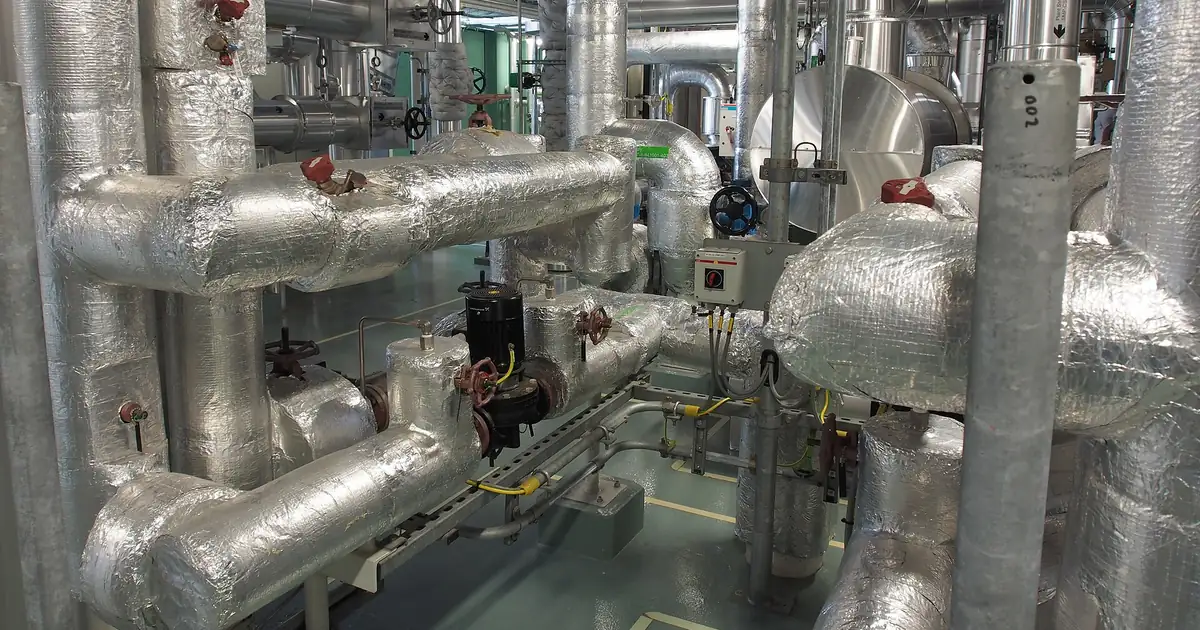
- Wikimedia Commons, "Piping pic1" (Alf van Beem, CC0): the hero photo of insulated plant piping, cropped. Not an MDL job.
- Wikimedia Commons, "Residual current device (RCD)" (Diermaier, CC0): the 30 mA residual current device photo. Not an MDL job.
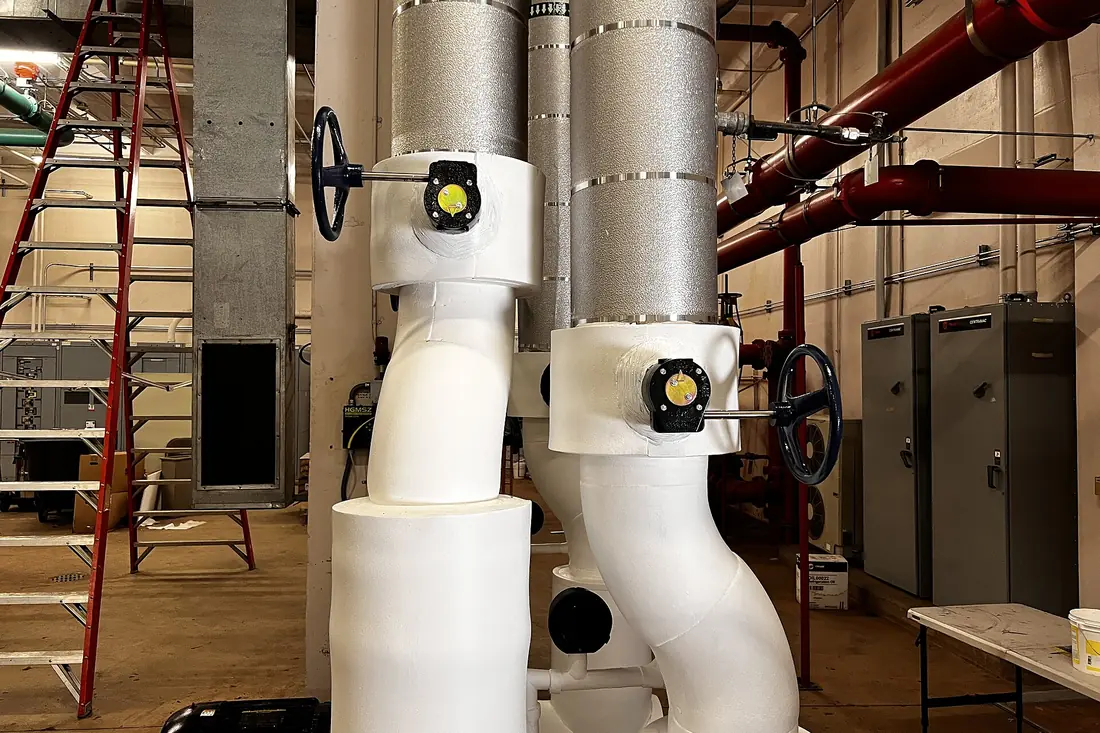
- Wikimedia Commons, "MLC chiller pump replacement-2" (IanVG, CC0): the insulated valve bodies photo, cropped. Not an MDL job.


Next steps
Related services
Commercial electrician
Panels, feeders and circuits for the rest of the building.
Learn moreCommercial services hub
Electrical and HVAC requests for the same building in one place.
Learn moreCommercial boiler replacement cost
Published New Jersey ranges for when the building's boiler, not its piping, needs replacing.
Learn moreCommercial boiler repair
Steam and hot-water boilers in apartment buildings and businesses.
Learn moreGenerator load bank testing
Load tests for a building's standby generator under NFPA 110 and New Jersey rules.
Learn moreRequest service
Send MDL the service, town, and best callback number.
Use the form for planned service or call for urgent electrical, heating, or cooling help.