
Commercial HVAC · West Orange and Essex County
Commercial HVAC service in West Orange and Essex County, NJ
Heating, air-conditioning and boiler service for a business or managed property, from a West Orange contractor that holds both a New Jersey master HVACR license and an electrical contractor license. Send the building, the equipment and the authorized contact; MDL inspects the property and writes the scope.
The short answer
One licensed contractor for the equipment and the circuit that feeds it.
What MDL does for a commercial property. Heating repair and service, air-conditioning repair and service, boiler service, and planned heating or cooling work, the same services MDL publishes on its commercial services page. On the electrical side: troubleshooting and repair, lighting, circuits and renovation wiring, panel and capacity questions, and equipment power.
Who it is for. Business owners, property managers, facilities contacts, landlords and general contractors in West Orange, Essex County and the rest of MDL's three-county area.
How it works. You send the building, the equipment, the symptom or project goal, the access conditions and the person who can approve the work. MDL confirms the service boundary after reviewing the property. A submitted request records the information; it is not yet an appointment or a proposal.
MDL Electric Cooling & Heating holds a New Jersey master HVACR contractor license (19HC00308200), an electrical contractor license (34EI01606200) and an electrical business permit (34EB01606200). It works from 4 Harrison Avenue in West Orange. Call 973.809.2339, or use the request form on this page.
The buildingAddress, building use, the areas and tenants affected, and whether the space is occupied during the work.
The equipmentType and location (roof, mechanical room, closet), and the nameplate brand, model and refrigerant if it is safe to read.
AccessRoof access, keys, escorts, loading, security rules, and the hours the space can be entered.
AuthorityThe person authorized to approve scope and cost, and the best callback number.
Equipment
What a commercial property in Essex County usually has on the roof or in the mechanical room.
Name the equipment in your request and MDL can route it. EPA groups chillers, commercial split systems and packaged rooftop units together as comfort-cooling appliances (EPA, Section 608 leak repair). MDL confirms which equipment it will service after reviewing the building.
Scroll sideways to see the whole table.
| Equipment | What it is | Where it usually sits | What to send MDL |
|---|---|---|---|
| Packaged rooftop unit | Heating and cooling in one cabinet, with the fan, coils and often a gas burner inside | Roof, over the space it serves, with a curb and a duct drop | Count of units, nameplate photo, which tenant spaces each one serves, roof access |
| Split system | An outdoor condenser paired with an indoor air handler or furnace, connected by refrigerant lines | Condenser on the roof, a pad or a wall; air handler in a closet or above a ceiling | Both nameplates, where the indoor unit is, and whether the breaker or disconnect tripped |
| Boiler | Heats water or makes steam for radiators, baseboard, air handlers or domestic hot water | Basement boiler room or a mechanical room | Boiler and burner labels, fuel, the distribution type, and whether hot water was lost too |
| Chiller and air handlers | A chiller cools water that air handlers use to cool the air they move | Chiller on the roof or at grade; air handlers in mechanical rooms | Nameplates, the control system in use, and which air handlers serve the affected areas |
| Variable refrigerant flow (VRF) | One outdoor unit feeding several indoor units through refrigerant piping, each zone controlled separately | Outdoor unit on the roof or at grade; indoor units in ceilings or on walls | Outdoor and indoor nameplates, zone layout, and the controller that reports the fault |
| Ductless mini-split | A wall or ceiling head for one room or tenant space, fed by a small outdoor unit | Head in the room; outdoor unit on a wall bracket, pad or roof | Head and outdoor nameplates and the error code on the remote or display |
| Unit heater | A hanging gas or electric heater for a garage, warehouse or loading area | Ceiling-hung in the space it heats | Fuel or voltage, the nameplate, and whether the fan runs |
| Controls | Thermostats, zone controllers or a building control system that schedules and reports the equipment | On the wall, in the mechanical room, or on a web dashboard | The fault or alarm text, a screenshot if the system has one, and who manages it |
HVAC and electrical together
Why one contractor for both sides matters in a commercial building.
Heating and cooling are the largest energy users in a commercial building, and a no-heat or no-cooling call often ends at a breaker, a contactor or a control rather than a compressor. MDL holds both licenses, so one request covers the equipment and the power behind it.
- Space heating is the biggest single energy use. About 32% of all energy used in U.S. commercial buildings in 2018 went to space heating. Ventilation and lighting were next, at about 10% each.U.S. EIA, Energy use in commercial buildings
- Most of that energy arrives as electricity. Electricity was 60% and natural gas 34% of commercial building energy use in 2018. Gas heats water and space and runs some cooking and cooling equipment; everything else runs on the building's electrical service.U.S. EIA
- Offices use the most energy of any building type. EIA counted about 5.9 million U.S. commercial buildings in 2018. Warehouses and offices were the most numerous, and office buildings consumed more energy than any other type.U.S. EIA
- The electrical parts fail first. Contactors, capacitors, fan motors, control boards and breakers start and protect every piece of HVAC equipment. When one fails, the symptom looks like an HVAC failure. MDL tests the circuit, the disconnect and the starting parts before anyone talks about replacing the unit.
- New equipment means new electrical questions. A replacement rooftop unit, VRF system or heat pump can change the breaker size, conductor size, disconnect and panel capacity. MDL's panel and capacity page covers what to send when a project adds load.
- Licensed on both sides. New Jersey's construction code allows heating, ventilating, air conditioning and refrigeration work, and electrical work, only by persons licensed to perform it; the homeowner exception applies only to a single-family house.N.J.A.C. 5:23-2.15(c)2.i
A breaker that trips with nothing else running, flickering lights or a burning smell at the panel: see electrical repair. Lighting, circuits and renovation wiring for the same property: start on the commercial services page.
Boilers and heating
Commercial boiler and heating service through an Essex County winter.
Many Essex County commercial buildings heat with a boiler and radiators or air handlers. MDL's boiler service page explains how it separates hot-water, steam and domestic hot water systems; this section covers what changes when the building is commercial.
- Freezing nights are routine. At Newark Liberty Airport, January's average low is 25.5°F and about 80 nights a year drop below 32°F (NOAA 1991 to 2020 normals). A heating failure in an occupied building is a tenant problem within hours.NOAA NCEI annual normals; monthly normals
- Summer presses the other way. July's average high is 86.9°F and about 28 days a year reach 90°F or more, so cooling equipment that limped through spring fails in the first heat wave.NOAA NCEI
- Identify the system, not just the brand. A hot-water boiler, a steam boiler and a domestic water heater are different service paths with different controls. Send photos of the boiler label, the nearby piping, the controls or error display, and one radiator or air handler, and say whether hot water was lost too.
- Repairs are usually ordinary maintenance. Repair and replacement of heating supply and return piping and radiation elements without rearranging the piping, and repair or replacement of heating controls, need no permit under the state code. Replacing the boiler itself does.N.J.A.C. 5:23-2.7(c)5 and 2.14(a)
- Do not improvise in the boiler room. Do not remove a cover, touch hot piping, open a valve, drain water or change a gas or oil control to identify the system. Safe photos and a plain description are enough to start.
Boiler not firing, radiators cold or water on the boiler-room floor in freezing weather: call 973.809.2339 first, then send the form. The emergency HVAC page explains how MDL separates urgent calls from planned work.
New Jersey rules
Permits, licenses and refrigerant rules for commercial HVAC work.
From the state Uniform Construction Code, N.J.A.C. 5:23-2, NJ Department of Community Affairs (published through August 17, 2026), the West Orange Building Department, and U.S. EPA, all read October 31, 2026. Your town's construction office enforces the code and decides edge cases.
Scroll sideways to see the whole table.
| Job | What the rule says | Section |
|---|---|---|
| Repair the air conditioning | "Repair of air conditioning equipment and systems" is ordinary heating, ventilation and air conditioning maintenance: no permit, inspection or notice. | 5:23-2.7(c)5.iv |
| Replace a motor, pump or fan | "Replacement of motors, pumps and fans of the same capacity" is ordinary maintenance. | 5:23-2.7(c)5.i |
| Thermostat or controls | "Repair or replacement of control devices for heating and air conditioning equipment" is ordinary maintenance. | 5:23-2.7(c)5.v |
| Ductwork and heating piping | Repair and replacement of ductwork, and of heating supply and return piping and radiation elements that does not rearrange the piping, is ordinary maintenance. | 5:23-2.7(c)5.ii and iii |
| Install or replace equipment | Installing or altering regulated equipment needs an application and a permit before the work. West Orange says permits are required to install or replace equipment such as air conditioning and furnaces; forms are the standard UCC forms, filed at 66 Main Street, Room 217. | 5:23-2.14(a); West Orange FAQ |
| Emergency work | May start first; notice as soon as practicable, and the permit applied for within 72 hours. | 5:23-2.14(b)3 |
| Who may do the work | HVACR work and electrical work only by persons licensed to perform it; the single-family homeowner exception does not reach a commercial building. The application lists each contractor's name and license number. | 5:23-2.15(c)2 |
| Engineering details | The construction official may require details of mechanical and electrical work, including computations; engineering plans and computations bear the seal and signature of the licensed engineer or registered architect responsible for the design. | 5:23-2.15(f)1.vii |
| Who to call in West Orange | The Building Department at (973) 325-4112 or wobuilding@westorange.org before any construction or alteration. | West Orange FAQ |
Refrigerant rules the building owner carries
- Certified technicians only. EPA requires technicians who maintain, service, repair or dispose of equipment that could release refrigerant to be certified under Section 608 of the Clean Air Act.EPA, Section 608 technician certification
- Leak rates are the owner's responsibility. For appliances with 50 or more pounds of ozone-depleting refrigerant, the trigger leak rates over 12 months are 10% for comfort cooling, 20% for commercial refrigeration and 30% for industrial process refrigeration.EPA, leak repair requirements
- Thirty days to act. Above the trigger rate, repair the leak within 30 days, or within 30 days write a plan to retrofit or retire the appliance and complete it within one year, with initial and follow-up verification tests after any repair.EPA, leak repair requirements
- New equipment uses new refrigerants. EPA's technology transitions rule set January 1, 2025 as the compliance date for lower-GWP refrigerants in new residential and light commercial air conditioning and heat pump systems, with pre-2025 inventory installable until January 1, 2026. VRF equipment made before January 1, 2026 may be installed until January 1, 2027, or January 1, 2028 for projects with a building permit approved before October 5, 2023.EPA, technology transitions
Scoping a request
Five details that let MDL evaluate a commercial HVAC request.
The same five the commercial services page asks for, written for HVAC equipment.
01
Stage and authority
Is this a live fault, a budget question, a bid or a scheduled project? Name the person authorized to discuss scope and approve the work.
02
Building and equipment
Address, building use, the areas and tenants affected, the equipment type and location, and the nameplate when it is safe to read.
03
Symptom or goal
What the equipment is doing, when it began, any alarm or code, recent work, and whether a breaker tripped. For a project, the result you want and any drawings or equipment schedules.
04
Occupancy and access
Occupied areas, shutdown limits, the hours the space can be entered, roof access, keys, escorts, loading and security rules.
05
Timing and approvals
Desired site-review date, proposal timing, target work window, required approvals, and the best callback details.
Do not enter a restricted or unsafe area, open electrical or mechanical equipment, or interrupt operating equipment to collect information. Safe exterior photos, visible labels, available documents and a plain description are enough to start.
The service visit
What a commercial HVAC service call should cover.
In the order the heat or cooling flows, ending with a written finding before parts go in.
01
Controls
The thermostat, zone controller or building control: mode, schedule, setpoints and any alarm text.
02
Power
Breakers, disconnects, contactors, capacitors and control transformers, and whether a trip repeats.
03
Outdoor or rooftop
Coil condition, fans, refrigerant charge and any leak, the burner on a packaged unit, and the curb and duct connections.
04
Indoor side
Filters, airflow, belts, the air handler and heat exchanger, or for a boiler the water level, pressure, controls and distribution; then a written scope.
Leaning toward replacement? MDL's cooling installation and heating installation pages list what a complete replacement scope should include, from capacity basis to permits, electrical work and startup.
Where MDL works
Commercial HVAC in Essex, Morris and Union County, from a West Orange base.
MDL works from 4 Harrison Avenue in West Orange. These are the towns in the three counties that have their own MDL service-area page. Whatever the town, include the exact address and ZIP code so coverage can be confirmed for that property.
Morris County
Union County
Commercial HVAC
No heat, no cooling or a project to scope at a commercial property? Call MDL.
Call or send the form with the address, building use, the equipment and what it is doing, the hours the space can be entered, and the person who can approve the work. Choose the heating, cooling or boiler service that fits, and pick Business / Commercial as the property type.
Commercial HVAC questions
Straight answers on systems, cost, permits, licenses and refrigerant rules.
Equipment definitions come from EPA, rules from the New Jersey code and the West Orange Building Department, energy facts from EIA, climate from NOAA. MDL publishes no commercial prices, and this page lists none.
What is commercial HVAC?
Commercial HVAC is the heating, ventilation and air-conditioning equipment that serves a business or managed property rather than one home: packaged rooftop units, split systems with outdoor condensers, chillers and boilers feeding air handlers, ductless heads, and the controls that run them. EPA groups chillers, commercial split systems and packaged rooftop units together as comfort-cooling appliances. For MDL, commercial HVAC means the heating repair, air-conditioning repair, boiler service and planned heating or cooling work it already publishes, applied to a commercial property and reviewed building by building.
What is the difference between HVAC and AC?
AC is one part of HVAC. Air conditioning cools and dehumidifies the space. HVAC also covers heating (a furnace, boiler or heat pump), ventilation (outside air, exhaust, and the fans and ducts that move it) and the controls that tie them together. In a commercial building the three usually share ductwork, power and a thermostat or building control, so a cooling complaint can have a heating, airflow or electrical cause.
What are the different types of commercial HVAC systems?
The common ones are packaged rooftop units (heating and cooling in one cabinet on the roof), split systems (an outdoor condenser paired with an indoor air handler or furnace), chillers and boilers that heat or cool water for air handlers and radiators, variable refrigerant flow systems that run several indoor units from one outdoor unit, ductless mini-splits for a single room or tenant space, and unit heaters in garages and warehouses. EPA lists chillers, commercial split systems and packaged rooftop units as examples of comfort-cooling equipment. Tell MDL which of these the property has; MDL confirms the service boundary after reviewing the building and equipment.
How much does commercial HVAC cost?
MDL does not publish commercial prices, and this page lists none. The cost of a commercial repair or project depends on the equipment type and age, whether the failed part is electrical (a contactor, capacitor, motor or control) or on the refrigerant side, roof or mechanical-room access, the refrigerant the unit uses, whether a permit and sealed drawings apply, and the hours the space can be entered. MDL inspects the property first and writes the scope before any price is discussed.
What is the $5,000 rule in HVAC?
It is a rule of thumb that circulates online, usually described as multiplying the equipment's age in years by the repair quote and leaning toward replacement when the result passes $5,000. It is a shortcut, not a diagnosis. It ignores what failed, whether the rest of the system is sound, whether parts are available, and which refrigerant the unit uses. MDL's cooling installation page says the same: compare the complete repair scope with the complete replacement scope before deciding.
Does commercial HVAC repair need a permit in New Jersey?
Usually not for a repair. The state Uniform Construction Code treats repair of air-conditioning equipment, replacement of motors, pumps and fans of the same capacity, repair or replacement of heating and cooling controls, and repair or replacement of ductwork as ordinary maintenance, which needs no permit, inspection or notice (N.J.A.C. 5:23-2.7). Installing or altering equipment needs a permit before the work starts (N.J.A.C. 5:23-2.14), and the West Orange Building Department says permits are required to install or replace equipment such as air conditioning and furnaces. Emergency work may start first, with notice as soon as practicable and a permit applied for within 72 hours.
Who is allowed to do HVAC work on a commercial building in New Jersey?
Only people licensed for it. N.J.A.C. 5:23-2.15 says heating, ventilating, air conditioning and refrigeration work, and electrical work, shall not be undertaken except by persons licensed to perform it. The one exception, a single-family homeowner working on his or her own house, does not apply to a commercial property. The permit application also has to list the name and license number of the HVACR and electrical contractors. MDL Electric Cooling & Heating holds New Jersey master HVACR contractor license 19HC00308200 and electrical contractor license 34EI01606200.
Can a plumber do air conditioning work?
In New Jersey, heating, ventilating, air conditioning and refrigeration work may be done only by persons licensed for that work under N.J.A.C. 5:23-2.15, and EPA requires technicians who maintain, service, repair or dispose of equipment that could release refrigerant to hold Section 608 certification. A plumbing license by itself is not an HVACR license. Ask any contractor for the HVACR license number that will go on the permit application. MDL's is 19HC00308200.
Can MDL look at the HVAC and the electrical side of the same property in one request?
Yes. Describe both needs in one request and identify the equipment, circuits, areas and project goal. MDL publishes both electrical-contractor and master-HVACR credentials, so the equipment and the circuit that feeds it can be reviewed together. The exact work included still depends on review of the property and the requested scope.
What should a property manager send with a commercial HVAC request?
Five things: the address and building use; the equipment involved (type, location, and the nameplate brand, model and refrigerant if it is safe to read) and what it is doing; the areas and tenants affected; access conditions, such as roof access, keys, escorts and the hours the space can be entered; and the person authorized to approve the work, with the best callback number. Safe exterior photos and visible labels help. Do not enter a restricted or unsafe area or open equipment to collect information.
Does a submitted request confirm an appointment or a project?
No. A submitted request records the information for review. MDL must confirm service fit, property access, project boundary, scheduling and the next step before an appointment or proposal is promised.
What does a technician check on a commercial HVAC service call?
In the order the heat or cooling flows: the thermostat or building control and its settings; power, meaning the breakers, disconnects, contactors and capacitors that start the equipment; the outdoor or rooftop equipment, including the coil, fans, refrigerant charge and any leak; the indoor side, meaning filters, airflow, the air handler, belts and heat exchanger or burner; and for a boiler, the water level, pressure, controls and distribution. The visit ends with a written finding and scope before parts go in.
What are the EPA refrigerant leak rules for a commercial building?
EPA's leak repair rules apply to appliances holding 50 or more pounds of ozone-depleting refrigerant. The trigger leak rates over 12 months are 10% for comfort cooling, 20% for commercial refrigeration and 30% for industrial process refrigeration. Above the trigger, the owner or operator must repair the leak within 30 days, or within 30 days write a plan to retrofit or retire the appliance and finish it within one year, with verification tests after the repair. Newer HFC systems follow EPA's separate HFC rules; ask MDL about the specific unit.
Will the refrigerant change affect a replacement I am planning?
Yes. EPA's technology transitions rule restricts higher global-warming-potential HFC refrigerants in new equipment. For residential and light commercial air conditioning and heat pumps the compliance date was January 1, 2025, with equipment manufactured or imported before that date allowed to be installed until January 1, 2026. For variable refrigerant flow systems, equipment made or imported before January 1, 2026 may be installed until January 1, 2027, and until January 1, 2028 for construction projects with a building permit approved before October 5, 2023. A replacement scope should name the refrigerant the new equipment uses.
What brands does MDL work on?
MDL's pages do not publish a brand list, and this page does not add one. Send the nameplate (brand, model, serial and refrigerant) from each unit when it is safe to read. MDL confirms the service boundary after reviewing the building and equipment.
Does MDL serve commercial properties outside West Orange?
MDL works from 4 Harrison Avenue in West Orange and publishes service coverage across Essex, Morris and Union County. Send the exact address and ZIP code with the request so coverage can be confirmed for that property.
Sources
Where the rules and numbers on this page come from.
All read October 31, 2026.
- N.J.A.C. 5:23-2, Uniform Construction Code, administration and enforcement, NJ Department of Community Affairs (published through August 17, 2026): ordinary maintenance (2.7), when permits are required and emergency work (2.14), permit applications, licensed work and sealed engineering details (2.15).
- Township of West Orange, Building Department FAQ: permits required to install or replace equipment such as air conditioning and furnaces; standard UCC forms at 66 Main Street, Room 217; (973) 325-4112.
- U.S. EPA, Stationary Refrigeration Leak Repair Requirements (updated December 8, 2025): 50-pound threshold, 10/20/30% trigger rates, 30-day repair or plan, one-year completion, verification tests, comfort-cooling examples.
- U.S. EPA, Section 608 Technician Certification (updated March 23, 2026): who must be certified.
- U.S. EPA, Technology Transitions regulatory actions (updated July 28, 2026): January 1, 2025 and January 1, 2026 dates for residential and light commercial systems; VRF installation dates of January 1, 2027 and January 1, 2028.
- U.S. Energy Information Administration, Energy use in commercial buildings (updated June 29, 2023, from the 2018 Commercial Buildings Energy Consumption Survey): 5.9 million buildings, 32% space heating, 10% ventilation, 10% lighting, 60% electricity, 34% natural gas, offices as the largest consumer.
- NOAA National Centers for Environmental Information, U.S. Climate Normals 1991 to 2020, Newark Liberty International Airport (station USW00014734): monthly normals and annual normals.
- MDL's own pages: commercial services, boiler service, cooling installation and HVAC services, for the services and license numbers MDL publishes.
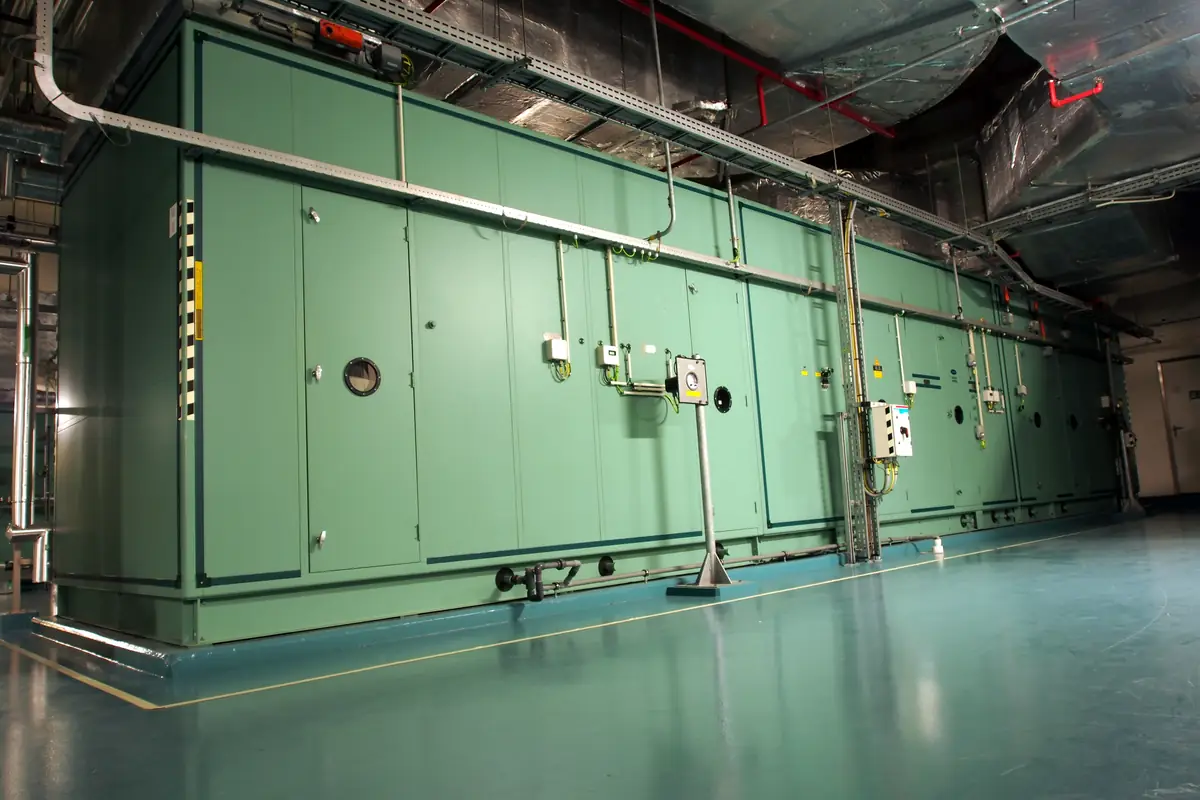
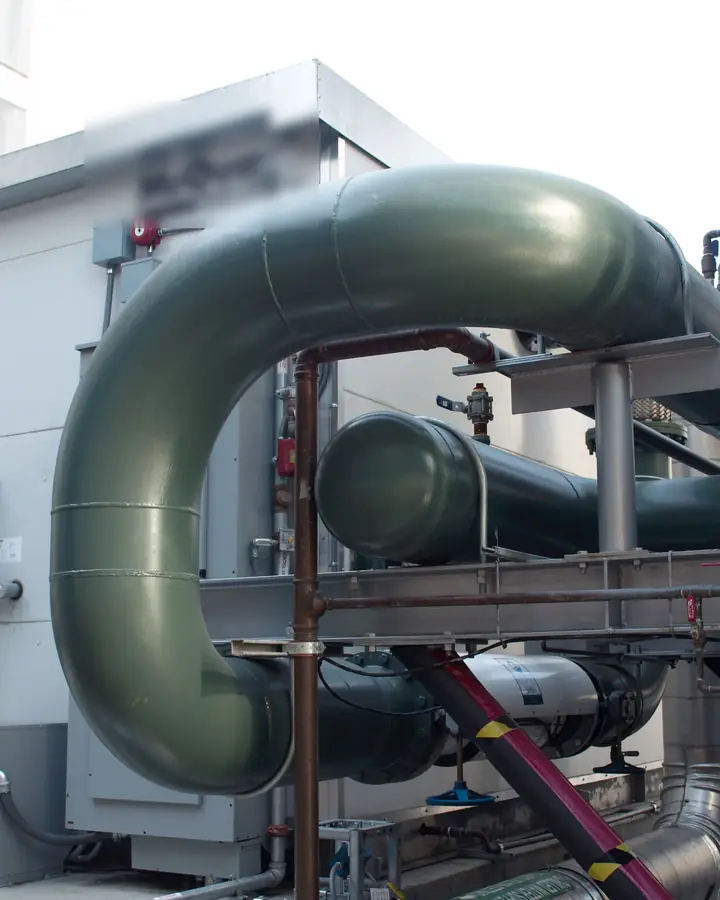
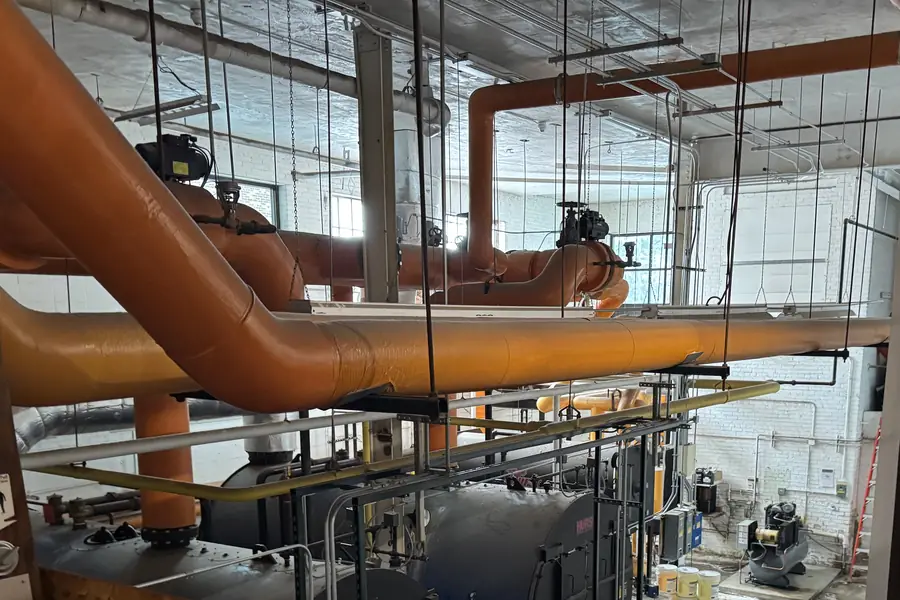
- Photos: Wikimedia Commons, air handling unit (Alf van Beem, CC0), boiler room (Braedencapaul, CC0) and outdoor chiller piping (Derrick Coetzee, CC0, brand name removed). Not MDL jobs.


Next steps
Related services
Commercial services
Lighting, circuits, renovation wiring, panels and equipment power for the same building, with the commercial request path.
Learn moreBoiler service
Hot-water, steam and domestic hot water paths, what to photograph, and when a boiler job needs a permit.
Learn moreAC repair
Warm air, weak airflow, water at the unit, short cycling or a system that will not start.
Learn moreEmergency HVAC service
How MDL separates an urgent no-heat or no-cooling call from planned work.
Learn moreRequest service
Send MDL the service, town, and best callback number.
Use the form for planned service or call for urgent electrical, heating, or cooling help.