
01 / The short answer
Size sets the range. Steam, venting, gas and asbestos decide where a building lands in it.
This page is for owners, property managers and condominium boards weighing a commercial boiler replacement. That covers apartment buildings, offices, schools, houses of worship, restaurants and medical buildings in Essex, Morris and Union counties.
On November 16, 2026, Google's top three results for this search were a maintenance-software blog, a New York City contractor's Facebook post and a heating forum thread. On that forum, one reply to a pricing question reads "More than $10K, but less than $250K" (Heating Help, April 3, 2026). This guide keeps the published ranges and adds what a New Jersey building also pays for.
300,000 to 600,000 Btu an hour: mid-size office, school or medical clinic (Oxmaint, May 21, 2026).
Multifamily of 50 or more units, where occupied buildings need temporary heat (Oxmaint).
Steam at the low end, an ENERGY STAR condensing boiler at the top (PSE&G 2026 table).
The state's fee by heating surface, for boilers under the state rules (N.J.A.C. 12:90-4.13).
Size the boiler from the building, not from the old nameplate. Price the vent, the gas service and any asbestos as separate lines. Settle the permit path and the PSE&G application before the boiler is ordered.
02 / Published ranges
What one 2026 cost guide publishes, by boiler size and building type.
Oxmaint, a maintenance-software company, published the most detailed commercial ranges we found. It does not say where its figures come from, and it does not price New Jersey on its own. Treat it as one market view, not a New Jersey quote.
| Boiler size | Equipment | Installed | Typical building | Source |
|---|---|---|---|---|
| 100,000 to 300,000 Btu/hr | $3,500 to $9,000 | $7,000 to $18,000 | Small retail, office under 5,000 sq ft | Oxmaint |
| 300,000 to 600,000 Btu/hr | $6,000 to $18,000 | $13,000 to $35,000 | Mid-size office, school, medical clinic | Oxmaint |
| 600,000 to 1.5 million Btu/hr | $15,000 to $45,000 | $28,000 to $80,000 | Large office, hotel, warehouse | Oxmaint |
| 1.5 to 3 million Btu/hr | $35,000 to $90,000 | $65,000 to $150,000 | Hospital, university, large industrial | Oxmaint |
| Over 3 million Btu/hr | $75,000 to $200,000 or more | $140,000 to $350,000 or more | Central plant, campus, heavy industrial | Oxmaint |
The same guide prices whole projects by the kind of building:
- Apartment buildings of 50 or more units. $18,000 to $65,000. Occupied buildings need temporary heat, and timing against lease cycles helps (Oxmaint).
- Offices and commercial buildings. $22,000 to $85,000 (Oxmaint).
- K–12 schools and universities. $35,000 to $120,000 (Oxmaint).
- Hospitals and healthcare. $80,000 to $250,000 or more (Oxmaint).
Price does not scale in a straight line with size. A boiler service firm puts it plainly: "a 300HP Boiler is not double the cost of a 150HP" (W.C. Rouse, January 18, 2024). Naming a company here is market evidence, not an endorsement. None of these figures is an MDL price.
03 / The lines in a quote
The lines that move a New Jersey quote, and what each is published at.
A replacement proposal is a list of lines, and only one of them is the boiler. Where a published figure exists, it is shown with its source. Where none exists, the rule that creates the line is shown instead.
| Line | When it applies | Published figure or rule | Source |
|---|---|---|---|
| Boiler and burner | Every job | $6,000 to $18,000 for 300,000 to 600,000 Btu/hr; installed runs 1.8 to 2.5 times equipment | Oxmaint |
| Labor | Every job | $3,000 to $8,000 like-for-like in an accessible room; $8,000 to $25,000 with new venting, gas line upgrades or a crane | Oxmaint |
| Steam work | Steam plants | $5,000 to $20,000 for traps, condensate lines and pressure controls | Oxmaint |
| Removal | Every job | $1,500 to $6,000 for demolition and removal | Oxmaint |
| Fuel change | Switching fuel during the replacement | $5,000 to $25,000 in piping and utility connection work | Oxmaint |
| Permit | Every job | $500 to $3,500 in Oxmaint's figures; New Jersey requires a permit, or notice for minor work | Oxmaint; N.J.A.C. 5:23-2 |
| State inspection | Boilers under N.J.A.C. 12:90 | State field fee $160, $220 or $300 by heating surface; $100 when an insurer inspects | N.J.A.C. 12:90-4.13 |
| Chimney or vent | Any fuel-fired replacement | No published figure; F370 chimney verification, and liner papers with the permit | UCC F370 |
| Gas service | Added load or a new pressure | No published figure; the utility needs the building's existing Btu load | PSE&G form |
| Asbestos | Old insulation disturbed | No published figure; thorough inspection first, licensed abatement | EPA |
Five conditions push a job toward the top of those ranges:
- Access. W.C. Rouse asks whether there is "a clear path to remove the existing boiler and install a new unit". Oxmaint says a crane lift can double or triple the labor figure.
- An occupied building in heating season. Apartments must be kept at 68°F by day from October 1 to May 15 (N.J.A.C. 5:10-14.4). Oxmaint notes occupied replacements need temporary heat.
- A new vent. When a direct-vent boiler leaves the chimney, F370 asks whether the chimney still suits the appliances left on it.
- Steam. Traps, condensate lines and pressure controls add their own line on a steam plant.
- Old insulation. Testing comes before anyone cuts it, and abatement is licensed work in New Jersey.
04 / Steam or hot water
Steam and hot-water plants are sized, vented and paid back differently.
New Jersey's boiler rules define a heating boiler as steam at no more than 15 psig, or hot water at no more than 250°F (N.J.A.C. 12:90-2.1). The two kinds still differ at every step of a replacement.
Sized by the radiators it feeds
- Size from the total capacity of the connected radiation, so steam fills every part of the system (Weil-McLain)
- PSE&G lists steam boilers as non-condensing only, at 81 percent thermal efficiency
- Traps, condensate lines and pressure controls are a separate line
- The federal floor for a gas steam boiler is 79 percent thermal efficiency
Sized by the building's heat loss
- Weil-McLain calls a heat-loss calculation the only accepted sizing method
- Condensing efficiency depends on return water below 130°F (GSA)
- PSE&G has condensing tiers at 88 and 94 percent, and a non-condensing row at 85
- An automatically fired boiler above 400,000 Btu an hour needs a low-water fuel cutoff (N.J.A.C. 12:90-4.5(d))
Essex County's apartment stock is older than the state's. In the Census Bureau's 2020–2024 survey, 99,406 occupied homes in Essex County were in buildings of five or more units. Of those, 36,963 were in buildings built before 1960: 37.2 percent, against 24.2 percent statewide. Another way to read it: 15,761 homes, or 15.9 percent, were in buildings from 1939 or earlier (ACS table B25127; our arithmetic).
05 / Sizing the new boiler
Size the new boiler from the building, not from the old nameplate.
Weil-McLain's replacement guide warns that boilers are often "sized simply by matching the rating of the old boiler." That "can result in an oversized boiler which wastes fuel—or an undersized unit which will not heat the building." The guide is written mainly for homes, but says it can often serve small commercial buildings.
- Hot water: a heat-loss calculation. Weil-McLain calls it the only accepted method for a hot-water boiler.
- Steam: a radiation survey. Add up the connected radiation, since the boiler must fill all of it with steam.
- Apartment buildings: the state's design rule. A multiple dwelling's heating design must conform to the ASHRAE guide (N.J.A.C. 5:10-14.4(a)).
- Old plants: check for oversizing. A forum reply notes many present boilers are oversized, so a smaller one may use less gas (Heating Help).
- The licence line. A plant above 4,000,000 Btu input, 100 horsepower or 499 square feet of heating surface needs a licensed operator while occupied (N.J.A.C. 12:90-3.5(b)).
W.C. Rouse adds that a replacement is the time to ask whether the building's needs have changed. In its view, like-for-like is not always the right answer.
06 / Efficiency floors
The federal floor for a gas hot-water boiler is 80 percent. The ENERGY STAR level is 94.
Federal law sets the minimum efficiency for a new commercial packaged boiler. In 2023, DOE amended its rule after a federal appeals court vacated its January 10, 2020 standards (88 FR 64351). The current text of 10 CFR 431.87 reads as follows.
| Boiler | 300,000 to 2,500,000 Btu/hr | Over 2,500,000 Btu/hr |
|---|---|---|
| Gas, hot water | 80.0% ET | 82.0% EC |
| Oil, hot water | 82.0% ET | 84.0% EC |
| Gas, steam (natural draft from March 2, 2022) | 79.0% ET | 79.0% ET |
| Oil, steam | 81.0% ET | 81.0% ET |
- ENERGY STAR. Certified commercial boilers reach at least 94.0 percent thermal efficiency and a 5:1 turndown. ENERGY STAR says they use 14 percent less energy and save more than $1,440 a year on average (ENERGY STAR).
- Return water decides condensing. GSA's federal field tests found return water below 130°F is the key, with more than 14 percent gas savings. Its 2014 summary gives a four to seven year payback at typical cost (GSA).
- End-of-life replacement. GSA found condensing boilers life-cycle cost-effective even when only 3 to 5 percent more efficient than high-efficiency boilers.
- The upfront premium. Oxmaint puts condensing units at 30 to 50 percent more than standard ones (Oxmaint).
- Boilers are common. GSA's summary says 32 percent of commercial buildings rely on boilers for heat.
07 / New Jersey rules
New Jersey's permit, inspection and licence rules for a replacement boiler.
Two state agencies touch a boiler replacement. The Department of Community Affairs writes the construction code your town enforces. The Department of Labor and Workforce Development registers and inspects boilers. Building-service boilers are built and installed under the code's mechanical subcode (N.J.A.C. 12:90-4.2(a)).
The construction code (N.J.A.C. 5:23)
- Like-capacity swap. Replacing an existing low-pressure boiler with a new one of like capacity is minor work (5:23-2.17A(c)3).
- Minor work steps. Notice to the town before work, then a permit application within five business days (5:23-2.17A(a) and (b)2).
- Inspection clock. The town inspects minor work within three business days of the request, or another time within 30 days (5:23-2.17A(d)1).
- Everything else. Other regulated equipment work needs a permit before it starts (5:23-2.14(a)).
- The codes applied. New Jersey adopts the International Mechanical Code/2024 and the International Fuel Gas Code/2024 as its subcodes (5:23-3.20 and 3.22).
- The chimney form. UCC F370 goes with a minor-work application, or to the code official before the final inspection on a full permit.
- High-pressure boilers. Their certificate of compliance runs 12 months at a time (5:23-2.23(l)1).
The state boiler rules (N.J.A.C. 12:90)
- Construction standard. Low-pressure boilers must comply with Section IV of the ASME code (12:90-4.5(a)).
- Registration. Each boiler is registered with the Bureau of Boiler and Pressure Vessel Compliance. The state certificate is framed and posted in the boiler room (12:90-4.14).
- Inspection. Yearly, and hot-water heating boilers internally every 24 months (12:90-4.10(a)). Dwellings of fewer than six family units are left out (4.10(c)).
- Fees. The state field inspection fee runs from $160 to $300 by heating surface (12:90-4.13).
- Licensed operator. Required above 4,000,000 Btu input, 100 horsepower, 499 square feet of heating surface or 1,000 kilowatts, when occupied (12:90-3.5(b)).
08 / Asbestos and removal
On an older plant, the insulation is tested before anyone cuts it.
Before an old boiler comes out, federal and state asbestos rules decide what happens to the insulation on it and its piping.
- Who is covered. The EPA asbestos rule covers renovation in all facilities except residential buildings of four or fewer units.
- Inspection first. It requires "a thorough inspection where the demolition or renovation operation will occur."
- Thresholds. At 260 linear feet, 160 square feet or 35 cubic feet, regulated material comes out before the work (EPA).
- Licensed abatement. In New Jersey, abatement other than operations and maintenance work needs a licensed contractor (N.J.A.C. 5:23-8.1(a)1.i).
- Schools and public buildings. Abatement there needs a construction permit under the state asbestos subcode. Private buildings with a day care, nursery or school count too (5:23-8.1(c)).
09 / Gas service and venting
The gas service and the chimney are two lines owners often learn about late.
PSE&G's form for adding gas load covers "Industrial, Commercial, and Multi-Unit Residential (4+) Customers." It lists Essex, Morris and Union among its northern counties. It states that "Existing BTU load is a requirement" and asks for the requested gas delivery pressure. Missing information delays the request, the form warns. Buildings on New Jersey Natural Gas or Elizabethtown Gas should ask that utility for its own process.
- List the building's gas load. Every appliance on the meter, existing and new, in thousands of Btu.
- Check the pressure. Note the gas pressure the new boiler needs, from its specification sheet.
- Settle the vent. A direct-vent boiler still needs the old chimney checked for the appliances left on it (UCC F370).
- Document any liner. F370 says liner documentation must accompany the permit application.
- Use the right signer. F370 "may not be submitted by a homeowner in lieu of the required inspection."
10 / PSE&G incentives
PSE&G pays business customers per MBH on qualifying gas boilers, by type and efficiency.
PSE&G's Prescriptive Program serves its business customers when they replace equipment. Its 2026 commercial and industrial table pays per MBH, a thousand Btu an hour. The examples below use a 1,000 MBH boiler.
| Boiler | Size | Qualifying efficiency | Incentive | On 1,000 MBH | Source |
|---|---|---|---|---|---|
| Hot water, condensing, Tier 2 (ENERGY STAR) | 300 to 2,500 MBH | 94% TE | $9.00 per MBH | $9,000 | PSE&G 2026 |
| Hot water, condensing, Tier 1 (CEE Tier 1) | 300 to 2,500 MBH | 88% TE | $4.00 per MBH | $4,000 | PSE&G 2026 |
| Hot water, non-condensing | 300 to 2,500 MBH | 85% TE | $5.00 per MBH | $5,000 | PSE&G 2026 |
| Steam, non-condensing | 300 to 2,500 MBH | 81% TE | $2.00 per MBH | $2,000 | PSE&G 2026 |
| Larger boilers | Over 2,500 to 4,000 MBH | 88% condensing; 85% hot water; 81% steam | $5.00 condensing Tier 1; $3.00 hot water; $3.00 steam | Not this size | PSE&G 2026 |
- Read the tiers closely. As printed, the Tier 1 condensing rate of $4.00 sits below the non-condensing hot-water rate of $5.00 (PSE&G 2026). Ask PSE&G to confirm the rate before choosing a boiler on it.
- Controls count too. The table pays $1 per kBtu for a boiler outside-air reset control, and $1,200 to $2,700 per unit for a boiler economizer control (PSE&G 2026).
- Repayment on the bill. Qualifying equipment can repay the cost the incentive does not cover on the PSE&G bill, with no interest, PSE&G says.
- The 90-day window. A facility that finished an upgrade within the last 90 days may still be eligible.
- Your own contractor. Customers may use a preferred contractor that meets eligibility rules and still receive the rebate.
- Equipment not listed. A project outside the table may still qualify for a custom rebate. This guide does not claim MDL is a PSE&G program partner.
11 / Send and get in writing
What a manager or board should send, and what the proposal should show.
A useful first visit starts with a few photos and facts. Collect them safely: do not open panels, touch hot piping or change a gas control to get them.
- The address, the building type and the number of apartments or occupants.
- Photos of each boiler's nameplate: make, model, input, and steam or hot water.
- A photo of the posted state certificate, if there is one.
- Twelve months of gas or oil bills, if the board can share them.
- Any asbestos survey already done on the boiler room.
- Who can open the boiler room, and who approves the work.
Then ask for each of these in writing before the boiler is ordered:
- The sizing method, a heat-loss calculation or a radiation survey, with the result.
- The boiler model, input, thermal efficiency and ENERGY STAR status.
- The permit path, minor work or a full permit, and who files it.
- The vent plan, the F370 form and any liner.
- The gas load application, if the load or pressure changes.
- The asbestos inspection result and, if needed, the licensed abatement scope.
- Removal and rigging: the path out for the old boiler and in for the new one.
- Temporary heat, if an apartment building's work falls between October 1 and May 15.
- State registration and inspection of the new boiler.
- The PSE&G application, settled before the order.
Commercial boilers
Planning a boiler replacement in an Essex County building?
Call MDL with the address, the building type, the boiler nameplate and whether it is steam or hot water. MDL's commercial boiler page explains the service.
12 / Where MDL works
Commercial boiler replacement in Essex, Morris and Union counties.
MDL replaces commercial boilers and works from 4 Harrison Ave in West Orange. The state rules on this page apply the same way in all three counties. The permit goes through the construction office of the town where the building stands.
13 / Questions answered
What boards, owners and facility managers ask before replacing a commercial boiler.
How much does it cost to replace a commercial boiler in New Jersey?
One 2026 cost guide puts installed cost at $7,000 to $18,000 for 100,000 to 300,000 Btu an hour. It gives $13,000 to $35,000 for 300,000 to 600,000, and $28,000 to $80,000 for 600,000 to 1.5 million (Oxmaint, May 21, 2026). Apartment buildings of 50 or more units run $18,000 to $65,000 in its figures. A New Jersey quote can add steam work, the vent, the gas service, asbestos, the permit and the state inspection.
How much does it cost to install a commercial boiler?
Oxmaint says installed cost typically runs 1.8 to 2.5 times the equipment-only price. It puts labor at $3,000 to $8,000 for a like-for-like swap in an accessible room. New venting, gas line upgrades or crane lifts commonly take it to $8,000 to $25,000 (Oxmaint). Labor is roughly 30 to 45 percent of the project in its figures.
What is the life expectancy of a commercial boiler?
Oxmaint gives an average design life of 20 to 30 years. W.C. Rouse writes that boilers typically last about 20 years, according to the NFPA. It adds that modern industrial boilers can last 30 years or more. Oxmaint's replacement point is annual repair spend above 25 to 30 percent of replacement cost.
How long does it take to install a commercial boiler?
None of the sources we read publishes a duration. New Jersey's permit steps do have clocks. A like-capacity low-pressure swap is minor work: notice before work, then a permit application within five business days. The town inspects within three business days of the request, or another time within 30 days. Other boiler work needs a permit before it starts.
Do I need a permit to replace a commercial boiler in NJ?
Yes. Replacing a low-pressure boiler with a new one of like capacity is minor work under N.J.A.C. 5:23-2.17A(c)3. Notice comes first, and the permit application follows within five business days. Work outside that definition, such as a larger boiler or a high-pressure boiler, needs a permit before it starts (N.J.A.C. 5:23-2.14(a)). For minor work, the UCC F370 chimney form goes with the application.
Does PSE&G give rebates for commercial boilers?
For business customers, PSE&G's 2026 table pays per MBH on qualifying gas boilers of 300 to 2,500 MBH. It pays $9.00 for an ENERGY STAR condensing hot-water boiler and $4.00 for a CEE Tier 1 condensing boiler. It pays $5.00 for a non-condensing hot-water boiler and $2.00 for a steam boiler (PSE&G 2026). On a 1,000 MBH boiler that is $9,000, $4,000, $5,000 or $2,000. Confirm eligibility with PSE&G before ordering.
Does a new commercial boiler need a state inspection in New Jersey?
In most commercial and larger apartment buildings, yes. N.J.A.C. 12:90 requires boilers to be registered, with the state certificate posted in the boiler room. They are inspected every year. Boilers serving dwellings of fewer than six family units are left out. A state field inspection costs $160, $220 or $300 by heating surface (N.J.A.C. 12:90-4.13).
Is a condensing boiler worth it in an older building?
It depends on the water coming back to the boiler. GSA's federal field tests found return water below 130°F is the key to condensing efficiency. They measured more than 14 percent gas savings. PSE&G lists steam boilers as non-condensing only. A hot-water building that can run cooler return water fits a condensing boiler and PSE&G's $9.00 per MBH tier (PSE&G 2026).
14 / About this guide
Who wrote this cost guide, and why no figure in it is an MDL price.
MDL Electric Cooling & Heating wrote this page. MDL is a licensed electrical contractor and master HVACR contractor at 4 Harrison Ave, West Orange (NJ Electrical Business Permit #34EB01606200; NJ Electrical Contractor #34EI01606200; NJ Master HVACR Contractor #19HC00308200). MDL replaces commercial boilers across Essex, Morris and Union counties. This guide collects published prices, federal and state rules and PSE&G's 2026 incentive table. No figure here is an MDL price, and MDL publishes none for commercial boilers. Every figure was read from the sources below on November 16, 2026. The incentive examples and Census shares are our arithmetic, shown so you can check them.
15 / Source record
Sources, read November 16, 2026
Prices, rates and codes change. No company named here was asked or paid to appear; their figures are quoted as market evidence only.
- Oxmaint — Boiler replacement cost in 2026: commercial pricing by BTU, fuel type and efficiencyJosh Turly, May 21, 2026: equipment and installed cost by size, building-type ranges, labor, steam, removal, permit and fuel-change lines, condensing premium, design life, replacement point.
- Heating Help: The Wall — Commercial boiler replacementThread of April 3, 2026: "More than $10K, but less than $250K"; a heat-loss calculation; many present boilers oversized.
- W.C. Rouse & Son — How much does it cost to replace a commercial boiler?Jeff Lawley, January 18, 2024: cost not linear with size; access; like-for-like not always right; about 20 years of life, according to the NFPA.
- 10 CFR 431.87 — Energy conservation standards for commercial packaged boilersCurrent eCFR text: thermal and combustion efficiency minimums by fuel, steam or hot water, and size.
- DOE — 88 FR 64351September 19, 2023: standards amended after the court vacated the January 10, 2020 rule.
- ENERGY STAR — Commercial boilersAt least 94.0 percent thermal efficiency and 5:1 turndown; 14 percent less energy; more than $1,440 a year in average savings.
- GSA Green Proving Ground — Condensing boilers (PDF)Updated July 2014: return water below 130°F; more than 14 percent gas savings; four to seven year payback; 32 percent of commercial buildings use boilers.
- Weil-McLain — Boiler replacement guide (PDF)Heat loss for hot water; connected radiation for steam; matching the old rating can oversize or undersize.
- N.J.A.C. 5:10 — Maintenance of hotels and multiple dwellings (PDF)14.4(a): 68°F by day and 65°F at night from October 1 to May 15; heating design to the ASHRAE guide.
- N.J.A.C. 5:23-2 — Uniform Construction Code, administration (PDF)Current through August 17, 2026: 2.14 permits; 2.17A minor work, including like-capacity low-pressure boilers; 2.23(l) high-pressure boiler certificates.
- N.J.A.C. 5:23-3 — Subcodes (PDF)3.20 adopts the International Mechanical Code/2024; 3.22 the International Fuel Gas Code/2024.
- UCC F370 — Chimney verification for replacement of fuel-fired equipment (PDF)Rev. 06/26: direct-vent statement on remaining appliances; liner documents with the permit; when the form is due.
- NJ Department of Labor and Workforce Development — Boiler act and N.J.A.C. 12:902.1 definitions; 3.5 licensed operators; 4.2 and 4.5 construction; 4.10 inspection; 4.13 fees; 4.14 registration.
- EPA — Overview of the asbestos NESHAPThorough inspection before renovation; buildings of four or fewer units excluded; 260 linear feet, 160 square feet, 35 cubic feet.
- N.J.A.C. 5:23-8 — Asbestos hazard abatement subcode (PDF)8.1: licensed contractors for abatement; schools, day care and public buildings under the subcode.
- PSE&G — Commercial gas service, adding load or changes (PDF)For commercial and multi-unit residential (4+) customers; existing Btu load required; requested delivery pressure.
- PSE&G — Incentive rates and requirements, 2026 commercial and industrial programs (PDF)Gas boilers per MBH by type and efficiency; outside-air reset and economizer controls; custom rebates.
- PSE&G — Prescriptive ProgramBusiness customers; on-bill repayment with no interest; 90-day look-back; preferred contractor if eligible.
- Census Reporter — ACS 2020–2024, table B25127Tenure by year built by units in structure: Essex County and New Jersey.
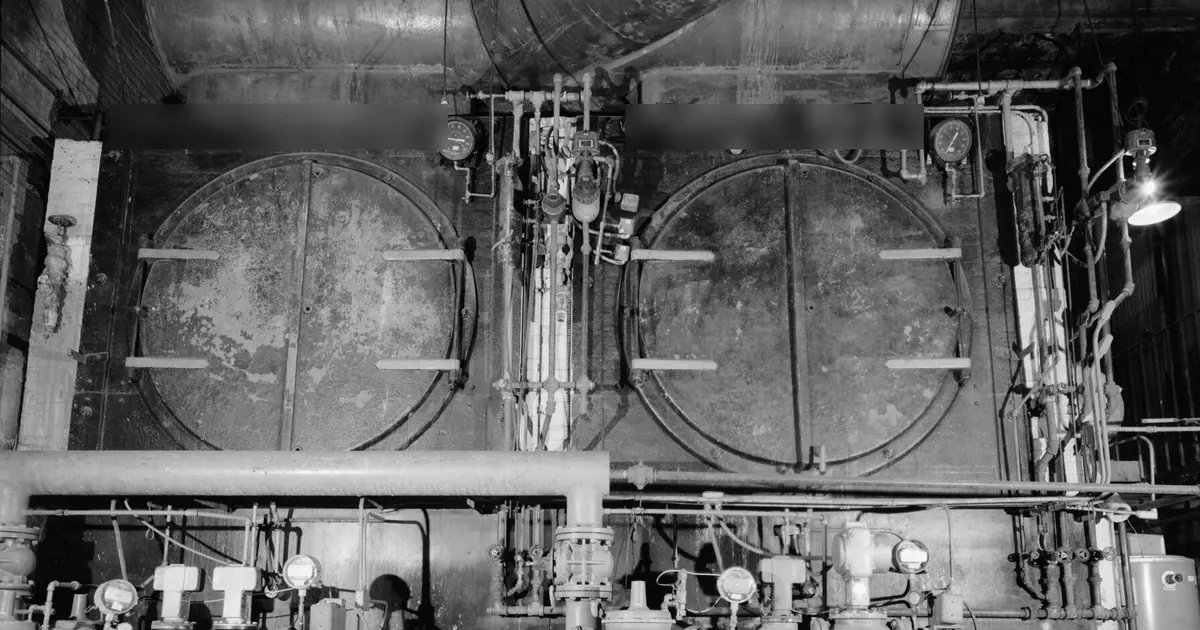
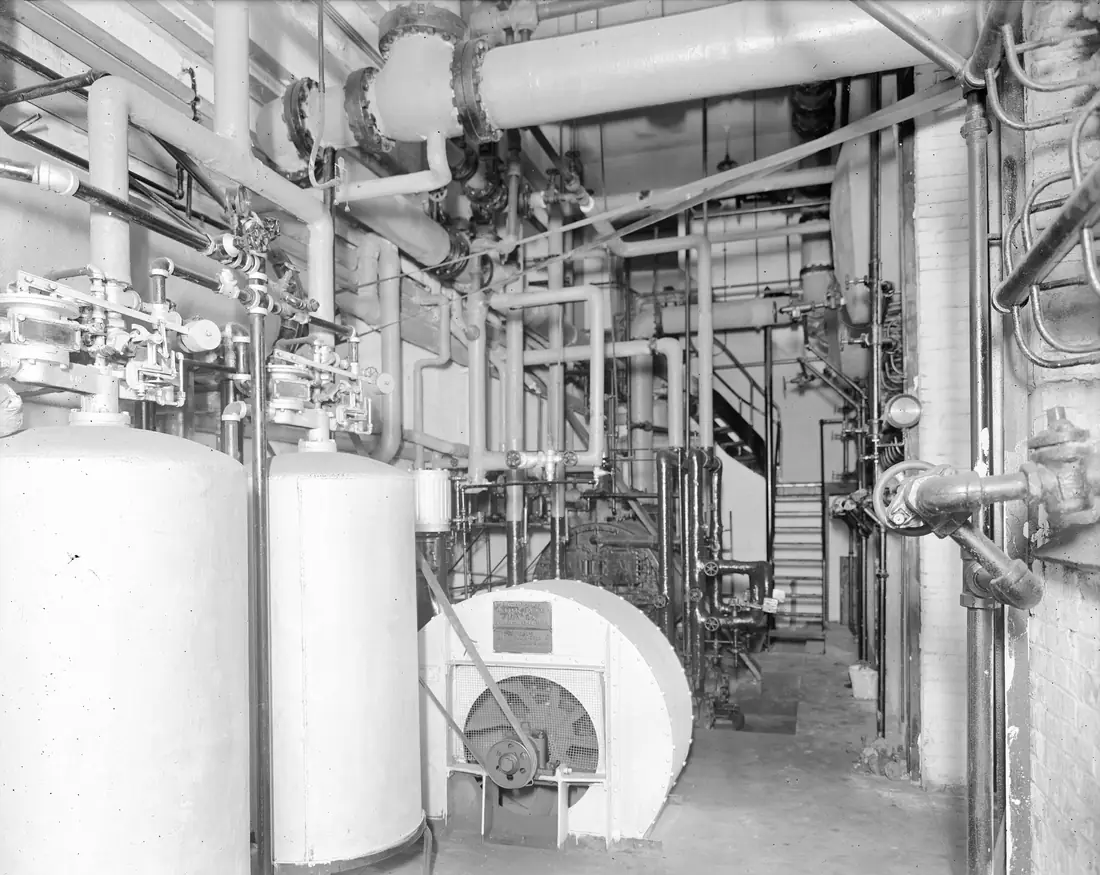
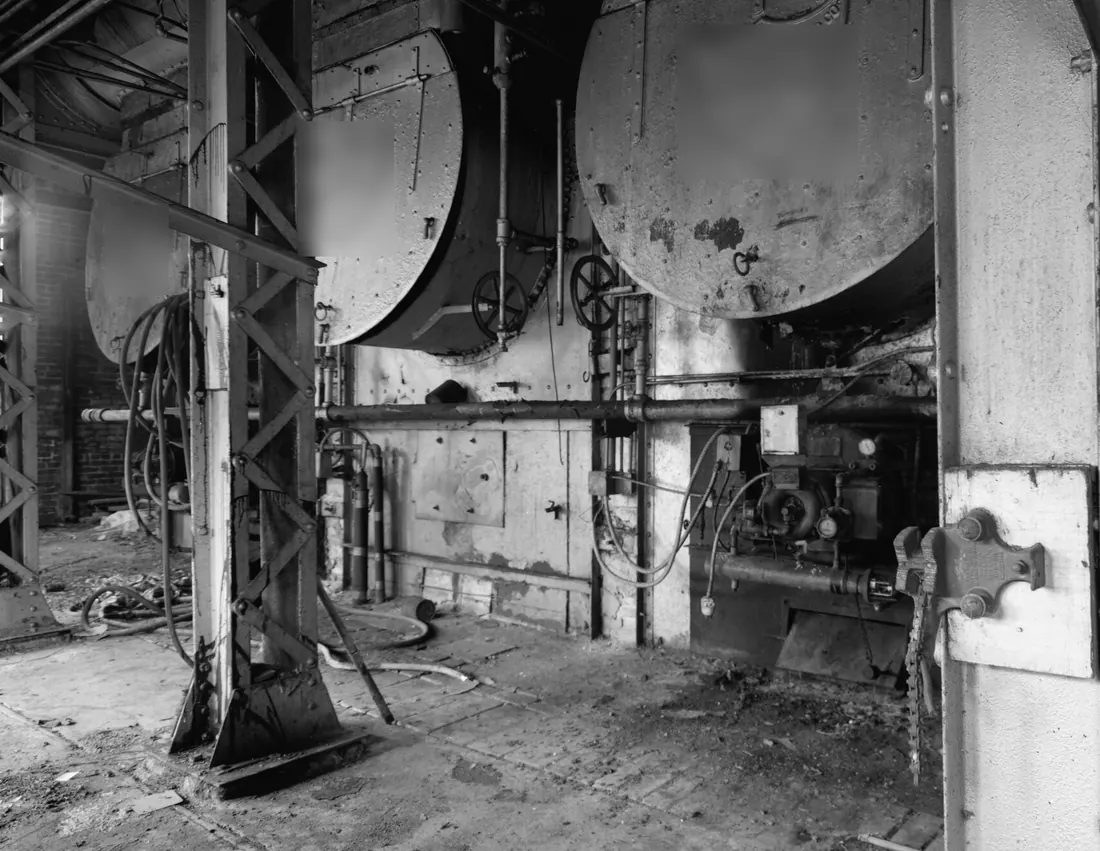
- Photos: Wikimedia Commons, Susan B. Anthony School boiler room (Ira Srole, Historic American Buildings Survey, 1987, public domain); Central High School boiler room (Hennepin County Library, public domain); Ormond Hotel boiler room (Christopher David Doncsecz, Historic American Buildings Survey, 1992, public domain). Cropped; maker's plates blurred. Not MDL jobs.