
Heated floors · Essex, Morris, Union
Electric radiant floor heating in Essex, Morris and Union County, NJ
A heated floor puts out about 12 watts per square foot, so a 50 square foot bathroom draws about 5 amps at 120 volts. It needs a GFCI-protected circuit, a floor-sensing thermostat and cable tests before and after the tile. Installed prices run $8 to $15 per square foot (HomeGuide). Call MDL in West Orange to ask about yours.

The short answer
A heated floor is a tile job and an electrical job.
The heating part is a thin mat or cable set in thinset right under the tile. Nuheat, SunTouch and Schluter DITRA-HEAT systems all put out about 12 watts per square foot (sizing table). At 120 volts that is about 1 amp per 10 square feet. A 50 square foot bathroom floor draws about 5 amps.
The electrical part is the circuit, a Class A GFCI, a floor-sensing thermostat and resistance tests before and after the tile goes down. Every manufacturer manual below requires the tests, and skipping them can void the warranty (tests). In New Jersey that wiring is licensed electrical work and needs a permit (rules).
Published installed prices run $8 to $15 per square foot before new flooring (HomeGuide). MDL Electric holds a New Jersey electrical contractor license (34EI01606200) and works from 4 Harrison Avenue in West Orange across Essex, Morris and Union County. Call 973.809.2339 to ask whether MDL handles your heated floor job.
The room and its sizeBathroom, kitchen, mudroom or basement, and roughly how many square feet get heat.
The floor going on topTile, stone, vinyl or laminate rated for floor heat.
Where the job standsFloor still down, floor torn out, or a new addition.
Who is setting the tileYour own tile setter, a remodeler, or not chosen yet.
Who does what
What the tile setter does and what the electrician does.
The mat or cable lives in the tile layer, so two trades touch it. The manuals leave the split to the job, but the electrical steps stay the same.
Scroll sideways to see the whole table.
| Step | Usually done by | What the manuals and code say |
|---|---|---|
| Check the panel has room and plan the circuit | Electrician | Breaker size follows the amp draw of the mats; over 15 amps needs another circuit and thermostat (SunTouch). |
| Box for the thermostat and the supply wire | Electrician | Minimum 14 AWG supply conductors (Nuheat). Licensed work in New Jersey, except a single-family homeowner on his or her own home (5:23-2.15). |
| Test the mat or cable out of the box | Whoever lays it | Record the ohms against the tag before it goes down (Nuheat, Schluter, SunTouch, WarmlyYours). |
| Lay the mat or cable in thinset, place the floor sensor | Tile setter or installer | Pressed into thinset with full contact; the sensor goes between heating runs (Nuheat). |
| Set the tile and grout | Tile setter | Flooring installers set the new floor once the heating is in place (HomeGuide). |
| Test again, connect the thermostat, label the breaker | Electrician | Connections only after the flooring is complete; label the panel circuit (Nuheat, Schluter). |
This is the usual split, not a rule. Some electricians lay the mat themselves, and some tile setters lay it and test it. Ask MDL which part it takes on your job: laying the mat, or wiring and testing it. For the fan in the same bathroom, see bathroom exhaust fan installation.
Watts and amps
How much power a heated floor draws.
The figures below come from each maker's own installation manual or FAQ. Check the tag on your mat or cable: it carries the exact voltage, resistance and amp rating.
Scroll sideways to see the whole table.
| System | Output | Example draw |
|---|---|---|
| SunTouch TapeMat | 12 W per sq ft | 120 V: 10 sq ft mat 1 amp, 50 sq ft mat 5 amps. 240 V: 100 sq ft mat 5 amps |
| Nuheat mat | 12 W per sq ft, or 15 on request | Thermostat up to 15 amps: about 150 sq ft at 120 V or 300 sq ft at 240 V |
| Schluter DITRA-HEAT cable | 12.7 W per sq ft at regular spacing, 15.2 at the tighter 3-2 spacing | 120 V cable for about 51 sq ft: 650 W, 5.4 amps; for about 113 sq ft: 11.9 amps |
| WarmlyYours TempZone cable | 3.7 W per foot of cable: about 14.8 W per sq ft at 3-inch spacing, 11.1 at 4 inches | Thermostat rated 15 amps |
- 240 volts is not hotter. Nuheat says 240 volt systems do not heat better or faster, and cost the same to run. They draw half the amps, so one thermostat covers twice the area.Nuheat FAQ
- Never mix the voltage. Schluter's handbook says never to install a cable designed for 120 volts on a 240 or 208 volt supply. Each system on one thermostat must be the same voltage (Nuheat).Schluter; Nuheat
- Mats cannot be cut to fit. SunTouch says the heating wire cannot be cut shorter; the mat has to be sized to the open floor, not the whole room.SunTouch
- Over 15 amps means a second thermostat. Schluter, Nuheat and WarmlyYours thermostats are limited to 15 amps; a bigger floor needs another thermostat or power module and its own circuit.Schluter; WarmlyYours
The circuit
The circuit, the breaker and the panel.
A heated floor is a steady heating load, so the manuals set the breaker by the amps and keep the floor off busy circuits.
Scroll sideways to see the whole table.
| Total mat draw | Supply wire | Breaker |
|---|---|---|
| 120 V, up to 12 amps | 14 AWG | Single-pole 15 or 20 A (15 A preferred) |
| 120 V, 12 to 15 amps | 12 AWG | Single-pole 20 A |
| 240 V, up to 12 amps | 14 AWG | Double-pole 15 or 20 A |
| 240 V, 12 to 15 amps | 12 AWG | Double-pole 20 A |
| Over 15 amps | Another circuit with its own breaker and thermostat | |
- Nuheat: a dedicated circuit. Its guide says the mat must be on a dedicated circuit for heating devices such as other mats, baseboard heaters or electric fireplaces.Nuheat
- Schluter: dedicated recommended. A circuit already feeding fixed room heaters may be used if it is 30 amps or less and the total stays under 80% of the breaker.Schluter
- SunTouch: keep it off busy circuits. You may tap an existing circuit with room to spare, but avoid circuits with lighting, motors, exhaust fans or hot tub pumps.SunTouch
- A full panel changes the plan. HomeGuide says some installs need electrical upgrades, and puts a new dedicated circuit at $250 to $900. If there is no space or capacity left, see panel upgrades.HomeGuide
Resistance tests
Test the cable before, during and after the tile.
Once the tile is down, a damaged cable means lifting tile. The tests catch a nick while it is still cheap to fix, and the warranty depends on them.
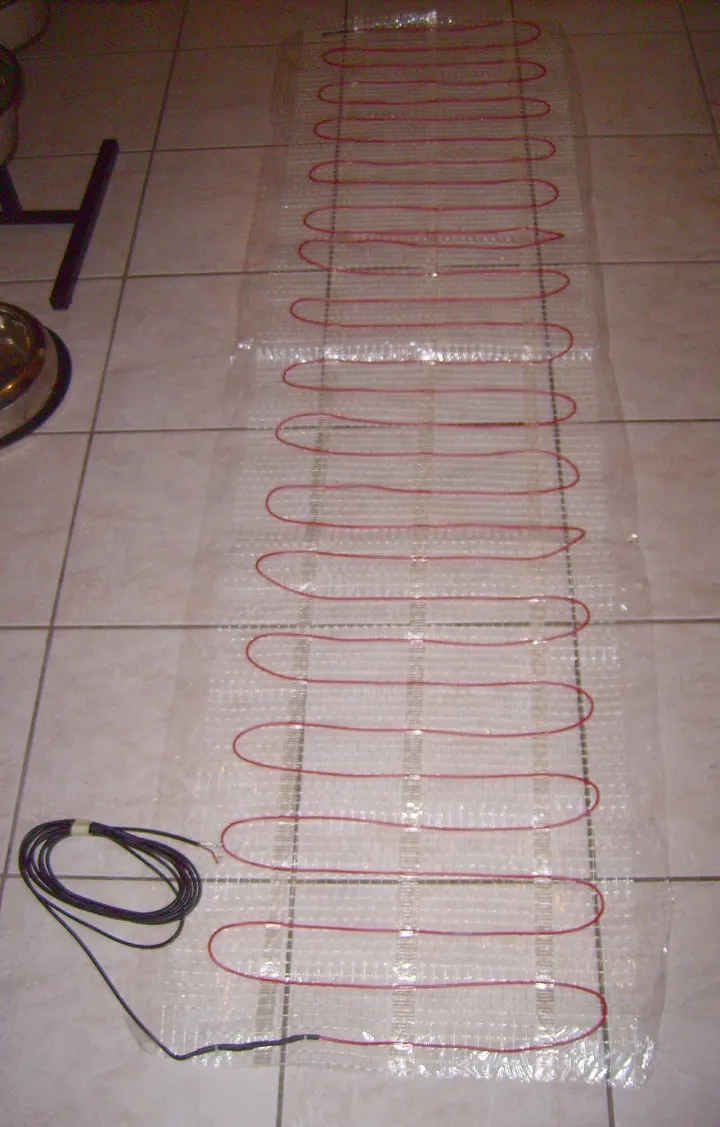
- Three readings at least. WarmlyYours asks for one before starting, one after the cable is secured to the subfloor, and one after the flooring is on. Nuheat says before, during and after.WarmlyYours; Nuheat
- Match the tag. Nuheat's reading must be within +10% / -5% of the resistance on the white tag. Schluter says a change of 10% or more from the spool means damage or a meter problem.Nuheat; Schluter
- No path to ground. Between a heating lead and the ground braid the meter should read open ("OL"). Schluter's optional insulation test uses a 1,000 volt megohmmeter and needs at least 1 gigaohm.Schluter; SunTouch
- The warranty rides on the log. Nuheat says failing to record the tests voids its warranty. Schluter gives 15 years with all four tests logged, 10 years without the insulation test, and no cable coverage with none.Nuheat; Schluter
- Keep the tag on. Nuheat says code requires the tag to stay on the cold lead, and SunTouch says the electrical inspector will need to see the nameplate label.Nuheat; SunTouch
The thermostat
What a heated floor thermostat does.
The thermostat is the floor's switch, its temperature control and, on most systems, its GFCI.
01
Reads the floor, not the air
A sensor wire sits between the heating runs. Nuheat expects it to read 8,000 to 12,000 ohms at room temperature; SunTouch lists about 10,000 ohms at 75°F.
02
Has the GFCI built in
Schluter, Nuheat, SunTouch and WarmlyYours floor thermostats include a Class A GFCI, so a separate GFCI breaker is usually not needed.
03
Carries up to 15 amps
That is the limit for one thermostat in all four manuals. More floor means another thermostat or a power module.
04
Goes at eye level
WarmlyYours says about 5 feet up, in a single-gang box. HomeGuide puts thermostat installation at $140 to $350.
Sources: Nuheat mat guide, SunTouch TapeMat manual, Schluter DITRA-HEAT handbook, WarmlyYours TempZone manual, HomeGuide. Floor stopped heating, or the GFCI keeps tripping? WarmlyYours says never bypass the GFCI and call a qualified electrician. See electrical repair.
Cost
What electric radiant floor heating costs.
Published national ranges, read October 29, 2026. A small bathroom sits at the low end; a retrofit with new tile and a new circuit sits at the high end. Market ranges, not MDL prices.
Scroll sideways to see the whole table.
| What | Market range | Source |
|---|---|---|
| Electric floor heat, installed, before new flooring | $8 to $15 per sq ft | HomeGuide |
| Materials plus installation | $10 to $15 per sq ft for materials, plus $5 to $10 per sq ft to install | Angi |
| System with materials and installation | $6 to $20 per sq ft | This Old House |
| Half-bath, 20 to 30 sq ft | $200 to $500 without new flooring; $250 to $1,700 with it | HomeGuide |
| Full bathroom, 40 to 50 sq ft | $300 to $800 without new flooring; $500 to $2,800 with it | HomeGuide |
| Primary bathroom, 60 to 160 sq ft | $500 to $2,400 without new flooring; $700 to $8,800 with it | HomeGuide |
| New dedicated circuit | $250 to $900 | HomeGuide |
| Thermostat installation | $140 to $350 | HomeGuide |
| Electrician's labor | $50 to $130 per hour | HomeGuide |
| Permit | $50 to $800, depending on the job | HomeGuide |
- Retrofit costs more. HomeGuide says installing heat in an existing bathroom costs 50% to 80% more than in new construction, because the old floor comes up first. Some contractors also charge a $500 to $600 minimum.HomeGuide
- The cheapest time is during a remodel. HomeGuide says combining a heated floor with other bathroom updates reduces the overall cost, since the floor is already coming up for new tile.HomeGuide
Running cost
What it costs to run in New Jersey.
The math is the floor's watts times the hours it heats times your electric rate.
- About 15 cents an hour at full power. A 50 sq ft floor at 12 watts per sq ft uses 600 watts while it heats. At New Jersey's August 2026 average residential rate of 24.61 cents per kWh, that is about 15 cents an hour.US EIA, Electric Power Monthly Table 5.6.A
- It does not run flat out all day. The thermostat shuts the floor off once it is warm. Schluter's handbook shows a floor at 82°F in a 72°F room gives off about 5.5 watts per sq ft. That is well under the 12 the cable can make.Schluter
- A schedule keeps it small. HomeGuide estimates $5 to $10 or more a month for a heated bathroom floor. On a timed schedule, it says, the bill does not rise much.HomeGuide
- Voltage does not change the bill. Nuheat says there is no difference in efficiency or running cost between 120 and 240 volt systems.Nuheat FAQ
New Jersey rules
Permits and code for a heated floor in New Jersey.
From the state Uniform Construction Code, N.J.A.C. 5:23-2 and N.J.A.C. 5:23-3.16, NJ Department of Community Affairs (published through August 17, 2026), read October 29, 2026. Your town's construction office enforces them and decides edge cases.
Scroll sideways to see the whole table.
| Question | What the rules say | Section |
|---|---|---|
| Is it ordinary maintenance? | No. Ordinary electrical maintenance covers replacing a receptacle, switch or fixture with a like item and repairs, not a new heating circuit and thermostat. | 5:23-2.7 |
| Does it need a permit? | Installing regulated electrical equipment needs a permit before the work. | 5:23-2.14(a) |
| Minor work | Some work in one- and two-family homes is minor work: the town is told before work starts and the permit application follows within five business days. The town decides what counts. | 5:23-2.17A |
| Who may do the wiring | Electrical work only by persons licensed to do it, except a single-family homeowner on his or her own home. | 5:23-2.15 |
| Which electrical code | New Jersey's electrical subcode is the National Electrical Code 2023. | 5:23-3.16 |
| GFCI in the floor | "GFCI protection shall be provided for cables installed in electrically heated floors of bathrooms and kitchens and hydromassage bathtub locations," as quoted by EC&M from the current NEC. The manufacturers require a Class A GFCI on every system. | NEC 424.44(E) |
Living with it
Floors, rugs and the downsides.
The heat has to get out through the floor, so what sits on top matters.
- Thin floors work best. Schluter limits the floor covering over DITRA-HEAT to an R-value of 1; Nuheat allows up to R-2.5 total. Tile and stone are the usual choice; HomeGuide says vinyl, laminate and thin wood only if rated for floor heat.Schluter; Nuheat; HomeGuide
- Rugs, with care. Schluter does not recommend area rugs, and any rug should be R-1 or less and never over the sensor. SunTouch says no rubber-backed or very heavy rugs.Schluter; SunTouch
- No flat-bottomed furniture on it. Nuheat and WarmlyYours warn that mattresses, foam or rubber mats and box-bottomed furniture trap heat. SunTouch wants 1-1/2 inches of air under furniture.Nuheat; WarmlyYours; SunTouch
- The downsides. It costs more to run than hydronic heat. A retrofit costs 50% to 80% more than new construction (HomeGuide). A damaged cable sits under tile, and the panel needs room for the circuit.HomeGuide
- Room heat or warm feet. Nuheat says 12 to 15 watts per sq ft can be a room's only heat if that is enough. An HVAC specialist should work that out. For the house's main heat, see heating or electric baseboard heaters.Nuheat FAQ
Where MDL works
Essex, Morris and Union County, from a West Orange base.
MDL works from 4 Harrison Avenue in West Orange. These are the towns in the three counties that have their own MDL service-area page. Whatever the town, start with a call. Tell MDL the town, the room and who is setting the tile, and MDL will tell you whether it handles that job.
Morris County
Union County
Heated floors
Call to ask whether MDL handles your heated floor job.
Call or send the form. Include your town, the room and its size, the floor going on top, and who is setting the tile.
Heated floor questions
Straight answers on cost, circuits, tests and permits.
Watts, amps and tests come from the manufacturers' manuals, rules from the New Jersey code, prices from published market ranges, not an MDL quote.
How much does electric radiant floor heating cost to install?
HomeGuide puts electric floor heating at $8 to $15 per square foot installed, before new flooring. For an average 40 to 50 square foot bathroom that is $300 to $800, without new flooring. Angi's rule of thumb is $10 to $15 per square foot for materials plus $5 to $10 per square foot to install. This Old House gives $6 to $20 per square foot. These are published national ranges, not MDL prices.
Do you need an electrician to install heated floors?
For the wiring, yes. In New Jersey, electrical work may only be done by a licensed electrician, or by a single-family homeowner on his or her own home (N.J.A.C. 5:23-2.15). SunTouch's manual recommends an electrician and says local codes may require one, and WarmlyYours says the electrical connections should be made by a licensed electrician. MDL Electric holds a New Jersey electrical contractor license (34EI01606200).
Does a heated floor need its own circuit?
Usually. Nuheat says its mat must be on a dedicated circuit for heating devices. Schluter recommends a dedicated circuit for DITRA-HEAT. It allows a circuit that already feeds fixed room heaters if the breaker is 30 amps or less and the total stays under 80% of it. SunTouch says you may tap an existing circuit with room to spare, but to avoid circuits with lighting, motors, exhaust fans or hot tub pumps.
How many amps does a heated bathroom floor use?
About 1 amp for every 10 square feet at 120 volts. SunTouch's 50 square foot, 120 volt TapeMat draws 5 amps, and Schluter's DITRA-HEAT cable for about 51 square feet draws 5.4 amps (650 watts). At 240 volts the same floor draws half the amps. Most floor heating thermostats are limited to 15 amps.
Should a heated floor be 120 volt or 240 volt?
It depends on the size. Nuheat says 240 volt systems do not heat better, faster or cheaper; they cover twice the area per amp. Its thermostats handle 15 amps, about 150 square feet at 120 volts or 300 at 240 volts. Schluter warns never to put a cable made for 120 volts on a 240 or 208 volt supply. Check the voltage on the cable's tag before anything is connected.
Do heated floors need GFCI protection?
Yes. The National Electrical Code requires GFCI protection for heating cables in bathroom and kitchen floors and hydromassage tub areas (Section 424.44(E), quoted by EC&M). Schluter, Nuheat, SunTouch and WarmlyYours all call for a Class A GFCI on the circuit. Their floor thermostats have one built in, so a separate GFCI breaker is usually not needed.
Who installs the heating mat, the tile setter or the electrician?
It varies by job. The mat or cable sits in thinset right under the tile. On many remodels the tile setter lays it and sets the tile. The electrician runs the circuit, sets the thermostat and makes the final connection. Nuheat's guide says the electrical connection is made only after the flooring is complete. Ask MDL whether it lays the mat itself or wires and tests it while your tile setter lays it.
Why test the heating cable before and after the tile goes down?
Because a cable nicked by a trowel or a tile cutter cannot be fixed without lifting tile. Nuheat says its mat must be tested before, during and after installation, within +10% / -5% of the resistance on its tag, or the warranty is void. Schluter gives DITRA-HEAT a 15-year warranty with all four cable tests logged. Without the insulation test it is 10 years, and with no tests the cable is not covered.
What kind of thermostat does a heated floor need?
A floor-heating thermostat with a floor sensor. The sensor is a wire laid between the heating runs. Nuheat expects it to read 8,000 to 12,000 ohms at room temperature. Schluter, Nuheat, SunTouch and WarmlyYours floor thermostats have a Class A GFCI built in and carry up to 15 amps. HomeGuide puts thermostat installation at $140 to $350.
How much does a heated bathroom floor cost to run in New Jersey?
A 50 square foot floor at 12 watts per square foot uses 600 watts while it heats. At New Jersey's August 2026 average residential rate of 24.61 cents per kilowatt-hour (US EIA), that is about 15 cents an hour at full power. The thermostat cycles it off once the floor is warm, so a timed schedule costs less. HomeGuide estimates $5 to $10 or more a month for a heated bathroom floor.
Can you put rugs on heated floors?
Thin ones, with care. Schluter does not recommend area rugs over DITRA-HEAT. Any rug used should have an R-value of 1 or less and never sit over the floor sensor. SunTouch says to avoid rubber-backed and very heavy rugs. Nuheat and WarmlyYours say not to put mattresses, memory foam or rubber mats, or flat-bottomed furniture on the heated area, because they trap heat.
What are the downsides of electric floor heating?
It costs more to run than hydronic heat (HomeGuide). Adding it to an existing bathroom costs 50% to 80% more than in new construction because the floor has to come up (HomeGuide). A damaged cable under tile is hard to reach, which is why the manufacturers require testing during installation. And it usually needs a circuit the panel has room for.
Can electric floor heating heat a whole room?
Sometimes. Nuheat says its systems typically give 12 watts per square foot, and up to 15. That can be a room's only heat if it is enough, which an HVAC specialist should work out. Schluter's handbook shows a floor at 82°F in a room at 72°F gives off about 5.5 watts per square foot. Most bathroom systems warm the floor rather than replace the room's heat.
Do I need a permit for heated floors in New Jersey?
Plan on one. A new heating circuit and thermostat is not on the state's ordinary electrical maintenance list. Installing regulated electrical equipment needs a permit before the work (N.J.A.C. 5:23-2.7 and 2.14). Your town's construction office decides whether part of a job counts as minor work under N.J.A.C. 5:23-2.17A. HomeGuide puts permit costs at $50 to $800 nationally.
Does radiant heat need electricity?
Electric radiant heat runs entirely on electricity: a resistance cable or mat under the floor warms up when power flows through it. Hydronic radiant heat runs warm water from a boiler or water heater through tubing instead, which HomeGuide says suits larger areas and new construction. This page is about the electric kind.
How do I ask MDL about a heated floor?
Call 973.809.2339 or send the form on this page. Include your town, the room and its rough square footage, the floor you plan to lay, and who is setting the tile. MDL will tell you whether it handles that job. MDL Electric is a licensed New Jersey electrical contractor at 4 Harrison Avenue in West Orange.
Sources
Where the rules, numbers and advice on this page come from.
All read October 29, 2026.
- Manufacturer manuals: Schluter DITRA-HEAT Installation Handbook (10/2025): output and amps, circuit rules, GFCI, cable tests and warranty, floor covering limits, heat output; Nuheat Mat Installation Guide: 12 W per sq ft, dedicated circuit, GFCI, resistance and sensor tests, wiring; SunTouch DIY TapeMat Installation Manual (Watts): mat sizes and amps, breaker and wire table, tests, rugs; WarmlyYours TempZone Floor Heating Cable Installation Instructions: watts per foot and spacing, three readings, GFCI, thermostat height.
- Nuheat FAQ: 120 V vs 240 V, thermostat limit, heating a whole room.
- N.J.A.C. 5:23-2, Uniform Construction Code, administration and enforcement and N.J.A.C. 5:23-3.16, electrical subcode, NJ Department of Community Affairs (published through August 17, 2026).
- EC&M, Test Your Code IQ, October 2026 (Ryan Jackson, October 20, 2026): NEC 424.44(E) GFCI text.
- Costs: HomeGuide, How Much Does a Heated Bathroom Floor Cost? (Tara Farmer); Angi, How Much Do Heated Floors Cost? (Mizuki Hisaka, updated October 16, 2026); This Old House, What You Need to Know About Electric Radiant Heating (updated June 6, 2026). Not MDL prices.
- Electric rate: US Energy Information Administration, Electric Power Monthly, Table 5.6.A: New Jersey residential, August 2026, 24.61 cents per kWh.
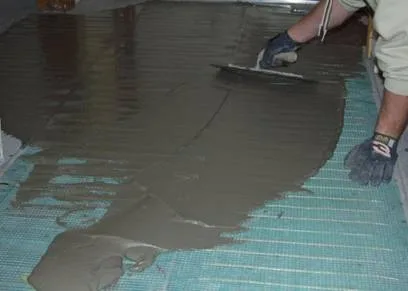
- Photos: Pexels, bare feet on floor tiles (cottonbro studio, Pexels License); Wikimedia Commons, electric floor heating mat (Hundehalter, CC0) and thinset over a heating mat (Gdjones, public domain). Not MDL jobs.


Next steps
Related services
Bathroom exhaust fan installation
The fan in the same bathroom: venting outside, sizing and the GFCI near the shower.
Learn morePanel upgrades
When the panel has no room for a heated floor's circuit, an EV charger or a generator.
Learn moreElectrical repair
A heated floor that stopped working, a GFCI that keeps tripping, or a dead circuit.
Learn moreElectric baseboard heater repair
Line-voltage room heat, the other common electric heater in New Jersey homes.
Learn moreRequest service
Send MDL the service, town, and best callback number.
Use the form for planned service or call for urgent electrical, heating, or cooling help.