
Bath fans · Essex, Morris, Union
Bathroom exhaust fan installation in Essex, Morris and Union County, NJ
A bath fan that already vents outside can usually be swapped with no New Jersey permit; a new fan needs a duct outside and new wiring. Most installs run $183 to $444 (Thumbtack). Call MDL, based in West Orange, to ask about yours.
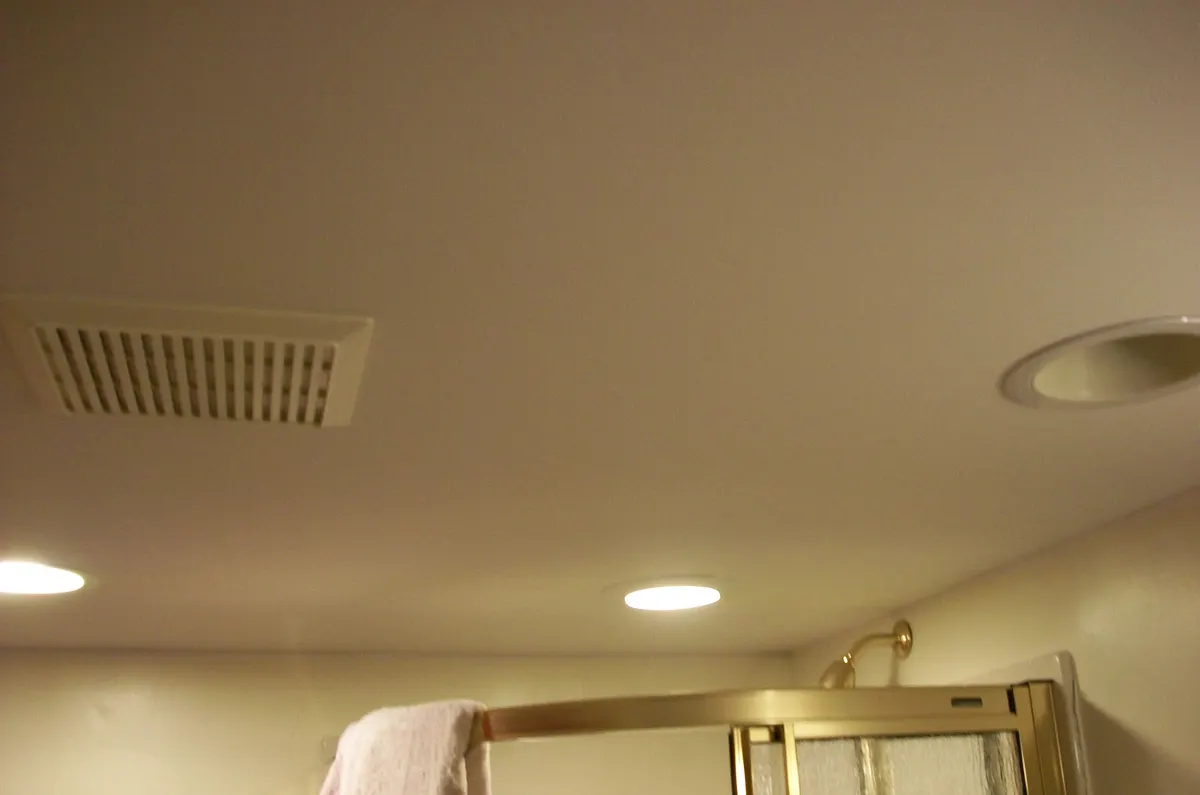
The short answer
Replacing a fan and adding a new one are two different jobs.
Replacing a fan is the easy case: Lowe's says you can reuse the existing switch, wires and duct, and a fan the same size as the old one avoids cutting a bigger ceiling hole (Lowe's). Home Depot's Pro Referral page says that swap can take less than an hour (Home Depot). In New Jersey, replacing a bathroom fan that vents on its own to the outdoors is ordinary maintenance: no permit and no notice to the town (N.J.A.C. 5:23-2.7(c)5.ix).
Adding a fan where there is none, or fixing one that blows into the attic, means cutting the ceiling, mounting the housing to a joist, running a duct to a roof or wall cap and bringing power from the switch. Home Depot says a completely new installation may take an entire day or longer, and that job needs a permit in New Jersey (rules below).
Most published installs land at $183 to $444 (Thumbtack's national average). MDL Electric holds a New Jersey electrical contractor license (34EI01606200) and works from 4 Harrison Avenue in West Orange across Essex, Morris and Union County. Call 973.809.2339 to ask whether MDL handles your bath fan job.
Is there a fan now?A working fan to replace, a dead one, or no fan at all.
Where it ventsA roof cap, a wall cap, or into the attic (which the code does not allow).
What is above the bathroomAn attic you can get into, another floor, or a flat roof.
What you want it to doFan only, fan and light, fan and heater, or a humidity sensor or timer.
Why winter shows it
Cold weather is when a weak or badly vented fan shows up.
The US Department of Energy lists showering among the everyday ways a household adds moisture to indoor air. When that air is not pulled outside, it ends up on the mirror, the paint and the colder parts of the house.
- Moisture condenses where it is cold. The US Department of Energy explains that when moist air meets a colder surface some of the moisture condenses, and that moisture condensing inside a wall or in the attic can lead to wood rot and mold. Its advice: bathroom vents should lead directly outside and never into the attic.US DOE
- A fan into the attic makes it worse. Lowe's says letting the fan exhaust into an open attic will cause moisture buildup on the underside of the roof.Lowe's
- The duct itself can sweat. ENERGY STAR's guide says to insulate the duct to minimize condensation, and where possible to slope it down to a side wall so any condensation runs away from the fan.ENERGY STAR / PNNL
- Ventilation keeps mold down. The EPA says to run the bathroom fan or open the window when showering, and to keep indoor humidity below 60 percent, ideally 30 to 50 percent. For bathroom mold that keeps coming back, more ventilation and more frequent cleaning will usually prevent it or keep it to a minimum.US EPA

Cost
What bathroom exhaust fan installation costs.
Published national ranges, read October 25, 2026. A replacement on good wiring and an existing duct sits at the low end; a new fan with a new duct and wiring sits at the high end. Market ranges, not MDL prices.
Scroll sideways to see the whole table.
| What | Market range | Source |
|---|---|---|
| Most installs, fan and labor | $183 to $444 national average; about $100 at the low end and $866 at the high end | Thumbtack |
| Labor, simple replacement | $100 or less | Home Depot |
| Labor, new ductwork and wiring | $500 or more | Home Depot |
| Professional labor, any job | $200 to $500, depending on ceiling height, wiring and roof vent access | Panasonic |
| The fan itself | From about $80 for a basic bath fan; $120 to $250 for an ENERGY STAR fan | Home Depot; Panasonic |
| Duct, tape and connectors | $15 to $40 | Panasonic |
- What pushes it up. Thumbtack lists a new install instead of a replacement, the fan's features (heater, light, humidity sensor), local labor rates, a hard-to-reach attic or high ceiling, and drywall, paint or old wiring repairs.Thumbtack
- The permit is a separate cost. A new fan or a new duct is not on New Jersey's no-permit list, so the town's permit fee is added to the installer's price. A like-for-like replacement that vents outside needs no permit.N.J.A.C. 5:23-2.7, 2.14
Venting
The fan has to vent outside, never into the attic.
Where the duct ends decides whether the moisture actually leaves the house.
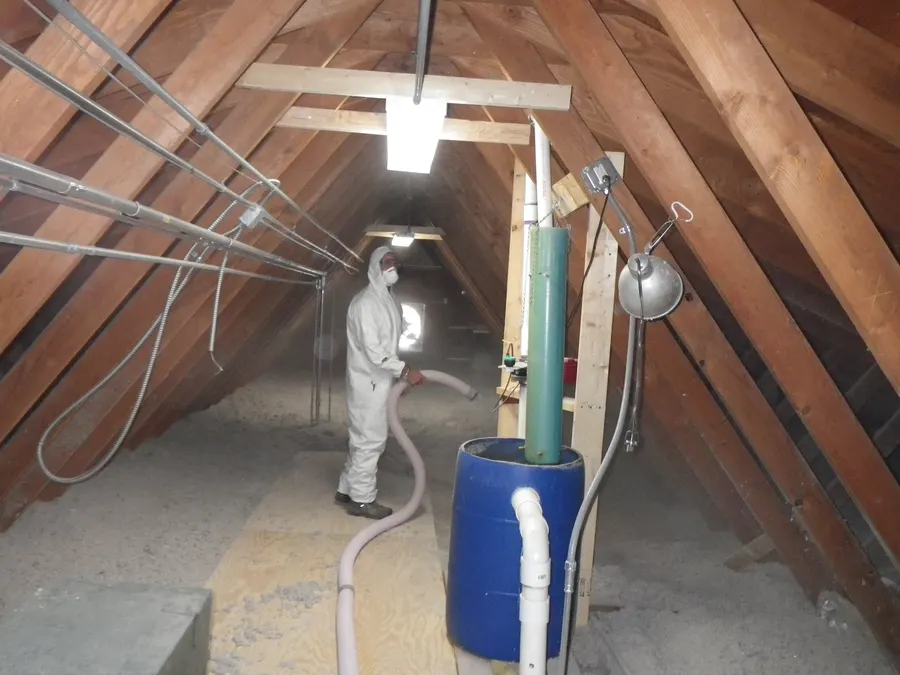
- The code says outdoors. Bathroom exhaust air must be exhausted directly to the outdoors and must not discharge into an attic, crawl space or other areas inside the building; exhaust may not go into an attic, soffit, ridge vent or crawl space.2024 IRC M1505.2, M1501.1
- Through the roof or a gable with an attic. With attic access, Lowe's says a ceiling fan can vent through a gable wall or the roof, and to avoid a soffit or ridge vent because the warm air comes back into the attic.Lowe's
- Through the wall without one. Without attic access, Lowe's says you vent through a sidewall with a wall-mounted fan, and to call a professional if there is no duct to a sidewall vent already.Lowe's
- Short, straight and sealed. Use the duct size the fan maker specifies, keep the first three feet straight, use gradual bends, seal joints with mastic or metal tape, and end at a cap with a damper that closes when the fan is off.ENERGY STAR / PNNL
- Away from windows and intakes. The outside opening must be at least 3 feet from property lines and from operable windows and doors (unless 1 foot above them) and 10 feet from mechanical air intakes.2024 IRC M1504.3
About half of Essex County's 339,451 homes were built before 1960, and about 30% in 1939 or earlier (US Census Bureau ACS 2024 1-year, table B25034, via Census Reporter). Panasonic notes that some older homes have no fan and rely on a window, which rarely gives consistent ventilation, and ENERGY STAR's guide says operable windows should not be relied on for it (Panasonic; ENERGY STAR / PNNL). If the attic has old wiring, see knob and tube wiring replacement; for a whole-attic fan, see attic fan installation.
Sizing
How big and how quiet the fan should be.
Fans are rated in CFM (cubic feet of air per minute) and sones (noise). The label is a factory number; ENERGY STAR notes that ducts and installation can bring the real airflow below it, so buy above the minimum.
Scroll sideways to see the whole table.
| Question | Answer | Source |
|---|---|---|
| The code minimum | 50 CFM if the fan is switched on and off, or 20 CFM if it runs all the time | 2024 IRC Table M1505.5 |
| A quick formula | Length × width × height × 0.13, rounded up to the next 10. Lowe's example: 8.5 × 9.5 × 8 feet × 0.13 = 84, so a 90 CFM fan or larger | Lowe's; Panasonic |
| Rule of thumb | About 50 CFM for a small bathroom, about 100 CFM for a large one | Lowe's |
| Bathroom over 100 sq ft | Add 50 CFM each for the toilet, the shower and the tub, and 100 CFM for a jetted tub | Lowe's |
| Buy above the minimum | For 50 CFM switched on and off, choose a fan rated at least 70 CFM; for 20 CFM running all the time, more than 50 CFM | ENERGY STAR / PNNL |
| Noise | 3 sones or less for a fan switched on and off, 1 sone or less for one that runs all the time; Lowe's calls 2 sones quiet, Panasonic suggests under 1.0 | ENERGY STAR / PNNL; Lowe's; Panasonic |
The electrical side
Switches, lights, heaters and the wet zone.
A bath fan is a duct job and a wiring job. The wiring decides whether an old circuit can take the new fan and what has to change near the shower.
01
Same switch, or new wiring
A plain swap uses the existing switch. A fan with a light that you want on its own switch needs new wiring for a double switch if the old fan had no light (Lowe's).
02
Over the tub or shower
Broan's 688ESL guide allows that fan over a tub or shower only on a GFCI-protected branch circuit, at least five feet above the floor, with the switch out of reach of the tub or shower, and grounded.
03
Heaters and old wires
Panasonic says to bring in a licensed electrician when the house wires lack a ground, the panel needs a new circuit, or a heater or light adds load. In New Jersey, only a licensed electrician or a single-family homeowner on his or her own home may do electrical work (N.J.A.C. 5:23-2.15).
04
Timer or humidity sensor
ENERGY STAR's guide recommends a timer switch and running the fan one hour after a shower. Panasonic sells fans with a humidity sensor that turn on by themselves.
What a like-for-like replacement looks like
Sources: Lowe's, Broan 688ESL installation guide, Panasonic, ENERGY STAR / PNNL, N.J.A.C. 5:23-2.15. Lights in the same ceiling: see recessed lighting installation. A breaker that trips when the fan or heater runs: see electrical repair.
New Jersey rules
When a bath fan job needs a permit in New Jersey.
From the state Uniform Construction Code, N.J.A.C. 5:23-2, NJ Department of Community Affairs (published through August 17, 2026), and the residential subcode at N.J.A.C. 5:23-3.21, read October 25, 2026. Your town's construction office enforces them and decides edge cases.
Scroll sideways to see the whole table.
| Job | What the code says | Section |
|---|---|---|
| Replace a fan that vents outside on its own | Ordinary maintenance: "the replacement of bathroom exhaust fans in dwelling units, provided that the fan vents independently to the outdoors." No permit, inspection or notice to the town. | 5:23-2.7(c)5.ix, 2.14(b)1 |
| Add a new fan, a new duct, or fix a fan that does not vent outside | Not on the ordinary-maintenance list. Installing or altering regulated equipment needs a permit before the work. | 5:23-2.14(a) |
| Minor work | Some work in one- and two-family homes is minor work: the town is told before work starts and the permit application follows within five business days. The town decides what counts. | 5:23-2.17A |
| Who may do the wiring | Electrical work only by persons licensed to do it, except a single-family homeowner on his or her own home. | 5:23-2.15 |
| The standard for new work | New Jersey uses the 2024 International Residential Code for one- and two-family homes. A bathroom needs a window of at least 3 square feet, half openable, or artificial light and an exhaust fan vented directly outdoors. | 5:23-3.21; IRC R325.2 |
Where MDL works
Essex, Morris and Union County, from a West Orange base.
MDL works from 4 Harrison Avenue in West Orange. These are the towns in the three counties that have their own MDL service-area page. Whatever the town, a bath fan job starts with a call: tell MDL the town, the bathroom and what is above it, and MDL will tell you whether it handles that job.
Morris County
Union County
Bathroom exhaust fans
Call to ask whether MDL handles your bath fan job.
Call or send the form with your town, whether there is a fan now and where it vents, what is above the bathroom, and whether you want a light, heater or humidity sensor.
Bath fan questions
Straight answers on cost, venting, sizing and permits.
Rules come from the New Jersey code, venting and sizing from ENERGY STAR and the manufacturers, prices from published market ranges, not an MDL quote.
How much does it cost to install a bathroom exhaust fan?
Thumbtack's national average is $183 to $444, with jobs running from about $100 to $866 (updated June 5, 2026). Home Depot's Pro Referral page says labor for a simple replacement may cost $100 or less, while new ductwork and wiring could cost $500 or more, and a basic bath fan starts around $80. Panasonic puts professional labor at $200 to $500. These are national market ranges, not MDL prices.
Do you need an electrician to install a bathroom fan?
In New Jersey, electrical work may only be done by a licensed electrician, or by a single-family homeowner on his or her own home (N.J.A.C. 5:23-2.15). Panasonic says to bring in a licensed electrician when the house wires lack a ground, the panel needs a new circuit, or you add a heater or light that increases the load. MDL Electric holds a New Jersey electrical contractor license (34EI01606200).
Can I install a bathroom exhaust fan myself?
A same-size swap on the existing wiring and duct is the job most how-to guides cover: Lowe's says it is easiest when you reuse the existing switch, wires and duct, and to call an electrician if you are not comfortable working with electricity. Thumbtack recommends a pro for a new install that cuts into the ceiling, runs a new duct outside or adds a circuit. In New Jersey a homeowner may do electrical work only on his or her own single-family home.
Does a bathroom exhaust fan have to vent outside?
Yes. New Jersey's residential code, the 2024 International Residential Code adopted at N.J.A.C. 5:23-3.21, says bathroom exhaust air must go directly to the outdoors and must not discharge into an attic, crawl space or other area inside the building (Section M1505.2). Section M1501.1 adds that exhaust may not go into an attic, soffit, ridge vent or crawl space.
How is a bathroom exhaust fan ducted to the outside?
ENERGY STAR's installation guide says to use the duct size the fan maker specifies, take the most direct route with as few bends as possible, keep the first three feet from the fan straight, seal the joints with mastic or metal tape, insulate the duct, and end it at a roof or wall cap with a damper. Lowe's describes a 4-inch duct to a roof vent cap when there is an attic, or a wall-mounted fan through a sidewall when there is not.
What size bathroom fan do I need?
Lowe's and Panasonic both use length times width times height times 0.13 to get the CFM. Lowe's example is 8.5 by 9.5 feet with an 8-foot ceiling, about 84, so a fan of 90 CFM or more. The New Jersey residential code's minimum for a bathroom is 50 CFM when the fan is switched on and off, or 20 CFM if it runs all the time (2024 IRC Table M1505.5). ENERGY STAR suggests buying a fan rated at least 70 CFM to be sure of 50 once it is installed.
Is it illegal not to have a bathroom fan?
Not if the bathroom has a big enough window. New Jersey's residential code (2024 IRC Section R325.2) says a bathroom needs windows with at least 3 square feet of glass, half of it openable, unless it has artificial light and a local exhaust fan, and that exhaust must go directly outdoors. ENERGY STAR's guide adds that operable windows should not be relied on for consistent bathroom ventilation. Ask your town's construction office about an existing bathroom.
Do I need a permit to replace a bathroom fan in New Jersey?
Not to replace one that vents on its own to the outdoors: N.J.A.C. 5:23-2.7(c)5.ix lists that as ordinary maintenance, which needs no permit or notice to the town (N.J.A.C. 5:23-2.14(b)1). A new fan, a new duct or a fan that does not vent outside on its own is not on that list, so it needs a permit under N.J.A.C. 5:23-2.14(a). Your town's construction office decides whether a job counts as minor work under N.J.A.C. 5:23-2.17A.
Can a bathroom fan go over the shower or tub?
Some can. Broan's installation guide for its 688ESL fan says it is acceptable for use over a bathtub or shower when installed in a GFCI-protected branch circuit, at least five feet above the floor, that the switch must never be placed where it can be reached from the tub or shower, and that the unit must be grounded. Check the instructions for the exact fan you buy.
How long should a bathroom fan run after a shower?
About an hour. ENERGY STAR's installation guide recommends leaving the fan running for one hour after a shower and using a timer switch instead of a standard wall switch, so the fan shuts itself off. Panasonic also sells fans with a humidity sensor that turn themselves on when moisture rises.
How long does it take to install a bathroom fan?
Home Depot's Pro Referral page says replacing a fan with proper wiring and ductwork can take less than an hour, wiring and duct upgrades may take a few hours, and a completely new installation may take an entire day or longer.
How do I know my bathroom fan is not working?
Panasonic lists the signs: a mirror that stays fogged for more than a minute, a rattling or loud fan, and peeling paint, mildew spots or musty smells. To test it, hold a tissue near the grille with the fan on; Panasonic says it should be pulled firmly against the grille, and moist air should come out of the outside vent within seconds.
How often should you replace a bathroom fan?
As a guideline, every 5 to 10 years: InterNACHI's Standard Estimated Life Expectancy Chart lists a ceiling vent fan at 5 to 10 years. InterNACHI says its figures assume normal wear and should be used as guidelines only. The signs above (a mirror that stays fogged, a loud fan, peeling paint) tell you sooner whether yours is failing.
How do I ask MDL about a bathroom fan?
Call 973.809.2339 or send the form on this page with your town, whether there is a fan now and where it vents, whether there is an attic above the bathroom, and whether you want a light, heater or humidity sensor. MDL will tell you whether it handles that job. MDL Electric is a licensed New Jersey electrical contractor at 4 Harrison Avenue in West Orange.
Sources
Where the rules, numbers and advice on this page come from.
All read October 25, 2026.
- N.J.A.C. 5:23-2, Uniform Construction Code, administration and enforcement, NJ Department of Community Affairs (published through August 17, 2026): ordinary maintenance (bathroom exhaust fan replacement), permits, licensed work, minor work.
- N.J.A.C. 5:23-3.21, one- and two-family dwelling subcode (adopts the 2024 International Residential Code), and the 2024 IRC text on UpCodes: R325.2 Bathrooms, M1501.1, M1504.3, M1505.2 and Table M1505.5.
- Bathroom Exhaust Fans, Building America Solution Center (ENERGY STAR / Pacific Northwest National Laboratory, US DOE): venting, duct, sizing, sone and timer guidance.
- Lowe's, How to Install a Bathroom Exhaust Fan (updated July 9, 2025): CFM formula, fixture allowances, exhaust routes, switches.
- Panasonic, How to replace a ventilation fan in your bathroom (June 2, 2025): signs a fan is failing, cost and time, when to call an electrician.
- Thumbtack, 2026 Bathroom Fan Installation Cost (updated June 5, 2026) and Home Depot, Exhaust Fan Installation by Pro Referral: market cost and time ranges.
- Broan-NuTone 688ESL installation guide: use over a tub or shower, GFCI, height, switch placement, grounding.
- InterNACHI, Standard Estimated Life Expectancy Chart for Homes: ceiling vent fan, 5 to 10 years (guidelines only).
- Video: Broan-NuTone, How to Install a Broan-NuTone EZFit Bathroom Exhaust Fan (YouTube, uploaded November 18, 2014): the manufacturer's own retrofit guide, not MDL work.
- US DOE, Consumer Guide to Home Ventilation and US EPA, A Brief Guide to Mold, Moisture and Your Home: condensation, bathroom venting and mold.
- Housing age: US Census Bureau ACS 2024 1-year, table B25034, Essex County, via Census Reporter.
- Photos: Wikimedia Commons, bathroom ceiling with vent (public domain) and insulating an attic (public domain, USFWS); Pexels, mirror with condensation (Pexels License).


Next steps
Related services
Electrical repair
Breakers that trip, dead circuits and wiring problems, diagnosed before anything is replaced.
Learn moreAttic fan installation
Attic exhaust fans that cool and dry the attic itself, a different job from a bathroom fan.
Learn moreRecessed lighting installation
Ceiling lights, often planned in the same bathroom ceiling as the fan.
Learn moreKnob and tube wiring replacement
Old ungrounded wiring found in the attic or ceiling while a fan duct is run.
Learn moreRequest service
Send MDL the service, town, and best callback number.
Use the form for planned service or call for urgent electrical, heating, or cooling help.