
01 / The short answer
Side by side: what each type costs you in power, heat, life, money and looks.
Every number in this table comes from a manufacturer's specification page, ENERGY STAR or EIA. All were read on November 2, 2026 and are linked in the source record. Prices to buy are left out on purpose: they change weekly and none of them is an MDL price.
Swipe across the table to see every column.
| What you are comparing | Incandescent | LED | Source |
|---|---|---|---|
| Power, 100-count mini strand | 40.8 W (0.408 W per bulb) | 4.8 W for a 70-count set (0.069 W per bulb) | Christmas Lights Etc spec pages |
| Power, C9 bulb | 7 W (10 W clear option); C7 is 5 W | 0.096 W per bulb; 25-bulb set 2.4 W | Christmas Lights Etc |
| Energy against incandescent | Baseline | About 92% less for an ENERGY STAR string | ENERGY STAR |
| Heat | Bulbs run warm to hot; lamps or bulbs were the heat source in 24% of home Christmas tree fires | Cool to the touch | NFPA; ENERGY STAR |
| Rated life | 3,000 hours, standard mini strand | 75,000 to 100,000 hours for strands; C9 bulbs 20,000 to 60,000; up to 10 times longer | Christmas Lights Etc; Christmas Designers; ENERGY STAR |
| Strands end to end, one plug | 5 for a standard mini set; CPSC says never more than 3 | 43 to 90 sets, or 216 W, by the tag | Christmas Lights Etc; Christmas Designers; CPSC |
| Cost to run, 10 mini strands, 6 h × 40 nights, NJ | About $24 | About $3 | EIA rate, our arithmetic below |
| Color and look | Warm filament glow; transparent bulbs show the filament | Warm white now common; cool white and saturated colors available; colors do not fade | Christmas Lights Etc |
| Dimming and flicker | Dims on an ordinary dimmer; no rectifier flicker | Dimmable only if the listing says so; half-wave sets flicker, full-wave sets do not | Christmas Designers spec |
| Bulb replacement | Removable, replaceable | Often sealed and non-removable on outdoor sets | Christmas Lights Etc |
Buy whichever look you want, then size the display to the outlet, not the other way round. An LED roofline will run off one outdoor outlet almost every time. An incandescent one of the same length needs three to five separate plugs. Those plugs need circuits that are not already carrying the garage freezer and the porch heater. When the display outgrows the house, the fix is a new outdoor GFCI outlet or a dedicated circuit, not a longer extension cord. MDL hangs and powers lights too; see holiday light installation.
02 / Watts, amps, strands
The electrician's math: watts on the tag, divided by 120, against the circuit and the plug fuse.
Every strand carries a tag near the plug. It states the watts and how many sets may be connected. Those two numbers, plus the breaker that feeds the outlet, are the whole calculation. Amps equal watts divided by volts, and a household outlet is 120 volts.
A 100-count clear mini strand on 22-gauge wire: 40.8 watts, 0.37 amps on the spec sheet, 3,000-hour bulbs, fused plug, maximum five sets connected. Ten strands: 408 watts, 3.4 amps.
C9 incandescent bulbs are 7 watts each (10 watts for the brighter clear option); C7 bulbs are 5 watts. One hundred C9s on a 12-inch stringer is 100 feet of roofline and 5.8 amps on their own.
A 70-count 5mm LED set: 4.8 watts from two different manufacturers, 0.04 amps, 75,000- to 100,000-hour bulbs, 43 to 45 sets end to end. Ten strands: 48 watts, 0.4 amps.
A 25-bulb C9 LED set is 2.4 watts and 0.02 amps, marked for 90 sets or 216 watts end to end. One hundred bulbs of roofline draw less than a single 10-watt incandescent C9.
The two limits, and the lower one wins
- The strand's own fuse. The plug on the first strand carries every strand after it, and the fuse inside is sized for the strand's thin wire. Christmas Lights Etc marks its standard incandescent mini at a maximum of 5 sets. Its premium LED strands are marked 45 sets (minis) and 90 sets (C9), or 216 watts. Its C7/C9 stringers carry a fused plug capped at 960 watts. Christmas Designers marks its 5mm LED set at 43. CPSC's rule for the public is stricter than any tag: never string together more than three sets of incandescent lights.
- The circuit. Lights that run for the evening are a continuous load. NEC 210.20(A) sizes a breaker at 125 percent of a continuous load. Put the other way, a breaker should carry no more than 80 percent of its rating for three hours or more (Electrical Toolbox). That is 12 amps, about 1,440 watts, on a 15-amp circuit. It is 16 amps, about 1,920 watts, on a 20-amp circuit. Both figures are shared with every other outlet and light on that breaker.
Swipe across the table to see every column.
| Strand | Watts | 15 A circuit (1,440 W) | 20 A circuit (1,920 W) | Plug limit per chain |
|---|---|---|---|---|
| 100-count incandescent mini | 40.8 | 35 strands | 47 strands | 5 sets (CPSC: 3), then a new plug |
| C9 incandescent, 7 W bulbs | 7 per bulb | 205 bulbs | 274 bulbs | 137 bulbs per 960 W stringer fuse |
| 70-count 5mm LED mini | 4.8 | 300 strands | 400 strands | 43 to 45 sets or 216 W |
| 25-count C9 LED | 2.4 | 600 sets | 800 sets | 90 sets or 216 W |
Read the table the way the breaker does. Thirty-five incandescent mini strands would fit the circuit. The plugs only let you chain five. So an all-incandescent house needs seven separate plug points for the same lights one LED chain carries. And the circuit figure assumes an empty circuit. The front outdoor outlet often shares a breaker with the garage or the porch. A freezer, a heated bird bath or a plug-in heater is already using part of those 12 amps before the first strand goes on. MDL's breaker keeps tripping guide covers how to map what an outlet shares.
03 / Cost to run in New Jersey
A season of lights at New Jersey's rate: incandescent minis about $24, LED minis about $3.
The U.S. Energy Information Administration's Electric Power Monthly, table 5.6.A, puts New Jersey's average residential price at 24.61 cents per kilowatt-hour for August 2026. That is the latest month published; August 2025 was 24.70 cents. The season below is six hours a night for 40 nights, Thanksgiving week to the first days of January. That is 240 hours. Your bill rate, hours and strand count will differ; the method does not.
408 watts is 0.408 kilowatts. Times 240 hours is 97.9 kilowatt-hours. Times $0.2461 is $24.10 for the season.
The same ten strands in 5mm LED. The difference, about $21, is roughly the price of one or two LED strands, so the swap pays for itself across a few seasons.
A 100-foot roofline of 7-watt C9s. This is the display that makes a December bill noticeable, and it is also 5.8 amps on one circuit before anything else.
The same roofline in 0.096-watt LED C9s. Under a dollar for the season, and under a tenth of an amp.
The watts are the manufacturers' figures, the rate is EIA's for New Jersey, and the hours are an assumption stated above. Christmas Designers answers "how much do LED Christmas lights cost to run" the same way: kilowatt-hours multiplied by your electricity rate. Running cost is the smaller reason to choose LED; the circuit and the plug fuse are the larger ones.
04 / Fuses, breakers, GFCIs
Three different things trip for three different reasons. Which one went tells you the fix.
The plug fuse blew
The little fuse in the first strand's plug carries every strand after it. Chain too many sets, or add a lighted figure to the end, and it opens. Christmas Designers lists a blown fuse among the main reasons a set stops working. Unplug, open the small door on the plug, fit the spare fuse that came with the set, and shorten the chain to what the tag allows. Never foil, never a bigger fuse. If it blows again at the right count, a socket or a crushed section of wire is shorting; retire that strand.
The breaker tripped
That is overload: the lights plus whatever else shares the circuit crossed the breaker's limit for long enough to heat its trip element. Count the watts with the table above, move strands to an outlet on a different breaker, and reset once. A breaker that trips the instant it is reset with the lights unplugged is a wiring fault, not a lighting problem. The breaker guide says what to do next.
The GFCI tripped
A GFCI opens when current leaks to ground. Outdoors the leak is almost always water: rain in a socket, a plug joint lying in snowmelt, a box whose cover will not close over the cord. Dry the connection, lift it off the ground, point sockets down, reset. A GFCI that trips in dry weather with nothing plugged in is a failed device or wet wiring in the box, which is an electrician's job.
Stop
Heat at a plug, a connection or a cord is a bad contact carrying current, and it is the failure that starts fires. Unplug it at the outlet. A warm outlet face, a buzzing sound or a hot-plastic smell at the outlet itself moves this to the emergency electrician page.
Three things people do in December that make it worse
- Plugging a power strip into an extension cord outdoors. IAEI's holiday guidance: power strips are for indoor use, plugged straight into a wall receptacle. Never daisy-chain one into another strip or an extension cord.
- Running the cord through the window. NEC 400.8, as IAEI summarizes it, bars cords through walls, ceilings, floors, doors or windows, attached to building surfaces, or hidden under floor coverings. A pinched cord is a cut cord by January.
- Resetting the GFCI over and over. Each trip is a sensed leak. Find the water first.
05 / Outlets and cords
Outdoor outlets, in-use covers and wet-rated cords: the 2023 code New Jersey enforces.
New Jersey's electrical subcode is the 2023 National Electrical Code. N.J.A.C. 5:23-3.16(a)1 adopts "The National Electrical Code (NEC) 2023" and its tentative interim amendments as the state's electrical subcode. The Department of Community Affairs text was read November 2, 2026. Four of its rules decide how holiday lights are powered.
- Every outdoor outlet at a home is GFCI-protected. NEC 210.8(A)(3) requires GFCI protection for a dwelling's outdoor receptacles; MDL's GFCI outlet installation page lists every location in 210.8(A) and the 2023 additions. If your front outlet is an old two-prong or an unprotected three-prong, the lights are plugging into a shock hazard before the first bulb lights.
- The cover must stay weatherproof with the plug in. Under 406.9(B), every 15- and 20-amp receptacle installed outdoors in a wet location needs an enclosure that is weatherproof whether or not the plug is inserted. That reading is the North Carolina Office of State Fire Marshal's code interpretation. That is the deep "in-use" bubble cover. A flat flip cover that cannot close over a cord is a common reason an outlet trips every time it rains.
- Cords outdoors must be wet-rated and listed. NEC 400.3 requires a cord suited to its location, and the "W" in a cord's marking means wet location (IAEI). A typical light-display cord is SJTW, 16-gauge, rated 13 amps (Christmas Lights Etc spec). That is more than a typical LED display and about seven five-strand incandescent mini chains (1.85 amps each). Read the amp rating on the cord against the watts you are plugging into it. NEC 590.5 requires the decorative lighting itself to be listed, UL 588 being the standard for seasonal light strings.
- Ninety days. NEC 590.3(B) allows holiday decorative lighting and its temporary wiring to stay up for up to 90 days (IAEI). A cord stapled along the eave in November and left until April is a permanent installation done with temporary parts.
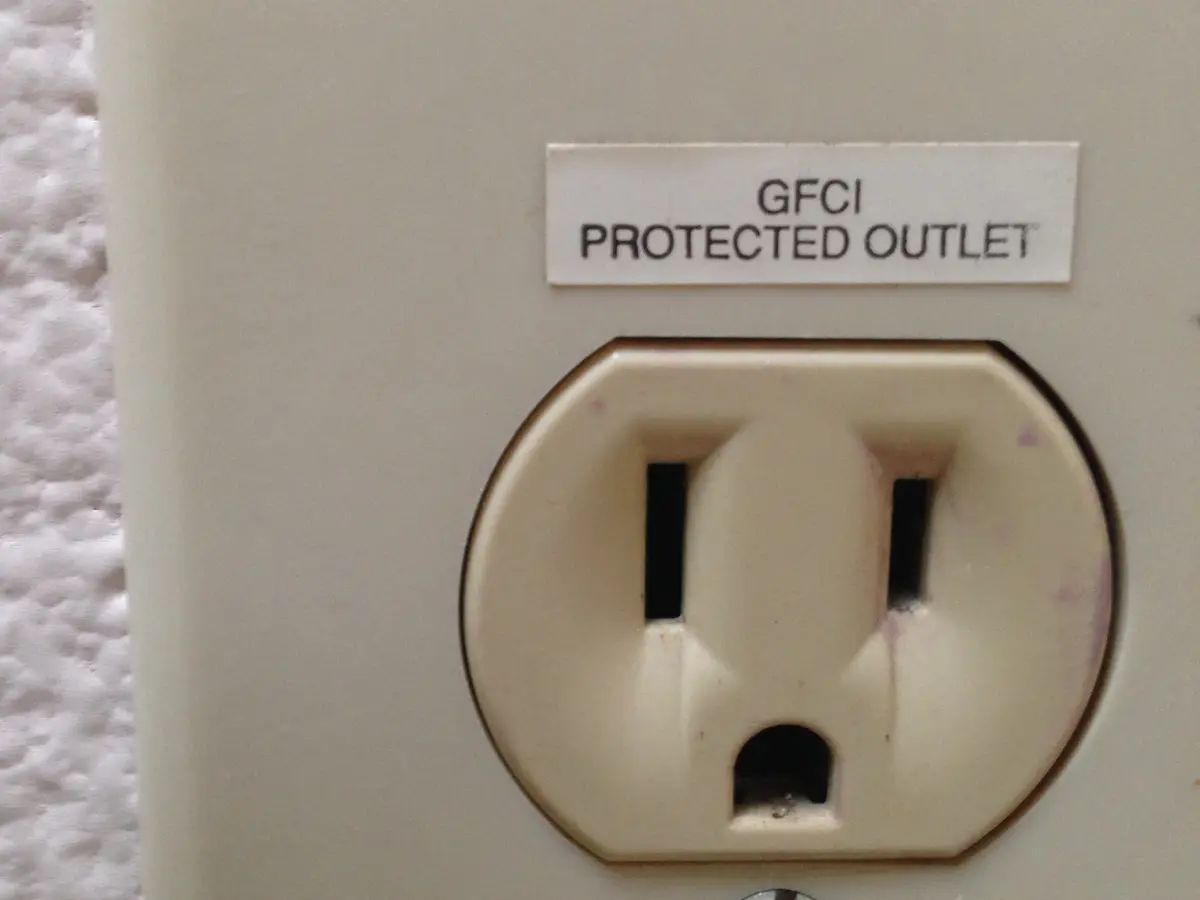
Adding an outdoor outlet is permitted work in New Jersey. Installing five or fewer outlets on circuits that can carry the load is "minor work" under N.J.A.C. 5:23-2.17A. The town gets notice first and the permit application within five business days. MDL's holiday light installation page sets that out with its source. Plug-in strands, timers and inflatables need no permit at all.
06 / On all night?
Can you leave Christmas lights on all night? The fire numbers say put them on a timer.
NFPA's winter holiday page, read November 2, 2026, gives these figures for 2020 to 2024. US fire departments responded to an average of 143 home fires a year that started with Christmas trees. Those fires caused an estimated 7 civilian deaths, 13 civilian injuries and $15 million in property damage a year. Another 835 home structure fires a year began with decorations other than trees. NFPA says "nearly half of home Christmas tree fires are caused by electrical problems." Electrical distribution or lighting equipment was involved in two in five (40 percent) of them. Lamps or bulbs started nearly one in four (24 percent). And 35 percent of Christmas tree fires were in January, when a cut tree has dried out.
- LED lowers the heat but not the connection risk. An LED bulb runs cool. The plug, the socket and the splice do not care which bulb is in the strand. A corroded or loose contact heats under load either way, slowly. That is why unattended hours matter.
- A timer is the whole answer. An outdoor-rated plug-in timer at the outlet, set for dusk to bedtime, removes the question and most of the running cost. Indoors, the tree lights go off when the room empties.
- Water the tree, and take it down. NFPA: as trees dry out they become more and more flammable. The January share of tree fires is the tree that stayed up.
- Inspect before the first night. IAEI's checklist: no broken bulbs exposing filaments, no abrasions or cuts in the cord, listed strands only, used within the listing and the instructions.
07 / LED or incandescent?
How to tell which you own in ten seconds.
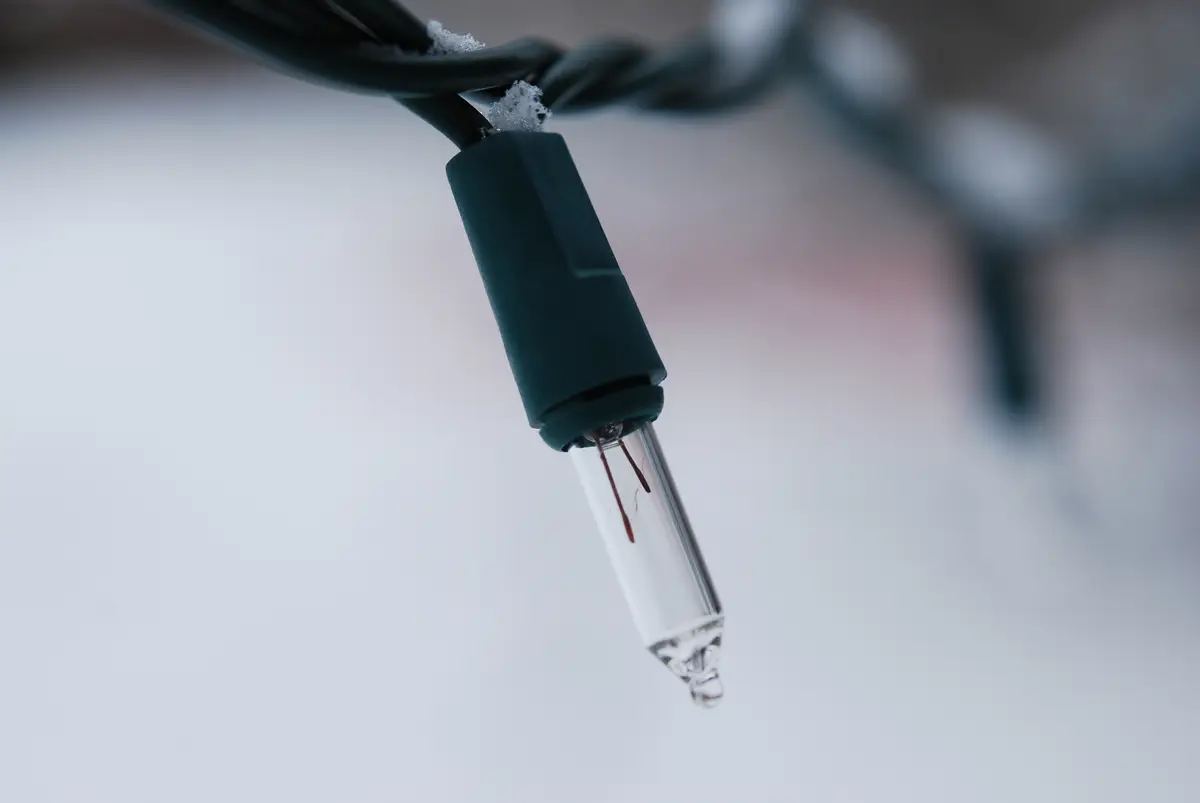
- Look inside an unlit bulb. A fine wire filament in clear glass is incandescent. A solid plastic lens, often faceted, conical or shaped like a strawberry, with no filament, is LED.
- Try to pull a bulb. Incandescent minis and C7/C9 bulbs come out for replacement. Most outdoor-grade LED strands are one-piece, hardwired and sealed; Christmas Lights Etc lists its premium LED sets as non-removable.
- Feel it after five minutes. Warm is incandescent. Cool is LED.
- Read the tag. The plug tag states the watts. A 100-bulb strand around 40 watts is incandescent; a strand under 10 watts is LED. The tag also gives the end-to-end limit: single digits means incandescent, dozens means LED.
- Count the voltage on an incandescent. The spec sheet for the 100-count incandescent mini shows 2.5-volt bulbs. In the maker's words, if one light goes out the rest stay lit. A dead section on an older strand is usually a bulb that has worked loose.
08 / The case for incandescent
Why some people go back to incandescent, and when it is a reasonable choice.
The search results for this question are nostalgia on one side and efficiency lectures on the other. Both are right about something.
An incandescent filament gives a warm, slightly amber light. Christmas Lights Etc describes it plainly: on incandescent, transparent bulbs show the filament, and opaque finishes diffuse it into a soft, even glow. Early LEDs were blue-white; warm-white LEDs at about 2800K now get close, but some people can still tell.
An incandescent strand dims smoothly on an ordinary dimmer. Many LED strands are not dimmable at all, and a half-wave LED set can shimmer. If you dim your tree, incandescent is the simpler buy; a dimmable, full-wave LED set is the alternative.
Christmas Lights Etc's own comparison says incandescent bulbs carry the lowest initial cost per bulb. For a small indoor tree run a few hours a night, the running cost difference is a few dollars and the circuit never notices.
Strand for strand, incandescent runs about 8.5 times the power (40.8 watts against 4.8 watts), and nearly all of it leaves the bulb as heat. That means a 3,000-hour life against tens of thousands, three to five strands per plug, and a roofline that needs several circuits. Outdoors and at scale, that trade turns against it.
MDL's position: incandescent on the tree and the mantel is a taste, not a mistake. Incandescent across the whole front of a house is an electrical project, and the house usually was not wired for it. If you want that look at that scale, the plan is more outdoor outlets on more than one circuit. That is the part MDL does.
09 / Flicker and dimmers
LED Christmas lights that flicker, and LED lights on a dimmer.
- Half-wave flicker. An LED only passes current one way. A cheap strand lights its LEDs on one half of each cycle of household alternating current, so they switch on and off with every cycle. Many people never notice; some see a shimmer, especially in peripheral vision or when they move. A full-wave rectified set lights the LEDs on both halves and looks steady. Christmas Designers' 5mm set lists an inline full-wave rectifier, "double sealed against the elements," and says its purpose is to prevent bulbs from flickering. Christmas Lights Etc's premium sets are marked "Full Wave." Look for those words on the box.
- Dimmer mismatch. A strand that flickers, buzzes or drops out when dimmed is on a dimmer it was not listed for. Christmas Designers marks its 5mm set's "Light Set Action" as dimmable. Christmas Lights Etc says every OptiCore C9 bulb is dimmable. Sets without that line should be run full on. Incandescent strands dim on a standard incandescent dimmer without any of this.
- Mechanical flicker. A strand that flickers when the cord is touched has a loose socket or a damaged conductor. So does a section that comes and goes in the wind. That is not a rectifier problem. It is a connection heating and cooling, and the strand should come down.
- Whole-house flicker. If the house lights dip when the display switches on, the circuit is near its limit or a connection upstream is loose. The breaker guide sorts a one-circuit dip from a whole-house one, which is urgent.
10 / When to call
What the lights cannot fix: four jobs that belong to an electrician.
Outdoor GFCI outlet, dedicated circuit
A new weather-resistant GFCI outlet with an in-use cover, at the corner of the house or under the eave. The display plugs in there without a cord across the walk. A dedicated 20-amp circuit from the panel for a large display, inflatables or an incandescent roofline. The lights stop sharing a breaker with the garage. A timer or smart switch on that circuit. Minor work under New Jersey's code: notice first, permit within five business days. Use the form below; Lighting Installation is already selected.
Outlet tripping, breaker that will not hold
A GFCI that trips in dry weather with nothing plugged in. A breaker that trips the instant it is reset with the lights unplugged. An outdoor box with water inside, a cover that will not close, or an outlet with no ground. A panel with no spare spaces for the circuit the display needs; the panel upgrades page covers that decision. Heat, buzzing or a burning smell at an outlet or the panel goes to the emergency electrician page instead.
MDL Electric Cooling & Heating works from 4 Harrison Avenue in West Orange and serves Essex, Morris, Hudson and Union counties. Would you rather have the lights hung, powered and timed by the crew that adds the outlet? The holiday light installation page explains what that visit includes. A surge on the service side in a winter storm is a separate question. The whole-house surge protector cost guide covers it.
11 / About this guide
Why a West Orange electrical contractor wrote the comparison the retailers do not.
The pages that rank for this search are light retailers and forums. They are right that LED uses far less power. None of them says what that means at the outlet. How many strands does a 15-amp circuit share with the garage freezer? Why does the plug fuse open at the fourth incandescent set? What is the GFCI reacting to in the rain? What does New Jersey's 2023 electrical code require of the outlet the lights plug into? Every number here is a manufacturer, EIA, NFPA, CPSC, IAEI or code figure with its source and date. None of it is an MDL price. Contact MDL or use the request form below.
12 / Direct answers
The questions people type after "LED vs incandescent Christmas lights."
Which is better, LED or incandescent Christmas lights?
For the electrical side of the question, LED. A 100-count incandescent mini strand draws 40.8 watts and a 70-count 5mm LED strand draws 4.8 watts, by the manufacturer's own specifications, and ENERGY STAR puts its LED strings at about 92 percent less energy than incandescent strings. That gap is why LED strands connect 43 to 90 sets end to end while incandescent minis stop at five, and why LED displays rarely trip a breaker. Incandescent still wins on warmth of color, smooth dimming and the lowest price per bulb. If you like the incandescent look, the circuit math on this page tells you how many strands your outlet can take.
Why are people going back to incandescent Christmas lights?
Mostly for the look. An incandescent filament gives a warm, slightly orange light that many people associate with older displays, it dims smoothly on an ordinary dimmer, and it is the cheapest bulb to buy. Early LED strands were a cold blue-white and some half-wave sets flicker, which put people off. Newer warm-white, full-wave LED sets have closed most of that gap, but they cost more per strand. The trade is real: incandescent costs roughly ten times more to run and limits you to a few strands per plug, so a large incandescent display needs more outlets and more circuits than an LED one.
How can I tell if my Christmas tree lights are incandescent or LED?
Look inside an unlit bulb. An incandescent mini has a glass bulb with a thin wire filament you can see, and the bulb pulls out of its socket. An LED bulb is usually a molded plastic lens, often faceted or cone-shaped, with no filament, and on most outdoor-grade sets it is sealed in and cannot be removed. Turn them on: incandescent bulbs are warm to the touch after a few minutes, LEDs stay cool. The tag on the plug end also helps; it states the watts, and a 100-bulb strand rated around 40 watts is incandescent, one rated under 10 watts is LED.
Are incandescent Christmas lights still a thing?
Yes. Retailers still sell incandescent mini strands, C7 and C9 bulbs and the stringers that take them, and they still carry the lowest initial cost per bulb. What has changed is the professional market: installers mostly use commercial LED because it runs cooler, lasts longer and lets them power a whole roofline from one plug.
Do LED Christmas lights last longer?
Yes, by the manufacturers' own ratings. Christmas Lights Etc rates its standard incandescent mini strand at 3,000 average hours and its C9 LED bulbs at 20,000 to 60,000 hours; its premium LED strands are rated at 100,000 hours and Christmas Designers rates its 5mm LED set at 75,000. ENERGY STAR says its LED strings can last up to 10 times longer than incandescent strands. The strand's wire, sockets and plug still age, so inspect LED sets for cracked insulation and corroded sockets each year the same as incandescent ones.
Do incandescent Christmas lights get hot?
Warm to hot, yes. An incandescent bulb makes light by heating a filament, so most of its 0.4 watts per mini bulb, or 7 watts per C9 bulb, leaves as heat. That is why CPSC limits incandescent sets to three joined end to end and why NFPA counts lamps or bulbs as the heat source in 24 percent of home Christmas tree fires. ENERGY STAR describes its LED strings as cool to the touch. If a strand of any type feels hot at the plug or at a connection, unplug it; that is heat at a bad contact, not at a bulb.
Is incandescent better for your eyes than LED?
We did not find a reliable source that settles that for decorative lights, so this page does not claim one is healthier. What is documented is flicker: cheaper half-wave LED strands light the bulbs on only one half of each cycle of household current, which some people notice as a shimmer, and a full-wave rectified set removes it; Christmas Designers lists its full-wave rectifier specifically as preventing flicker. Incandescent filaments do not flicker that way. If a flickering strand bothers you, swap it for a full-wave LED set or an incandescent one.
How many strands of Christmas lights can you connect end to end?
Two limits apply and the lower one wins. The first is the strand's own fused plug: a standard 100-count incandescent mini set is marked for a maximum of five sets connected, CPSC's safety rule is never more than three incandescent sets, and the LED sets on this page are marked for 43 to 90 sets or 216 watts end to end. The second is the circuit: a 15-amp breaker is meant for 12 amps of continuous load, about 1,440 watts, and a 20-amp breaker for 16 amps, about 1,920 watts, shared with everything else on that circuit. Read the tag on each strand, add up the watts, and stay under both numbers.
Why do my Christmas lights keep blowing fuses?
The small fuse inside the plug of the first strand carries the current for every strand plugged in after it. Join more sets than the tag allows, or a few incandescent sets plus a lighted figure, and the plug fuse opens; that is the fuse protecting a 22-gauge wire that was never meant for that load. A fuse that blows again with the correct number of strands points to a short in a damaged socket or a crushed section of wire. Replace the fuse with the spare in the plug, never with foil or a larger fuse, and if it blows again with nothing extra connected, retire the strand.
Can you leave Christmas lights on all night?
The electrical risk is lower with LED, but the advice is the same for both: put the display on a timer and have it off while you sleep. NFPA counts an average of 143 home fires a year that started with Christmas trees in 2020 to 2024, with 7 deaths, 13 injuries and $15 million in damage, plus 835 home fires a year that began with other decorations, and says nearly half of the tree fires were caused by electrical problems. A strand that overheats at a bad connection does it slowly, which is exactly the fault no one notices at 3 a.m. An outdoor-rated timer on the outlet costs little and removes the question.
How much electricity do Christmas lights use?
Read the watts off each strand's tag and multiply by hours. At the manufacturer figures on this page, ten 100-count incandescent mini strands draw 408 watts; ten 70-count 5mm LED strands draw 48 watts; 100 C9 incandescent bulbs at 7 watts each draw 700 watts; 100 C9 LED bulbs at 0.096 watts each draw under 10 watts. Run six hours a night for 40 nights, that is 98 kilowatt-hours for the incandescent minis and about 12 for the LED minis. At New Jersey's average residential rate of 24.61 cents per kilowatt-hour for August 2026 (EIA), the incandescent minis cost about $24 for the season and the LED minis about $3; the C9 incandescent line costs about $41 and the C9 LED line under a dollar.
Why do my LED Christmas lights flicker?
Usually because the strand is half-wave rectified: it lights the LEDs on only one half of each cycle of household alternating current, so they switch on and off with every cycle, and some people see it as shimmer, especially when their eyes move. Full-wave rectified sets light the LEDs on both halves and look steady; the spec sheet or box says which you have. A strand that flickers on a dimmer is a second cause: most LED Christmas sets are not dimmable unless the listing says so. A strand that flickers when a cord is moved has a loose connection and should come down.
Why does my outdoor outlet keep tripping with Christmas lights plugged in?
An outdoor outlet at a New Jersey home is required to be GFCI-protected, and a GFCI trips on current leaking to ground, not on overload. The usual leak is water: rain or snowmelt in a strand's socket, a plug connection lying on wet ground, or an outlet box whose cover does not close over the cord. Lift every connection off the ground, point sockets down, wrap connections or use a cord cover, and give the outlet an in-use cover that stays weatherproof with the plug in, which the code requires. If it trips in dry weather with the lights unplugged, the outlet or its wiring is the fault and that is an electrician's call. If instead the breaker in the panel trips, that is overload; count the watts.
13 / Source record
Sources, all read on November 2, 2026
Every figure, rule and safety statement on this page was read from the source below on November 2, 2026. Amps are our arithmetic on the manufacturer's watts and a 120-volt circuit where the spec sheet does not state them; the 1,440-watt and 1,920-watt circuit figures are 80 percent of 15 and 20 amps at 120 volts as the cited rule explains; season costs are watts times 240 hours times EIA's New Jersey rate. Nothing here is an MDL price.
- Christmas Lights Etc — 100 Clear Mini Christmas Lights, 6-inch spacing, green wire (specifications)40.8 watts, 0.37 amps, 0.408 watts per bulb, 2.5-volt bulbs, 22-gauge wire, fused stackable plug, maximum 5 sets connected, 3,000 average hours, UL Listed, indoor/outdoor, incandescent, removable bulbs.
- Christmas Lights Etc — 5mm Warm White LED Christmas Lights, commercial (specifications)70 bulbs, 4.8 total watts, 0.0686 watts per bulb, 120 volts, 45 max sets or 216 watts end to end, 100,000 hours, full wave, non-removable bulbs, 22-gauge, UL and ENERGY STAR.
- Christmas Lights Etc — C9 Warm White LED Christmas Lights (specifications)25 bulbs, 2.4 total watts, 0.096 watts per bulb, 0.02 amps, 90 max sets or 216 watts end to end, 100,000 hours, full wave.
- Christmas Lights Etc — C7 / C9 Christmas light bulbsC7 incandescent 5 watts (7-watt clear option), C9 incandescent 7 watts (10-watt clear option); LED C7/C9 bulbs rated 20,000 to 60,000 hours and "under a watt, 90% less than the 7-watt C9 incandescent"; incandescent lowest initial cost per bulb; transparent bulbs show the filament; every OptiCore bulb dimmable; commercial incandescent 3,000-hour average life.
- Christmas Lights Etc — C7 / C9 Christmas light stringersPre-sized stringers carry a fused plug capping the load at 960 watts; 18-gauge SPT-1 and SPT-2 wire; sockets with weep holes; 12-inch spacing option.
- Christmas Lights Etc — SJTW 12-foot medium-duty extension cord16-gauge wire, 13-amp capacity, SJTW insulation, indoor/outdoor use.
- Christmas Designers — 70 Light 2800K Warm White 5mm Wide Angle Conical LED Lights (specifications)4.8 watts per set, 0.04 amps, 43 max sets connected, 75,000-hour bulbs, dimmable, 22-gauge, fused stackable plug, full-wave rectifier described as preventing bulbs from flickering.
- Christmas Designers — frequently asked questionsA blown fuse, missing or loose bulbs, socket corrosion and circuit breaker overload as reasons a set stops working; running cost as kilowatt-hours multiplied by the electricity rate; the number of sets you can string depends on the set and is given in the product information.
- ENERGY STAR — decorative light stringsENERGY STAR strings use about 92 percent less energy than incandescent strings, can last up to 10 times longer, and are cool to the touch.
- U.S. Energy Information Administration — Electric Power Monthly, Table 5.6.A, average price of electricity to ultimate customers by stateNew Jersey residential: 24.61 cents per kilowatt-hour, August 2026; 24.70 cents, August 2025.
- Electrical Toolbox — how to size a breaker for a continuous loadNEC 210.20(A): 125 percent of the continuous load, equivalent to an 80 percent limit; continuous means three hours or more; amperes equal watts divided by volts.
- National Fire Protection Association — Winter holiday fire safety2020 to 2024: 143 home Christmas tree fires a year, 7 deaths, 13 injuries, $15 million; 835 decoration fires a year; nearly half of tree fires caused by electrical problems; 40 percent involved electrical distribution or lighting equipment; 24 percent started by lamps or bulbs; 35 percent in January; drying trees become more flammable.
- U.S. Consumer Product Safety Commission — Holiday Safety"Never string together more than three sets of incandescent lights and never overload electrical outlets."
- IAEI Magazine — Electrical safety tips for the holidaysNEC 400.3 cords suited to the location and the "W" wet-location marking; 400.8 no cords through walls, doors or windows or attached to buildings; 590.3(B) holiday lighting up to 90 days; 590.5 listed lighting, UL 588; power strips indoors only, never daisy-chained; inspect bulbs and cords before energizing; USFA's roughly 24,000 residential electrical fires a year.
- North Carolina Office of State Fire Marshal — 406.9(B), in-use type receptacle covers in wet locationsAll 15- and 20-ampere, 125- and 250-volt receptacles installed outdoors in wet locations require an enclosure that is weatherproof whether or not the plug is inserted.
- New Jersey Department of Community Affairs — N.J.A.C. 5:23-3, Uniform Construction Code subcodesSection 3.16(a)1: the Commissioner adopts "The National Electrical Code (NEC) 2023" and Tentative Interim Amendments 70-23-1 through 70-23-13 as the electrical subcode for New Jersey.
- MDL Electric — GFCI outlet installationNEC 210.8(A)(3) outdoor GFCI requirement and the full 210.8(A) location list; its own page, read November 2, 2026.
- MDL Electric — holiday light installationN.J.A.C. 5:23-2.17A minor-work rule for five or fewer outlets, with its DCA source; what MDL's installation visit includes.