
01 / The short answer
A few hundred dollars at the panel, required whenever the service is replaced, and useless against a direct strike.
A whole-house surge protector, which the electrical code calls a surge-protective device or SPD, is a small box wired into your electrical service. It catches voltage spikes on the incoming power before they reach the furnace control board, the air conditioner, the refrigerator, and everything else that is wired in or plugged in. It is not a power strip, and it does not replace the strips behind the TV and the computer. It works alongside them.
Most homeowners asking about cost are in one of two situations. Either an electrician has included one in a panel replacement or service upgrade quote, or they want to add one to a panel that is staying put. In the first case the code already requires it in New Jersey, so the question is only what it adds to the bill. In the second it is a choice, and the numbers below are what to weigh.
The cost pages that rank for this question either give no price at all or give national ranges with no date or source. This guide does the opposite: every figure names where it came from and when it was read, the device prices are today's prices at a New Jersey store, and the code section names the edition New Jersey actually enforces.
HomeAdvisor, updated June 19, 2026, and Angi: an average of $300 for the project.
HomeGuide's range for the common panel-mounted type; its Type 1 range is $250 to $800.
Four in-stock devices at Home Depot's Montville, New Jersey store on October 14, 2026.
A Type 1 or Type 2 device on every new or replaced dwelling service, under the 2023 National Electrical Code.
If your panel or service is being replaced, the device is required, so ask for it to be priced as a line item in that quote. If your panel is staying, a Type 2 device on its own breaker at the panel is the usual add-on: budget from HomeGuide's $200 to $450 range plus your town's electrical permit, and keep plug-in strips for TVs and computers. If the panel has no open space for the device's breaker, that, not the device, decides the price.
02 / How it works
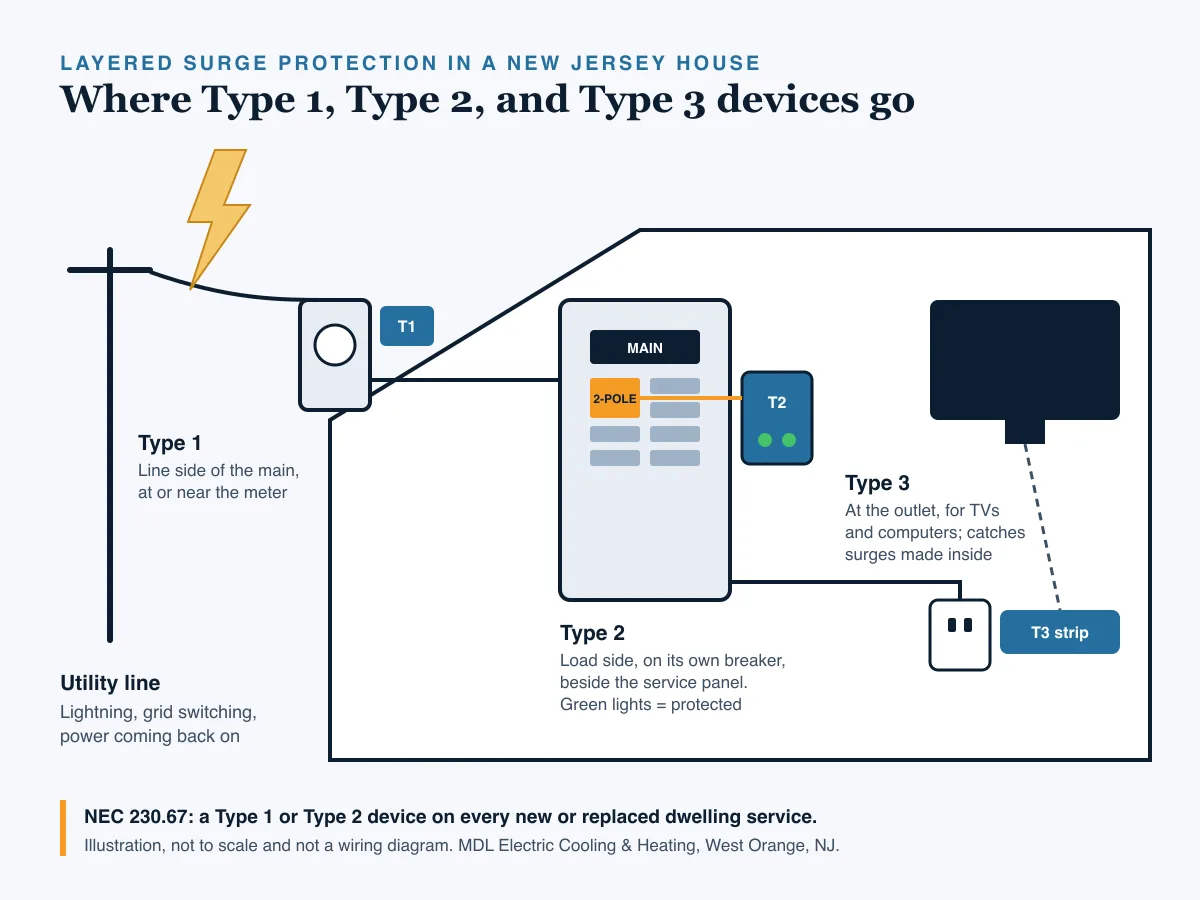
What a whole-house surge protector does, and where Type 1, Type 2, and Type 3 devices go.
A surge is a spike in voltage that lasts a fraction of a second. Some come in from outside, on the utility lines, from nearby lightning, grid switching, or the moment power is restored after an outage. Many more start inside the house. FirstEnergy, the parent company of JCP&L, lists both: surges "can be caused externally by events like storms and accidents, or internally by things like air conditioners, power tools, coffee makers or microwave ovens." Eaton goes further: "80% of surges originate inside a facility." Each one is small, but they add up in electronics and control boards.
A surge-protective device sits in parallel with your wiring and diverts the excess voltage to ground. The code and the UL 1449 safety standard sort these devices by where they connect. In Electrical Contractor magazine's summary of the definitions:
- Type 1 is "a permanently connected SPD intended for installation between the secondary of the service transformer and the line side of the service disconnect overcurrent device." In a house, that means at or near the meter, ahead of the main breaker.
- Type 2 is "a permanently connected SPD intended for installation on the load side of the service disconnect overcurrent device, including SPDs located at the branch panel." In a house, that means on its own breaker in the panel, which is the most common install.
- Type 3 is the point-of-use device: the plug-in surge strip or surge receptacle at the TV, the computer, or the router.
Leviton notes that "Type 1 devices can automatically be used in Type 2 applications," which is why some products are sold as Type 1 or 2. Manufacturers agree that the panel device is the first layer, not the only one. Leviton's code flyer puts it directly: "For complete surge protection, a Type 3 SPD is recommended at point of use to protect against internally created power anomalies." This Old House adds the reason: whole-house units "may allow up to 15% of excess voltage to pass through."
03 / What it costs
What a whole-house surge protector costs: four panel devices at today's prices, and the installed ranges publishers report.
Shoppers can see two sets of figures. Store prices show the device alone. Cost publishers' installed ranges show what jobs elsewhere have cost. Neither one prices your panel. The four devices below were priced online on October 14, 2026, with Home Depot's Montville store selected, and shelf prices move.
Scroll sideways to see the whole table.
| Device | Type and rating | Breaker or mounting | Price | Warranty as listed |
|---|---|---|---|---|
| Square D HEPD80 | Type 1 (Schneider), 80 kA | Maximum 30 A two-pole breaker; NEMA 4X enclosure | $142.00 | 5 years; $75,000 downstream equipment |
| Intermatic IG1240RC3 | Type 1 or 2, 50 kA per phase | Outdoor Type 3R plastic enclosure | $175.70 | 5 years; $10,000 connected equipment |
| Eaton CHSPT2ULTRA | Type 2, 108 kA | Dedicated 50 A breaker (Eaton); NEMA 4 | $195.22 | Limited lifetime; $75,000 connected equipment |
| Siemens BoltShield FSPD140 | Type 2, 140 kA | Replaces the discontinued FirstSurge FS140 | $260.96 | Not captured |
Two familiar models are gone. Siemens' FirstSurge Pro FS140 was discontinued on June 22, 2024, according to SupplyHouse, and Lowe's says it "can be replaced with Siemens new BoltShield FSPD140." Leviton lists its 51110-SRG as discontinued. If an older quote or article names either one, ask what replaces it.
Scroll sideways to see the whole table.
| Source and date | Installed | Device | Labor and other notes |
|---|---|---|---|
| HomeAdvisor, updated June 19, 2026 | $70 to $700; average $300 | Type 1 and 2 units $50 to $250; Type 3 $10 to $25 | Labor can be half the cost, at $50 to $100 an hour; permit $10 to $500; inspection $100 to $400 |
| Angi, 2026 | $70 to $700; average $300 | Type 1 and 2 units $50 to $250 | $100 to $200 for about two hours of electrician time |
| Angi, Boston page, July 21, 2026 | $76 to $758; average $325 | Not split out | Labor $110 to $220; the nearest Northeast city page, as Angi publishes none for New Jersey |
| HomeGuide (byline April 22, 2024) | $200 to $800; Type 2 $200 to $450; Type 1 $250 to $800 | $60 to $500 and up | Labor $140 to $300; electricians $50 to $130 an hour, $100 to $200 service call |
| Today's Homeowner, April 9, 2025 | Device plus $100 to $300 installation | $300 to $600 for a high-quality unit | Installation varies with "your home's setup" |
| This Old House, July 16, 2024 | Device plus about $200 | $100 to $200 | Installation by an electrician |
HomeAdvisor and Angi belong to the same company and publish the same national range, so treat them as one source. The ranges disagree mainly on the device: HomeAdvisor's $50 to $250 matches the Home Depot shelf, while Today's Homeowner's $300 to $600 describes higher-end units than the four above. A quote far outside these ranges is worth a question, and the next section explains the usual reasons.
04 / What moves the price
Why installed prices range so widely: the six things that change what you pay.
The device is the smallest part of most jobs. What the electrician finds at the panel decides the rest.
- An open space for the right breaker. A Type 2 device lands on its own breaker. Schneider's instructions call for a maximum 30 A two-pole breaker for the HEPD80, while Eaton says its CHSPT2ULTRA "requires dedicated 50 A breaker." A panel with two open spaces makes this a short job.
- A full or worn-out panel. With no space, the choices are rearranging circuits, a different device, or panel work. If the panel itself needs replacing, Angi puts a panel upgrade at $500 to $4,000 or more, and the code then requires the surge device anyway.
- Type 1 at the meter instead of Type 2 in the panel. State Farm notes that a whole-house unit "can be installed on the electrical meter by the utility company, or next to the electric service panel by an electrician." Work on the line side of the main usually involves the meter, which means coordinating with PSE&G or JCP&L.
- Adding it to other panel work. If the panel is already open for a EV charger circuit, a generator inlet, or a new circuit, the device adds little labor. Asking for it in the same visit is usually the cheapest time to do it.
- The permit and inspection. HomeAdvisor's national ranges are $10 to $500 for the permit and $100 to $400 for an inspection. In Essex County, West Orange's minimum electrical permit fee is $100 and Montclair's is $85.
- Grounding and bonding problems found on the way. A surge device diverts energy to ground, so it can only work as well as the home's grounding. Corrections are separate work and should be listed separately on the quote.
A useful quote names the device and its type, the breaker size and position, whether panel space has to be made, the permit, and any grounding corrections, each as its own line. That makes it easy to compare against the ranges above and against a second quote.
05 / The New Jersey code
New Jersey's rule: NEC 230.67 requires one on every new or replaced home service, now under the 2023 code.
New Jersey adopts the National Electrical Code as the electrical subcode of its Uniform Construction Code. The current rule text, N.J.A.C. 5:23-3.16, adopts "The National Electrical Code (NEC) 2023," with Tentative Interim Amendments 70-23-1 through 70-23-13, and the Department of Community Affairs adoption notice gives the effective date: August 17, 2026. Before that, New Jersey enforced the 2020 NEC from September 6, 2022. Pages written before August 2026, including some electricians' pages, still say New Jersey is on the 2020 code; that is now out of date.
Section 230.67 is the surge rule. In the 2020 text as reprinted by Leviton with NFPA's permission: "All services supplying dwelling units shall be provided with a surge-protective device (SPD)." The device "shall be an integral part of the service equipment or shall be located immediately adjacent thereto," and "the SPD shall be a Type 1 or Type 2 SPD." The 2023 edition keeps Type 1 or Type 2 and extends the rule to dormitory units, guest rooms of hotels and motels, and sleeping rooms of nursing homes. A search of New Jersey's adoption notice and its current rule text found no state amendment to 230.67, so the national wording applies as written.
What the rule means for a New Jersey house
- New house or new service: the device is required on the service.
- Panel replacement or service upgrade: required too. Section 230.67(D): "Where service equipment is replaced, all of the requirements of this section shall apply." Schneider Electric summarizes it as covering "both new construction and replacement equipment, such as service changes or upgrades."
- Existing service left alone: nothing in the rule makes you add one. It is a choice, and the rest of this guide is about that choice.
- Permits filed during the changeover: New Jersey lets applicants use the previous code for six months after a new edition takes effect, which by our count runs to about February 17, 2027. Both editions require the device, so the changeover does not change the answer.
The practical upshot: if a New Jersey home has had a new service or panel since September 2022, the inspector should have looked for a surge-protective device at the service. If a quote for a panel upgrade leaves it out, ask why.
06 / Permit and installer
The permit, the inspection, and who is allowed to install a surge protector in New Jersey.
The Uniform Construction Code exempts only two short lists of electrical work from a full permit. Ordinary maintenance, under N.J.A.C. 5:23-2.7, covers items like "the replacement of any receptacle, switch, or lighting fixture ... with a like or similar item." Minor work, under N.J.A.C. 5:23-2.17A, covers items like new electrical work for air conditioning, dryers, and ranges, and "the installation of five or fewer outlets," and N.J.A.C. 5:23-2.14 says even minor work "shall require a permit." Neither list names surge-protective devices. The Department of Community Affairs' guidance says "Electrical projects not listed below would require, at a minimum, a minor work permit or full permit." In MDL's reading, adding a panel surge device therefore needs an electrical permit. No state bulletin names surge devices directly, so the town's electrical subcode official has the final word on which kind.
Who may do the work
New Jersey licenses electrical contractors, and the licensing law's homeowner exemption covers only "work performed by a person on a dwelling that is occupied solely as a residence for himself or for a member or members of his immediate family" (N.J.S.A. 45:5A-18). Manalapan Township reads that narrowly: owners of a single-family detached home may do their own electrical work, while owners of condominiums, townhouses, duplexes, or multifamily buildings must hire a New Jersey licensed electrician. Work on anyone else's home requires a licensed electrical contractor.
Even where a homeowner may legally do it, three facts argue for a licensed electrician. The work happens inside the service panel, where the conductors ahead of the main breaker stay energized with the main off. The device has to be wired with short, direct leads to work well, and Schneider's sheet sets the breaker size. And HomeGuide notes that "most surge protector warranties only cover damage to appliances and electronics if a licensed electrician installs the device." That connected-equipment coverage, $75,000 on the Square D and Eaton units above, is part of what you are paying for.
07 / Is it worth it here
Is a whole-house surge protector worth it in New Jersey? The lightning, claim, and outage numbers.
New Jersey is not Florida, but it is not quiet either. Vaisala's 2025 annual lightning report counted 242,298 lightning events in New Jersey, 41st of 51 by count, and named North Plainfield the state's lightning capital at 83 events per square kilometer. In 2024, by NJ101.5's reading of the same report, New Jersey was 32nd by density at 12 events per square kilometer. Vaisala called 2025 an eight-year high for lightning across the United States.
Homeowners claims for lightning, with $1.65 billion paid (Insurance Information Institute, June 2026).
Up 42.8 percent, which Triple-I ties partly to "increasingly sophisticated home electronics and connected devices."
Pennsylvania: 2,177 claims averaging $15,355. New York: 2,004 averaging $22,577. Triple-I publishes no New Jersey figure.
Eaton: "80% of surges originate inside a facility," from motors and appliances switching on and off.
The utilities' own storm advice points the same way. PSE&G tells customers before a storm to "unplug electronics to protect from destructive power surges." FirstEnergy, JCP&L's parent, warns about the moment power comes back: "Turn off or unplug sensitive electrical devices to safeguard them from power surges that may occur during the restoration process." Nobody unplugs a furnace, a central air condenser, or a refrigerator during every storm, and those are the hard-wired loads a panel device covers.
Insurers recommend it too. State Farm's lightning guidance says: "Consider installing a whole-house surge protection system to help absorb larger surges coming from outside the home," and an earlier State Farm piece calls it "the best starting point for reducing the risk of damage or a fire." The case is strongest in homes with central air or a heat pump, a furnace or boiler with an electronic control board, a well or sump pump, new appliances, or a home office. It is weakest in a small apartment with nothing hard-wired but lights.
08 / What it cannot do
What a whole-house surge protector will not do, and the layer it still needs.
Eaton: surge protective devices "do not safeguard equipment against direct lightning strikes."
Electrical Safety Foundation: "No surge protection device can handle a direct lightning strike."
This Old House: whole-house units "may allow up to 15% of excess voltage to pass through."
A device warranty supplements insurance; Eaton says its connected-equipment warranty "supplements your homeowners insurance."
A direct strike on the house or its service drop carries far more energy than any residential device is built to divert. That is the job of a lightning protection system, which is a different product. State Farm says it plainly: "Whole house surge protection will not protect you from a direct strike on your house."
The panel device also leaves some surge through, and it cannot see surges made downstream of it, such as a motor starting on the same circuit as a computer. Keep good Type 3 strips at the TV, the computer, and the router. PSE&G's marketplace sells advanced power strips with surge protection, which are point-of-use devices, not whole-house units. And keep them for electronics only: UL Solutions warns that heating products like toasters, hair dryers, and space heaters "draw a lot more power," and Entergy says power strips "are not designed for large appliances such as refrigerators, dishwashers, clothes dryers and clothes washers."
09 / Choosing a device
Choosing a whole-house surge protector: what the type, kA rating, breaker, and warranty mean.
The specifications on the box are easy to over-read. Here is what each one tells you.
- Type. Type 1 or Type 2 both satisfy NEC 230.67. A Type 1 or Type 1-or-2 device gives the electrician more mounting choices; a Type 2 device is the usual choice for a panel breaker.
- kA rating. The surge current rating, such as 80 kA or 140 kA, is mostly about life span, not about letting less through. Eaton compares it to tire tread: "Increasing the kA rating of the surge suppressor does not significantly increase the protection performance." Schneider adds that "generally, the higher the kA rating, the longer the life span."
- Breaker size. Match the manufacturer: a maximum 30 A two-pole breaker for the Square D HEPD80, a dedicated 50 A breaker for the Eaton CHSPT2ULTRA. The breaker has to fit your panel's brand and have an open space.
- Enclosure. Outdoor-rated enclosures, such as NEMA 4X on the HEPD80, NEMA 4 on the Eaton, and Type 3R on the Intermatic, matter when the device mounts outside beside an outdoor panel or meter.
- Status lights. Check that the device has status lights, and mount it where someone will actually look at them.
- Warranty. Read the connected-equipment terms, not just the headline number: $75,000 for the Square D and Eaton units, $10,000 for the Intermatic. HomeGuide says most of these warranties only pay out when a licensed electrician installed the device.
Brands and models are named so the prices are real and checkable on one day. They are not recommendations of one brand over another, and this page makes no dealer claim for any of them. The right device is the one that fits your panel and its breaker.
10 / Lifespan and replacement
How long a whole-house surge protector lasts, and how to tell when it needs replacing.
Manufacturers do not give a fixed number of years for home units, because every surge the device absorbs wears it a little. Schneider Electric's answer is "it depends," on "a variety of factors from environment to product protection (kA) ratings, and even installation practices." Eaton's buying guide says the same in fewer words: "Surge protectors wear out overtime as they absorb electrical surges."
The status lights are the test. Schneider: "If the light is off or flickering, your surge protection may no longer be reliable." Siemens described a three-stage warning on its FirstSurge units, an audible beep, status lights going out, and a flashing red service light, and told owners to turn off the device's dedicated breaker and contact an electrician to arrange a replacement unit. Because the device is wired on its own breaker beside your circuits, not in line with them, the house keeps power when it wears out. That is exactly why nobody notices unless they look.
Two simple habits cover it. Look at the lights after any nearby lightning or a long outage, and add the device to whatever you check twice a year, like the smoke alarm batteries. If a light is out, do what Siemens told its owners: switch off the device's breaker and have an electrician replace the unit.
11 / Outages and generators
Outages, restoration surges, generators, and EV chargers: when to plan surge protection with other panel work.
The surge that worries New Jersey utilities most is not always the storm itself. It is the moment the lines are re-energized. FirstEnergy tells JCP&L-area customers to "unplug appliances like refrigerators and freezers, and sensitive electronic equipment like TVs and computers, so that they won't overload when power is restored." A panel device is the version of that advice that works when nobody is home.
If you are planning other panel work, plan the surge device with it. A portable generator inlet with an interlock or transfer switch, a home standby generator, or an EV charger all put an electrician in the panel with a permit already being pulled. Asking for the surge device in the same scope avoids paying for a second visit and a second inspection, as long as the panel has room for both.
FirstEnergy also sells a surge repair plan, starting at $5.49 a month for up to $2,000 a year in protection. Its page does not say whether JCP&L customers can buy it, so ask FirstEnergy before counting on it. It is a repair plan, not a device, and it does nothing to stop the surge.
Check your insurance wording
Lightning damage is a common homeowners claim, but surge wording varies. State Farm says "some policies provide specific details for damage caused by power surges induced by lightning strikes." Read your own policy's language on power surges and electrical damage, or ask your agent, before relying on it. The device warranty and the policy are separate, and neither replaces the other.
12 / Which setup fits
Which surge protection fits your New Jersey home: pick by the panel and what is plugged in.
Scroll sideways to see the whole table.
| If your home has | Start with | Reason |
|---|---|---|
| Panel replacement or service upgrade planned | Type 1 or Type 2 device, priced as a line item | NEC 230.67(D) requires it when service equipment is replaced. |
| Panel staying, two open spaces, central air or a furnace control board | Type 2 device on its own breaker, plus Type 3 strips | The shortest install, covering hard-wired equipment the strips cannot. |
| Generator inlet, standby generator, or EV charger planned | Add the device to that scope | One panel visit and one permit process instead of two. |
| Panel full, damaged, or obsolete | Panel evaluation first | No breaker space or a failing panel decides the job, not the device. |
| Condo, townhouse, or rental | Type 3 strips now; ask the association or landlord about the service | Only a licensed electrician may work on those services, and the panel may not be yours. |
| Status light already out on an existing device | Replacement unit | A worn device gives no protection while the house keeps power, so it fails silently. |
In every case, start with the panel's label: its brand and main breaker rating, whether there are open breaker spaces, and any other panel work you are planning. MDL's panel upgrade page explains how MDL scopes panel and service work in West Orange and across Essex County. A burning smell, heat, or sparking at the panel goes to the emergency electrician line, not a quote request.
13 / Who wrote it
Who is behind this guide, and why there is no MDL price in it.
This guide comes from MDL Electric Cooling & Heating at 4 Harrison Avenue, West Orange, a licensed New Jersey electrical contractor (#34EI01606200) with electrical business permit #34EB01606200 and master HVACR license #19HC00308200. Any homeowner can look those numbers up in the Division of Consumer Affairs license verification system. The products named are there for their published prices and specifications only; MDL makes no dealer or certification claim for any brand, and nobody paid to be included. A real price depends on your panel, so MDL writes up the device, the breaker, and any panel work after a look at it. Reach MDL here, or use the form at the bottom of this page.
14 / Direct answers
Whole-house surge protector questions New Jersey homeowners ask.
How much does a whole-house surge protector cost installed in New Jersey?
No cost publisher has a New Jersey page, so the published figures are national and regional. HomeAdvisor, updated June 19, 2026, and Angi both put installation at $70 to $700, with an average of $300. Angi's nearest Northeast city page, Boston, averages $325. HomeGuide gives $200 to $450 for a Type 2 unit installed and $250 to $800 for a Type 1. On October 14, 2026, four panel devices cost $142.00 to $260.96 at Home Depot's Montville store, before labor and the town's electrical permit.
Do you need an electrician to install a whole-house surge protector?
In New Jersey, anyone installing one in someone else's home must be a licensed electrical contractor. The licensing law exempts only work on a dwelling occupied solely as a residence for yourself or your immediate family, and Manalapan Township reads that as single-family detached homes only. Either way, the device goes inside the service panel, it needs an electrical permit and inspection, and HomeGuide notes that most connected-equipment warranties only pay out if a licensed electrician installed the device.
Is a whole-house surge protector required by code in New Jersey?
Yes, for new and replaced services. New Jersey has enforced the 2023 National Electrical Code since August 17, 2026, and section 230.67 says all services supplying dwelling units shall be provided with a surge-protective device, Type 1 or Type 2. Where service equipment is replaced, the requirement applies too. The 2020 code that New Jersey enforced from September 2022 had the same rule. It does not require you to add one to an existing service that is not being changed.
Do I need a permit to install a surge protector in my panel in New Jersey?
In MDL's reading of the state rules, yes. New Jersey's construction code requires a permit for electrical work unless it is on the ordinary maintenance list or the minor work list, and neither list names surge-protective devices. The state's 2018 guidance says electrical projects not listed require at least a minor work permit or a full permit. Your town's electrical subcode official makes the final call. Minimum electrical permit fees are $100 in West Orange and $85 in Montclair.
What size breaker does a Square D HEPD80 need?
Schneider Electric's instruction sheet recommends installing the HEPD80 on a maximum 30 A breaker, two-pole for a 120/240-volt home, and its drawing shows a 20 or 30 A double-pole breaker. Schneider's FAQ suggests a 30 A two-pole breaker and says the device comes with about 20 to 24 inches of 12 AWG wire. Other brands differ: Eaton says its CHSPT2ULTRA needs a dedicated 50 A breaker, so the panel must have space for the right one.
How long do whole-house surge protectors usually last?
There is no fixed number of years. Schneider Electric says it depends on the environment, the kA rating, and installation practices, and that generally the higher the kA rating, the longer the life span. Eaton compares the kA rating to tire tread: it relates to life expectancy, not to better protection. Each surge wears the device a little. Check the status lights after storms and replace the unit when Schneider's rule applies: if the light is off or flickering, protection may no longer be reliable.
What should never be plugged into a surge protector strip?
Heating and large appliances. UL Solutions names toasters, hair dryers, crockpots, electric skillets, and especially space heaters, because they draw a lot more power. Entergy adds refrigerators, dishwashers, clothes dryers, and washers, and says never to plug one power strip into another. Those large appliances are what a whole-house device at the panel is for, while plug-in Type 3 strips are for TVs, computers, and other electronics.
Is a whole-house surge protector worth it?
For most New Jersey homes with central air, a furnace or boiler control board, a well or sump pump, and modern appliances, the published numbers favor it. A device costs $142.00 to $260.96 at Home Depot today, while the Insurance Information Institute puts the average 2025 lightning homeowners claim at $26,616. Eaton says 80 percent of surges start inside the building, and FirstEnergy warns of surges when power is restored after an outage. It does not stop a direct lightning strike.
Will a whole-house surge protector protect my house from a lightning strike?
No. Eaton says surge protective devices do not safeguard equipment against direct lightning strikes, the Electrical Safety Foundation says no surge protection device can handle a direct lightning strike, and State Farm says whole-house protection will not protect you from a direct strike on your house. It is built for the far more common surges that arrive on the utility lines from nearby lightning and grid switching, and for wear from surges made inside the home.
What is the difference between a Type 1 and a Type 2 surge protector?
Location. A Type 1 device is permanently connected between the utility transformer and the line side of the main breaker, so it can sit at or near the meter. A Type 2 device connects on the load side of the main breaker, usually on its own breaker in the panel. Leviton says Type 1 devices can also be used in Type 2 applications. Either type satisfies NEC 230.67. Type 3 is the plug-in strip at the outlet.
Will my house lose power if the surge protector wears out?
No. A panel surge protector is connected on its own breaker beside your circuits, not in line with them, so the lights stay on when it wears out. What changes is the indicator. Siemens' instructions for its FirstSurge units describe a beep, status lights going out, and a flashing red service light, and they tell the owner to turn off the device's dedicated breaker and contact an electrician to replace the unit.
15 / Source record
Sources, all retrieved October 14, 2026
Prices and rules change, so each item below was read on October 14, 2026, the day this guide was published. NFPA's own text of the code requires a login, so the 230.67 wording comes from Leviton's reprint made with NFPA's permission. The permit conclusion is our reading of the state's exemption lists, the February 2027 date is our count of the state's six-month window, and the parallel-wiring explanation of why the house keeps power is our summary of how these devices connect. No source paid to be cited, and no figure here is an MDL price.
- HomeAdvisor — whole-house surge protector cost$70 to $700, average $300; device, labor, permit, and inspection ranges; updated June 19, 2026.
- Angi — whole-house surge protector installation cost2026 national average $300; two-hour labor estimate; panel upgrade range.
- Angi — Boston cost pageAverage $325, range $76 to $758, labor $110 to $220; published July 21, 2026.
- HomeGuide — whole-house surge protector costInstalled ranges by type, labor, and the licensed-installer warranty note.
- Today's Homeowner — pros and cons of whole-house surge protectors$300 to $600 device and $100 to $300 installation; last updated April 9, 2025.
- This Old House — how effective are surge protectors$100 to $200 device plus about $200 installation; up to 15 percent let-through.
- Home Depot — Square D HEPD80$142.00, Montville store; warranty terms.
- Schneider Electric — HEPD80 product page80 kA, SPD Type 1.
- Schneider Electric — HEPD instruction sheetMaximum 30 A breaker; 20 or 30 A double-pole drawing.
- Schneider Electric — HEPD breaker FAQ30 A two-pole suggestion and 12 AWG leads.
- Home Depot — Eaton CHSPT2ULTRA$195.22, Montville store.
- Eaton — CHSPT2ULTRA product pageSPD Type 2, 108 kA, NEMA 4, warranty.
- Eaton — residential surge protectionDedicated 50 A breaker requirement.
- Home Depot — Intermatic IG1240RC3$175.70, Montville store.
- Intermatic — IG1240RC3 product page50 kA per phase, Type 3R enclosure, warranty.
- Home Depot — Siemens BoltShield FSPD140$260.96, Montville store; 140 kA Type 2.
- Lowe's — Siemens FS140 listingFS140 phased out, replaced by the FSPD140.
- Home Depot — Siemens FirstSurge Pro FS140Discontinued model; the three-stage wear-out warning and replacement instructions.
- Leviton — 51110-SRGDiscontinued.
- N.J.A.C. 5:23-3 — subcodes, including 5:23-3.16 electricalAdoption of the 2023 NEC with TIAs 70-23-1 through 70-23-13.
- NJ DCA — model codes adoption notice, 58 N.J.R. 8(2)Adopted July 15, 2026; effective August 17, 2026.
- NJ DCA — current construction codesNEC 2023 listed with its August 17, 2026 adoption date.
- NJ DCA — previous codes and the six-month windowPermit applications may use the prior code for six months.
- Leviton — NEC 2020 230.67 reprintThe dwelling-unit rule, location, Type 1 or 2, and replacement wording.
- Leviton — NEC code requirements for surgeThe 2023 edition's added occupancies.
- Leviton — NEC 230.67 surge protection flyerType 3 at point of use recommended.
- Schneider Electric — 2023 NEC surge protection changesNew construction and replacement equipment.
- Electrical Contractor magazine — residential SPD concernsType 1 and Type 2 definitions.
- Eaton — surge protection FAQ80 percent of surges inside; kA and life expectancy.
- Eaton — what is a surge protectorNo protection from direct strikes; warranty supplements insurance.
- Eaton — surge protector buying guideDevices wear out as they absorb surges.
- Schneider Electric — how long should a surge protector lastLife span factors and the indicator light rule.
- Electrical Safety Foundation — surge and protectNo device handles a direct strike.
- Vaisala Xweather — 2025 annual lightning reportNew Jersey's 242,298 events and North Plainfield's 83 per square kilometer.
- Vaisala — 2025 report press releaseUS lightning at an eight-year high.
- NJ101.5 — New Jersey's 2024 lightning ranking32nd by density at 12 events per square kilometer.
- Insurance Information Institute — lightning facts and statistics2025 claims, payouts, average claim, and top states.
- PSE&G — before a stormUnplug electronics to protect from power surges.
- PSE&G Marketplace — advanced power stripsPoint-of-use surge strips.
- FirstEnergy — power outage do's and don'tsSurges during the restoration process.
- FirstEnergy — storm informationUnplug appliances before power is restored.
- FirstEnergy — electrical problemsExternal and internal causes of surges.
- FirstEnergy — surge assistance planFrom $5.49 a month for up to $2,000 a year.
- State Farm — lightning protection for your homeWhole-house protection advice, meter or panel mounting, and surge policy wording.
- State Farm — lightning awareness and safety tipsBest starting point; no protection from a direct strike.
- N.J.A.C. 5:23-2 — construction code permits and exemptionsSection 2.14 permit rule, 2.7 ordinary maintenance, and 2.17A minor work.
- NJ DCA — Construction Code Communicator, Spring 2018Unlisted electrical projects need at least a minor work permit.
- Township of West Orange — construction fee scheduleElectrical minimum fee of $100.
- Township of Montclair — Chapter 121 feesElectrical minimum fee of $85.
- N.J.S.A. 45:5A-18 — licensing exemptionsWho may do electrical work at home.
- NJ Board of Examiners of Electrical Contractors — FAQWhen a license is required.
- Manalapan Township — electrical permitsSingle-family detached homeowners only.
- UL Solutions — guide to power strips and surge protectorsHeating appliances on strips.
- Entergy — things you should not plug into a power stripLarge appliances and strip-into-strip.