
Essex County
- Belleville
- Bloomfield
- Caldwell
- Cedar Grove
- Essex Fells
- Fairfield
- Glen Ridge
- Livingston
- Maplewood
- Millburn and Short Hills
- Montclair
- North Caldwell
- Nutley
- Orange
- Roseland
- South Orange
- Verona
- West Caldwell
- West Orange
- Essex County hub
Emergency lights and exit signs · Businesses and buildings
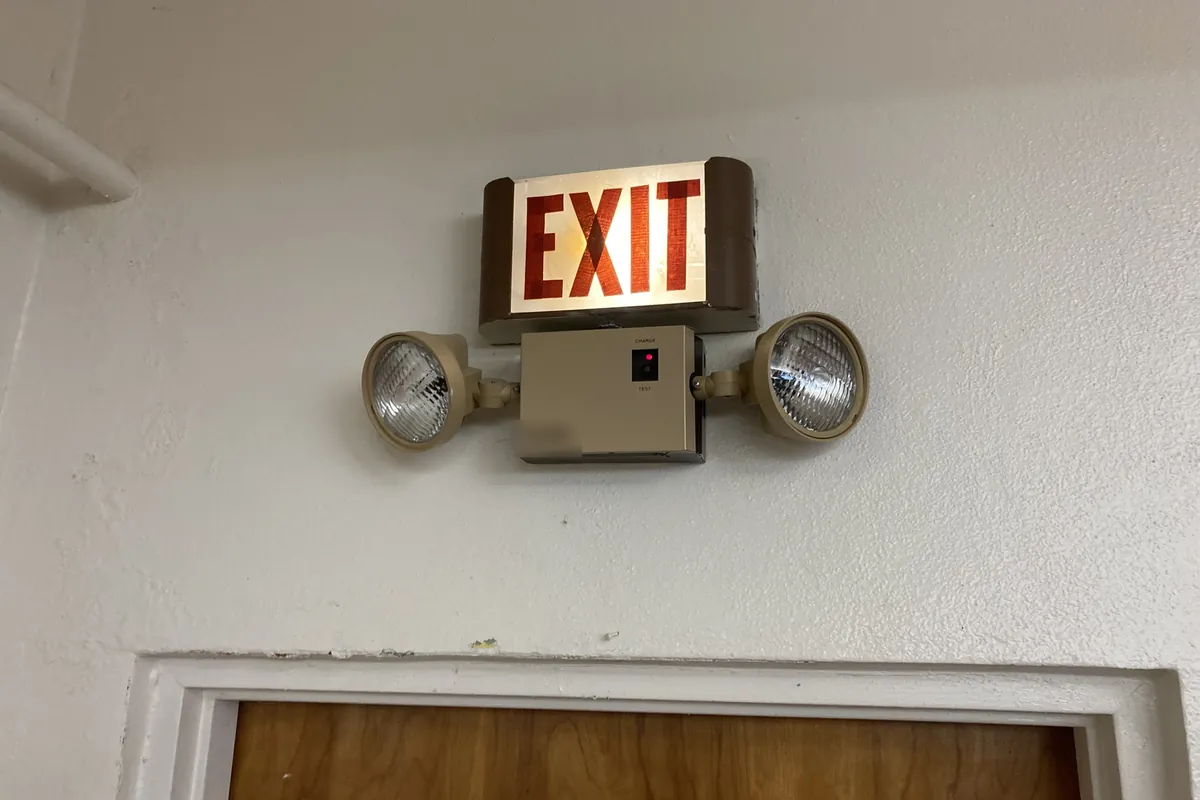
Emergency lights and exit signs for offices, stores, restaurants, warehouses, schools, houses of worship and apartment buildings. MDL Electric Cooling & Heating is a licensed New Jersey electrical contractor in West Orange. It installs, tests, repairs and replaces them, and wires the circuits behind them, across Essex and Morris County.
The short answer
What MDL does. MDL Electric Cooling & Heating installs, tests, repairs and replaces emergency lights and exit signs, and wires the circuits and backup power behind them. MDL confirms the scope after reviewing the building, or the inspection notice.
What New Jersey requires. The fire code calls for a 30-second test every month and a 60- or 90-minute battery test every year. Each test is written down (the rules). A failed unit is to be repaired at once.
Why it matters. The U.S. Fire Administration estimates 110,000 nonresidential building fires in 2023, with 130 deaths and 1,200 injuries (USFA). Emergency lighting lights the way out when a fire or an outage cuts the power.
Licensed electrical work. MDL Electric Cooling & Heating holds New Jersey electrical contractor license 34EI01606200 and master HVACR contractor license 19HC00308200. It works from 4 Harrison Avenue in West Orange. Call 973.809.2339 or use the request form.
What New Jersey requires
The fire official enforces the Uniform Fire Code, N.J.A.C. 5:70. Its State Fire Prevention Code is the 2018 International Fire Code, as amended for New Jersey (N.J.A.C. 5:70-3.1). New work follows the building subcode, the 2024 International Building Code (N.J.A.C. 5:23-3.14). Read November 15, 2026.
Scroll sideways to see the whole table.
| Topic | What the rule says | Section |
|---|---|---|
| Exit signs | Exits are marked with approved exit signs where the construction code in effect at first occupancy, or N.J.A.C. 5:70-4, requires them. Signs stay visible, and illuminated signs stay lit whenever the building is occupied. | 1013.1 |
| Nothing in the way | Decorations, furnishings and equipment that impair the visibility of egress signs are not permitted. | 1013.4 |
| Kept working | Emergency lighting fixtures are kept secure, unobstructed, operable and properly aimed. Where they are not, they are to be repaired immediately. | 1031.10 |
| Monthly test | At least 30 seconds every month, done by hand or by an automatic self-test. With self-testing units, a visual check every month for trouble lights or damage. | 1031.10.1 |
| Annual test | Battery-powered units run on battery once a year, as their original approval requires, for not less than 60 or 90 minutes. | 1031.10.2 |
| Records | Each record shows the location tested, whether the unit passed or failed, the date and the person who did the test. | 1031.10.3 |
| Older buildings | Where the retrofit rules apply and more than one exit is required, egress lighting runs on an emergency system for at least one hour. Exit signs are lit by at least five footcandles and stay lit for an hour after a power loss. | 5:70-4.11(j), (k) |
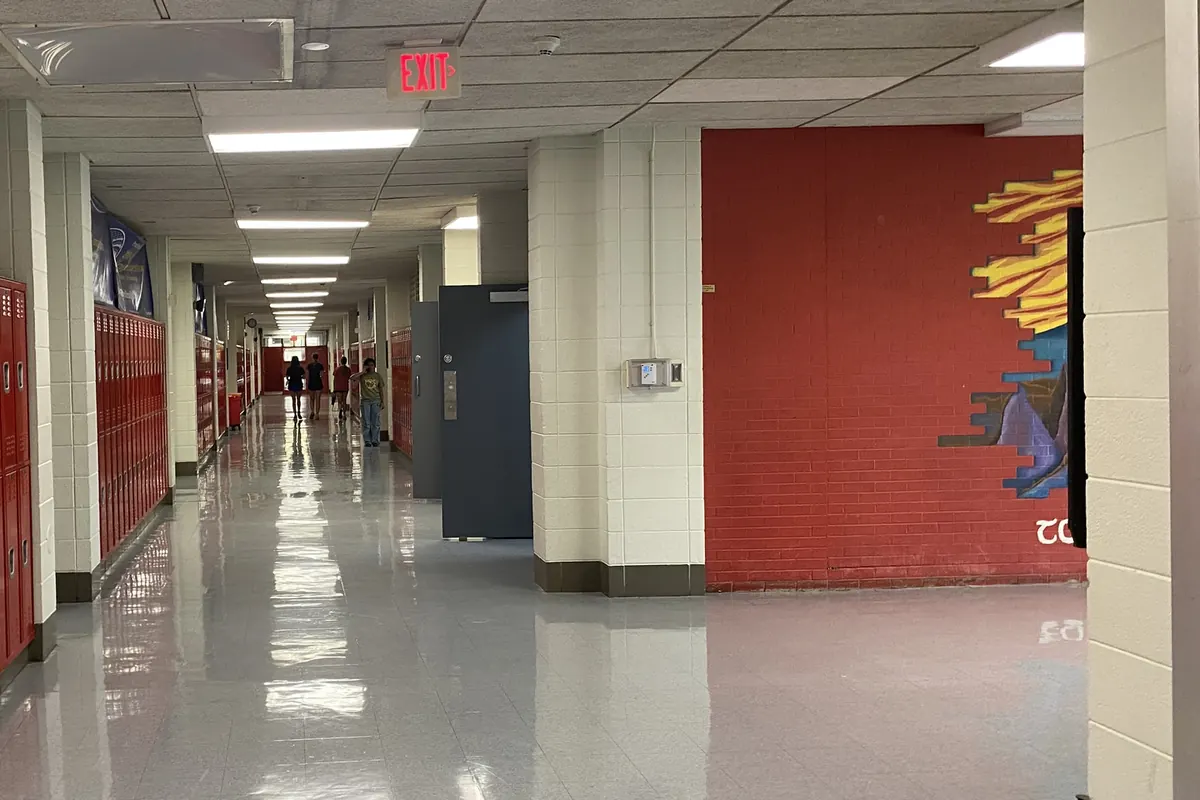
New Jersey building subcode, 2024 IBC, Chapter 10 as published by UpCodes, read November 15, 2026.
Monthly and annual tests
NFPA 101, the Life Safety Code, sets the same rhythm: 30 seconds a month, 90 minutes a year, written records (NFPA Journal, July 2020; Consulting-Specifying Engineer, citing 7.9.3).
Scroll sideways to see the whole table.
| What the test shows | What it usually means | Usual fix |
|---|---|---|
| Passes in 30 seconds, dies before the annual test ends | A battery that no longer holds its charge | A new battery, or a new unit if the charger or housing has also failed |
| Charge light off | No normal power at the unit, or a failed charger | Check the circuit, then the charger |
| One lamp head dark | A failed lamp or LED head, or a loose connection | Replace the head or the lamp, then aim it |
| Exit sign letters dim or partly lit | A failed LED board or battery; on a tritium sign, damage or the end of its working life (NRC) | Repair or replace the sign; tritium signs follow the disposal rules below |
| Unit hanging loose or aimed at a wall | Damage, or a move during other work | Secure and aim it, as the fire code requires |
Exit sign types
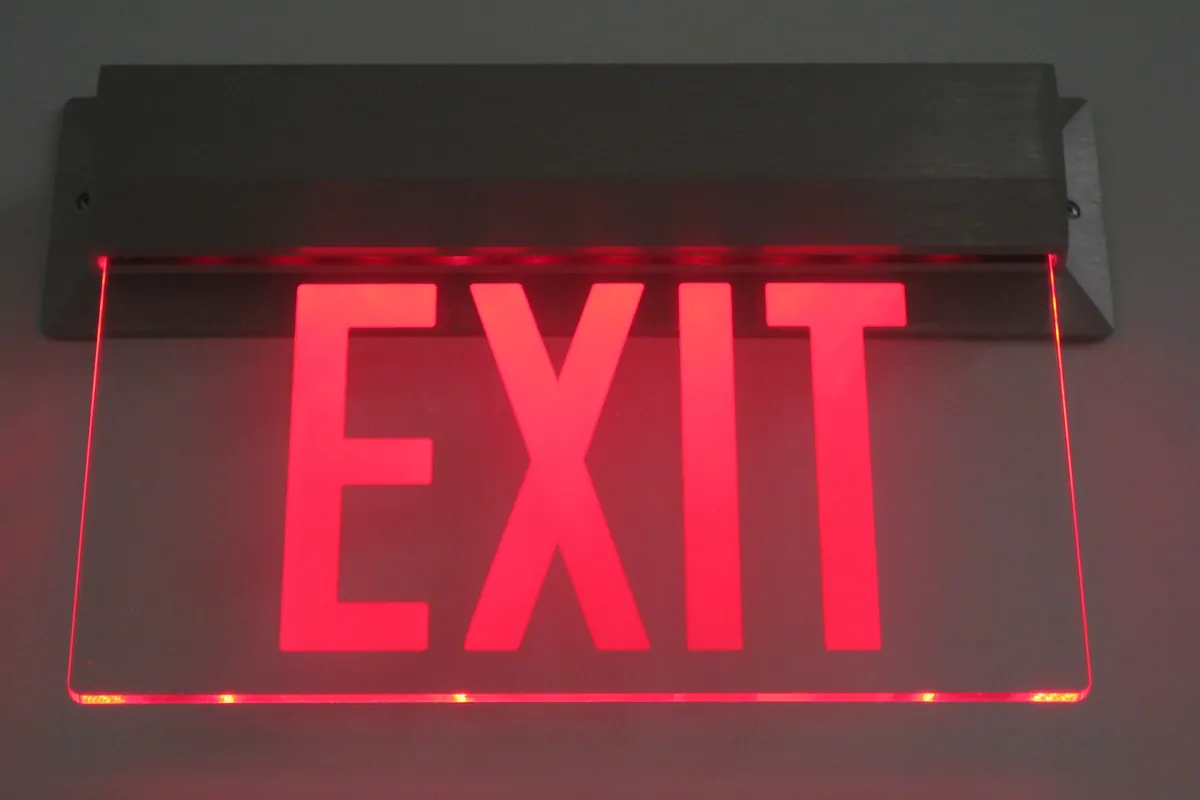
The building subcode requires electrically powered, self-luminous and photoluminescent exit signs to be listed and labeled to UL 924. They are installed per the maker's instructions and lit at all times (1013.5).
The electrical side
An emergency light has to notice a power loss in its own area, not just in the whole building. That is why its circuit matters as much as its battery.
Scroll sideways to see the whole table.
| Option | Strengths | Drawbacks |
|---|---|---|
| Battery units ("bug-eye" lights) | Instant on, wired to the local lighting circuit, easy to see and test | Many batteries to maintain; appearance |
| Fixtures with a built-in battery | Instant on, match the other fixtures, simple wiring | Easy to miss in manual testing; emergency output is below full output |
| Remote lamp heads | Instant on, fewer batteries, neater look | Larger batteries; wiring distance and circuiting need care |
| Central inverter | Instant on, ordinary fixtures, less equipment to maintain | Needs relays that force fixtures on; one system carries many lights |
| Generator | Ordinary fixtures, often already on site | Up to 10 seconds to come on, its own transfer switch, more maintenance |
After a failed fire inspection
From N.J.A.C. 5:70-2.10 and 5:70-2.12, read November 15, 2026. The fire official's notice governs the building's dates.
MDL repairs and tests the listed units. The fire official decides whether the violation is cleared.
What to send
Photos and a plain description are enough to start. Do not open units or electrical panels to collect them.
Address and ZIP code, what it is used for, and how many floors.
A photo of the fire inspection notice, if there is one.
How many emergency lights and exit signs, and on which floors.
Which units failed which test, and a photo of one unit's label.
The last monthly and annual test records, if the building keeps them.
The hours the building can be worked, and who approves the work.
Where MDL works
MDL works from 4 Harrison Avenue in West Orange, across the Essex County towns below and Morris County towns near the Essex line. Include the exact address and ZIP code so coverage can be confirmed for the building.
Emergency lighting and exit signs
Call or send the form with the address, the number of units and signs, and the inspection notice if there is one. The form opens with Commercial Electrical chosen; pick Business / Commercial or Rental / Managed Property as the property type. Other lighting in the building has its own page: commercial lighting installation.
Emergency lighting questions
Rules come from the New Jersey fire code and building subcode, NFPA, the NRC and EPA texts named on this page. MDL publishes no commercial prices, and this page lists none.
New Jersey's fire code calls for a test of at least 30 seconds every month, done by hand or by a self-testing unit. Once a year, battery-powered units run on battery for 60 or 90 minutes, as the unit's original approval requires. Self-testing units still need a monthly visual check, and the records must show the location, pass or fail, the date and who tested.
In an existing building, the fire official enforces the Uniform Fire Code, N.J.A.C. 5:70. Its State Fire Prevention Code is the 2018 International Fire Code with New Jersey changes. New work is built to the Uniform Construction Code, whose building subcode is the 2024 International Building Code. Some older buildings also fall under the state's retrofit rules, N.J.A.C. 5:70-4.
For new work, the building subcode requires an emergency electrical system to light aisles, corridors and exit access stairways in rooms that need two or more exits. It also covers exit stairways and passageways in buildings that need two or more exits, and electrical, fire pump and generator rooms and public restrooms over 300 square feet. In an existing building, the code in effect at first occupancy, or N.J.A.C. 5:70-4, sets the requirement.
The 2024 building subcode requires at least 90 minutes. Lighting starts at an average of 1 footcandle, with at least 0.1 at any point along the egress path, and may fall to 0.6 and 0.06 by the end. New Jersey's retrofit rules for older buildings use one hour. The fire code's annual test allows 60 or 90 minutes, according to the unit's original approval.
The notice of violation sets the time. For a violation of the State Fire Prevention Code, the fire official must allow at least 15 days, or not less than three days for a dangerous condition. For the retrofit rules, it is at least 30 days. An extension must be requested in writing, and asking for one counts as admitting the violation existed (N.J.A.C. 5:70-2.10).
Often, when the unit is otherwise sound and the battery is what failed the annual test. A unit with a failed charger, a cracked housing or lamp heads that will not hold their aim may be better replaced. MDL decides after testing the unit. Replacing a fixture that contains an emergency battery pack is not on New Jersey's no-permit maintenance list, so the permit question is checked first.
Do not put it in the trash. The NRC says a tritium exit sign must be transferred to a specific licensee. That can be the manufacturer, a distributor, a licensed radioactive waste broker or a licensed disposal facility. The owner then reports the disposal within 30 days to the NRC or, in an Agreement State, the state. If a tritium sign is broken, EPA says to leave the area and call for help.
Yes, when they are listed and labeled to UL 924 and installed per the manufacturer's instructions. The building subcode sets that rule for electrically powered, self-luminous and photoluminescent signs alike. A photoluminescent sign needs a light source that keeps it charged, as the manufacturer's instructions require.
Battery units are the simplest: each light carries its own battery and comes on at once. A central inverter powers ordinary fixtures from one battery system, but needs relays that force those fixtures on. A generator serving emergency lighting must meet the National Electrical Code's emergency system rules, including power within 10 seconds. MDL reviews the building before recommending one.
MDL does not publish commercial prices, and this page lists none. The cost depends on how many units and signs fail, and whether batteries or whole units are replaced. Ceiling heights, circuits, any permit and the work hours matter too. MDL reviews the building, or the inspection notice, before it prices the job.
Sources
All read November 15, 2026.
Next steps
Failed fixtures and ballasts, fluorescent-to-LED conversions and lighting controls for the rest of the building.
Learn moreStandby power for the building, including generators that serve emergency lighting.
Learn moreTroubleshooting, circuits, panels and the New Jersey permit rules for the rest of the building.
Learn moreElectrical and HVAC requests for the same building in one place.
Learn moreRequest service
Use the form for planned service or call for urgent electrical, heating, or cooling help.


