
01 / The short answer
The national guides disagree because they price different jobs.
Search for 240-volt outlet cost and the numbers run from Angi's $175 to a $7,000 quote posted on Reddit. The low end and the high end describe different work. Here is what each published range covers.
- A 240-volt outlet, $175 to $300. Angi gives a $220 national average, updated October 29, 2026. It says labor is most of the cost, at $50 to $150 an hour.
- New York City, $197 to $338. Angi's New York page gives a $248 average, updated July 9, 2026. It lists labor at $120 to $200 an hour.
- A new circuit from the panel, $250 to $800. HomeGuide gives a $450 average, with $100 at the floor and $1,500 at the top. It says a garage or dryer outlet needs new wire to a dedicated circuit.
- A dedicated 30- to 50-amp circuit, $570 to $1,000. Angi gives a $700 average, updated October 30, 2026. Its New York figure is $890 to $1,090.
A new dryer, range or EV outlet usually needs its own breaker, new cable from the panel and an inspection. That is the job the two higher ranges price. The forum quotes in the thousands that rank for this search, such as $3,000 and $3,300 on the Chevy Bolt EV Forum, came with subpanels, long runs or trenches. Section 06 prices those paths.
Angi, October 29, 2026. $220 national average. The 50-amp outlet itself is $9 and a 120/240-volt breaker about $45.
HomeGuide. A new run costs $7 to $10 a foot for wire and labor. Its average panel-to-dryer run is 30 to 40 feet.
Angi, October 30, 2026. The national range is $570 to $1,000. Philadelphia is $720 to $880.
A GFCI breaker is $20 to $150 for the part (HomeGuide). West Orange's permit line starts at $100.
Budget a new 240-volt outlet as a dedicated circuit, not as a receptacle swap. Check two things first: a free double space in the panel, and room in the service for the new load. If both are there, the job is the circuit, the GFCI protection and the permit. If not, the panel work is the real price, and it should be quoted as its own line.
02 / Which outlet you need
The appliance decides the outlet, the amps and the breaker.
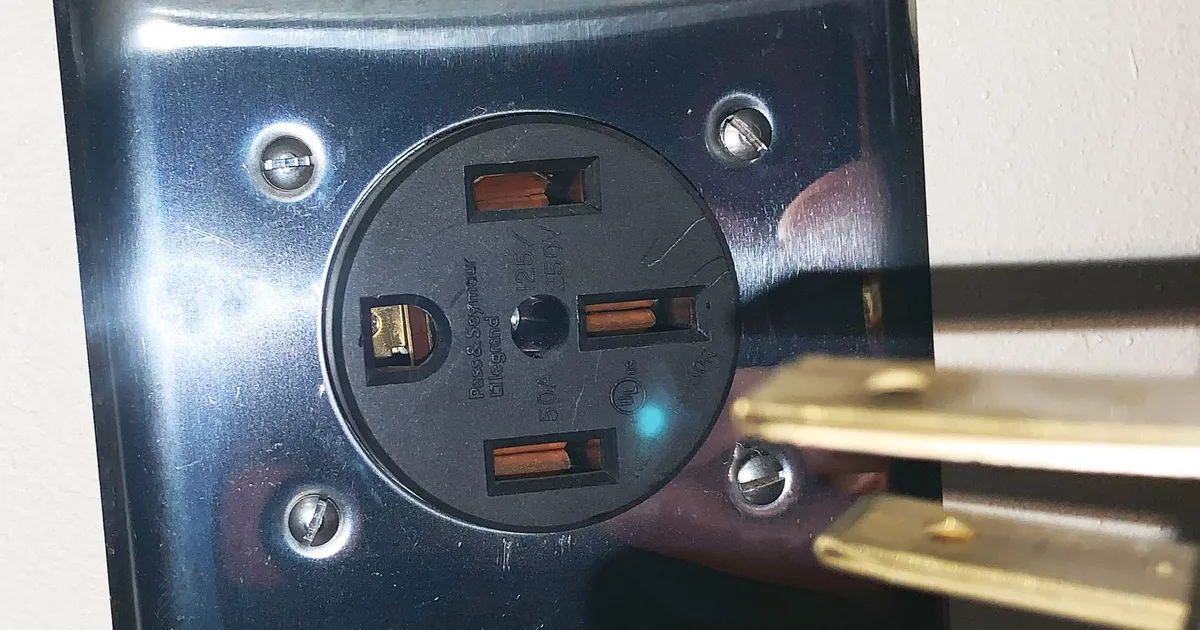
A 240-volt outlet is not one product. Each appliance uses a set shape and amperage. HomeGuide says dryers typically need a 30-amp outlet and most EV charging stations a 50-amp outlet. The manufacturers' own listings give the rest.
| Outlet | Rating | Typical use | Source |
|---|---|---|---|
| NEMA 14-30, four slots | 30 A, 125/250 V, 4-wire with ground | Electric clothes dryer | Eaton range and dryer spec sheet |
| NEMA 14-50, four slots | 50 A, 125/250 V, 4-wire with ground | Electric range; many plug-in EV chargers | Eaton spec sheet; Leviton 1450R, sold as an EV charging outlet |
| NEMA 10-30, three slots | 30 A, 125/250 V, 3-wire, no ground | Older dryer hookups | Leviton 5207-S10, listed as non-grounding |
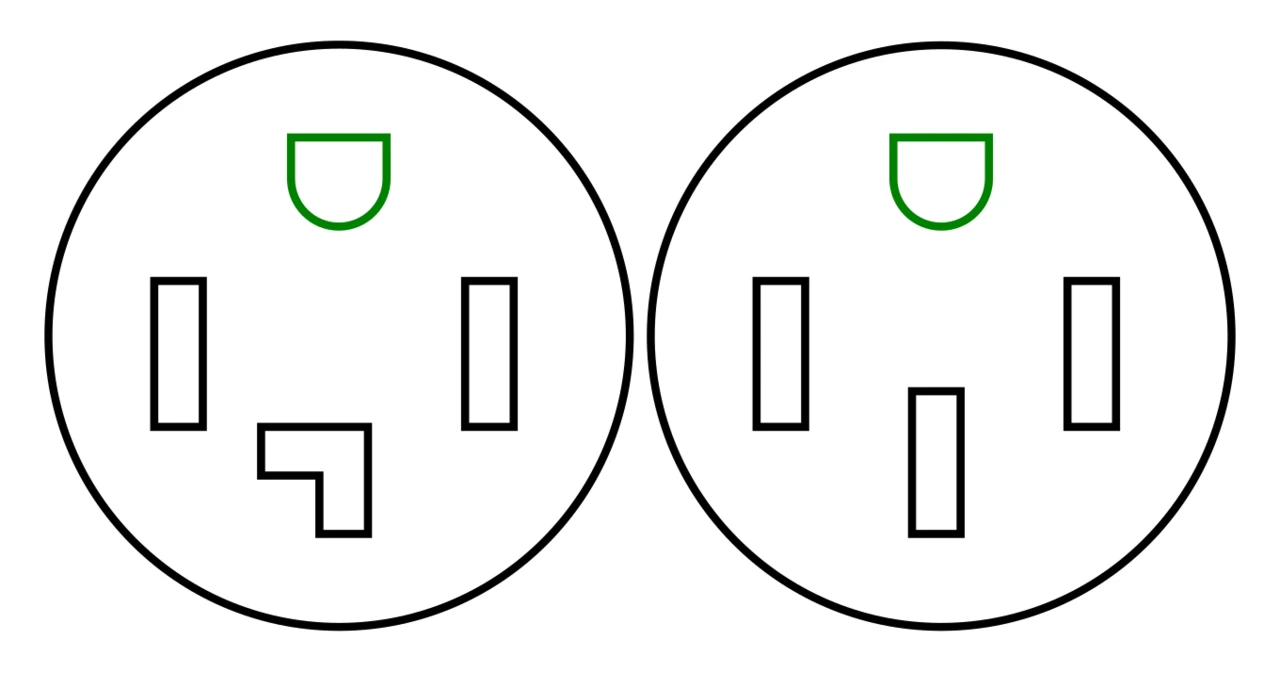
HomeGuide puts the outlet itself at $8 to $30. It says three-slot outlets serve large appliances made before 1996 and four-slot outlets those made in 1996 or later. A replacement cord to match costs $15 to $30.
Older houses matter here. The Census Bureau's 2020 to 2024 survey puts the median Essex County home at 1958 and Union County at 1956. Morris County's median is 1971, and the US median is 1980. Half the homes in Essex and Union counties predate HomeGuide's 1996 four-slot line by decades. An older three-slot dryer outlet is worth checking for before a new dryer arrives.
- A new dryer with a four-prong cord and an old three-slot outlet. Either the outlet is updated or the cord is changed. Ask which, and why.
- An induction range replacing gas. There is no outlet yet. This is a new 50-amp circuit from the panel.
- An EV that will plug in, not hardwire. A 50-amp outlet is one route. MDL's EV charger installation page covers wall-mounted chargers, Tesla breaker settings and New Jersey incentives.
- A shop tool, welder or garage heater. Match the outlet to the nameplate. Hardwired heaters, hot tubs and saunas use their own circuits, not an outlet.
03 / What moves the price
Six things decide where your job lands in the range.
- Distance from the panel. HomeGuide prices a new run at $7 to $10 a foot. A 35-foot dryer run is $245 to $350 for the run alone.
- The path. HomeGuide says new wire is easiest in an unfinished basement or attic. Angi lists opening walls and running wire at $600 to $6,000 as an add-on.
- The breaker. A 120/240-volt breaker is about $45 (Angi). HomeGuide puts a standard 30- or 50-amp breaker at $5 to $40, and AFCI or GFCI breakers at $20 to $150.
- Panel space and capacity. A full panel adds a subpanel or a service upgrade. HomeGuide lists a subpanel at $500 to $1,700.
- Labor rates. Angi gives $50 to $150 an hour nationally and $120 to $200 in New York City. Malfettone Electric publishes $50 to $150 for a licensed New Jersey electrician.
- The permit and inspection. Angi lists an inspection at $100 to $400. The state and West Orange fee lines are in section 05.
The forum threads that rank for this search show the spread. On the Chevy Bolt EV Forum in May 2022, one owner paid $650 for a 60-amp circuit about 50 feet. Another paid about $3,000 for an 80-foot run to a detached garage with a subpanel. A third paid $3,300 for a 120-foot trench and a subpanel. Those are 2022 prices from other states. The pattern still holds: distance, digging and panel work set the price.
04 / The GFCI rule in New Jersey
New Jersey's 2023 code calls for GFCI protection on most new 240-volt outlets.
New Jersey adopts the 2023 National Electrical Code as its electrical subcode (N.J.A.C. 5:23-3.16, state file current through August 17, 2026). The state's amendments do not change section 210.8, so its GFCI rules apply as written.
- Location, 210.8(A). It covers 125-volt through 250-volt receptacles in listed parts of a home. These include garages, basements, outdoors, kitchens, laundry areas and within 6 feet of a sink (Mike Holt; Electrical License Renewal).
- Dryers, 210.8(A). Electrical License Renewal notes that "most 240V residential clothes dryer receptacles will require GFCI protection." Dryers usually sit in laundry areas, basements or garages.
- Appliances, 210.8(D). The 2023 list adds electric ranges, wall-mounted ovens, cooking units, clothes dryers and microwaves (Eaton). The rule applies whether the appliance plugs in or is hardwired.
- EV outlets. GFCI protection for receptacles used for EV charging dates from a 2017 code amendment, EC&M reported in April 2026.
In practice the breaker line changes. HomeGuide prices a standard 30- or 50-amp breaker at $5 to $40 and AFCI or GFCI breakers at $20 to $150. Eaton notes the 2023 rule allows the protection at the breaker or at the outlet, so ask which one the quote includes.
05 / Permits and fees
A new 240-volt outlet needs a permit in New Jersey, and the work may start on notice.
New Jersey makes it unlawful to install regulated equipment "without first filing an application" and "obtaining the required permit" (N.J.A.C. 5:23-2.14(a)). A new 240-volt outlet is regulated electrical work. The rules below come from the state's administrative code, N.J.A.C. 5:23-2.
- Minor work, 2.17A. New electrical work for dryers, ranges or ovens in one- and two-family homes counts as minor work. So does adding five or fewer outlets, where the existing circuits and service can carry the load.
- Notice first, permit after. Minor work still needs a permit, but it "may proceed, upon notice to the enforcing agency" (2.14(b)2). The permit application follows within five business days (2.17A(b)2).
- Licensed work. Electrical work is done by licensed contractors, "except in the case of a single-family homeowner on his or her own dwelling" (2.15).
- Like-for-like swaps. Replacing a receptacle with a like or similar one is ordinary maintenance, with no permit (2.7(c)3.i). Where GFCI protection is required, the replacement must comply.
Fees are local. Each town sets its code-office fees by ordinance (N.J.A.C. 5:23-4.17(a)). Where the state Department of Community Affairs runs the code office, its own schedule applies (N.J.A.C. 5:23-4.20(c)2iii). It charges $50 for the first 1 to 50 receptacles, fixtures or devices. It adds $15.00 for each receptacle rated 30 to 50 amps, and $15.00 for household electric cooking equipment up to 16 kW. West Orange, in Essex County, publishes its own lines.
| Fee line | West Orange |
|---|---|
| Rough and final wiring, first 1 to 25 switches, receptacles, outlets and fixtures | $100 |
| Each additional 25 or fraction | $50 |
| Electric dryer, in a dwelling | $25 each |
| Electric range or electric oven, in a dwelling | $25 each |
| Minimum electrical fee | $100 |
In West Orange, whether the dryer or range line is added to the wiring line is the code office's call, so budget $100 to $125. In any other Essex County town, ask the construction office for its electrical fee lines before work starts.
06 / When the panel is full
The quotes that reach thousands are usually panel quotes.
A 240-volt circuit needs a two-pole breaker, which takes two spaces in the panel. It also adds load to the service. When either is short, the outlet job grows into panel work. MDL's panel upgrade page puts it this way: "Add a circuit only after capacity and route are confirmed." It names an EV charger, range, dryer, water heater, hot tub and workshop among the loads that "can require a dedicated circuit."
- It fits. Free spaces and room in the service. The job stays inside the ranges in section 01.
- Spaces, but no room in the service. A load calculation decides. Load management can sometimes avoid an upgrade.
- Room in the service, but no spaces. A subpanel adds them. HomeGuide lists $500 to $1,700. Malfettone Electric publishes $1,500 to $3,500 in New Jersey, and $1,200 to $2,500 for a detached garage or workshop subpanel in Essex County.
- Neither. A service upgrade. Malfettone publishes $3,500 to $4,800 for 200 amps in Essex County, permit and inspection included.
For each panel path priced line by line, see the electrical panel replacement cost guide. Large hardwired loads have their own pages: hot tub wiring, sauna circuits and the heated driveway cost guide. For a 120-volt outlet that needs GFCI protection, see GFCI outlet installation.
07 / Run-length calculator
Put your own run into the published numbers.
240-volt outlet run-length calculator
Enter the distance from the panel to the outlet and choose the appliance. The calculator adds HomeGuide's published unit prices, the breaker the code calls for, and one Essex County permit schedule, West Orange's. It is arithmetic on figures in this guide. It is not a quote and not an MDL price.
Published-figure range$473 to $855
- New run, 35 ft at $7 to $10 a foot (HomeGuide): $245 to $350
- Outlet (HomeGuide): $8 to $30
- GFCI breaker, part only (HomeGuide): $20 to $150
- Service call fee (HomeGuide): $100 to $200
- West Orange permit lines: $100 to $125
Defaults: 35 feet sits inside HomeGuide's 30-to-40-foot average dryer run. HomeGuide says the service call fee may be applied to the first hour of labor. Not counted: opening and patching finished walls, which Angi lists at $600 to $6,000, and any panel work.
Ask about a new 240-volt circuit08 / How the job goes
From the first call to the inspection.
- Read the nameplate. The appliance's volts, amps and plug type set the outlet and breaker.
- Check the panel. Two free spaces, the main breaker rating and the other large loads.
- Plan the route. Panel to outlet, through open framing where possible.
- Notice and permit. Notice to the town before work, then the permit application (N.J.A.C. 5:23-2.17A).
- Install. Breaker, cable, box and outlet, with GFCI protection where section 04 calls for it.
- Test and label. Angi's steps end with labeling the new circuit and outlet, so there is a record of the voltage and where it is drawn from.
- Inspection. The town's electrical inspector checks the work.
09 / What the proposal should show
Ask for these lines in writing before work starts.
- The outlet type and amperage, matched to the appliance.
- The breaker size, and whether GFCI protection is at the breaker or the outlet.
- The cable route and length, and any wall openings and patching.
- Whether the panel has spaces, and the load check on the service.
- Any subpanel or service work, each priced as its own line.
- The permit, the notice and the inspection, with who files each.
Lines 4 and 5 are the work MDL's panel upgrade page describes. MDL Electric in West Orange wires dedicated circuits across Essex, Morris and Union County.
New 240-volt circuit
Find out whether your panel can take the new circuit before you buy the appliance.
Send MDL the address, the appliance and its amps, the main breaker rating, and a photo of the panel door's open spaces. The request form is on MDL's panel upgrade page, which starts with capacity and route.
10 / Questions answered
240-volt outlet questions from Essex County and New Jersey homeowners.
How much does it cost to install a 240-volt outlet in Essex County, NJ?
The published ranges are national: $175 to $300 for the outlet job (Angi, October 29, 2026) and $250 to $800 with a new circuit (HomeGuide). A dedicated 30- to 50-amp circuit is $570 to $1,000 nationally and $890 to $1,090 in New York (Angi, October 30, 2026). In New Jersey, add GFCI protection for most dryer, range and EV outlets and a town permit. West Orange's permit starts at $100.
How much would an electrician charge to install a 220V outlet?
The same as a 240-volt outlet. HomeGuide says 220-volt, 240-volt and 250-volt outlets "are considered identical," and that 220 volts was the standard until the 1960s. Use the ranges above.
Is it hard to add a 240-volt outlet to a house?
It is a new circuit, not an outlet swap. Angi's steps start with planning the load, then a breaker and new wiring from the panel. The hard part is the route and the panel. A short run through an open basement ceiling is simple. A long run through finished walls, or a full panel, is not.
Can a regular outlet be converted to 240 volts?
Not by changing the outlet. HomeGuide says conversion needs new heavier-gauge wire to the panel and a dedicated breaker. It prices conversion at $250 to $800, the same as a new 240-volt outlet.
How much does it cost to add a 240-volt outlet in a garage?
Angi puts a garage dedicated circuit at $250 to $900, with a $650 average, and says 15 to 20 amps usually covers tools. A 30- or 50-amp outlet for a car or a large tool is a larger circuit. Under New Jersey's 2023 code, a garage receptacle up to 250 volts needs GFCI protection (210.8(A)).
Do I need a permit to install a 240-volt outlet in NJ?
Yes. New electrical work for dryers, ranges and ovens, and five or fewer new outlets, is minor work under N.J.A.C. 5:23-2.17A. It needs a permit, but work may start on notice to the town (5:23-2.14(b)2). Replacing an outlet with a like one is ordinary maintenance with no permit (5:23-2.7). Each town sets its own fee (5:23-4.17); the state's schedule charges $15.00 for each 30- to 50-amp outlet (5:23-4.20).
Do you need an electrician to install a 240-volt outlet?
In New Jersey, electrical work is for licensed contractors, except a single-family homeowner on his or her own home (N.J.A.C. 5:23-2.15). Angi says hiring a licensed electrical contractor is the only safe approach for 240-volt work.
Does a new dryer or range outlet need GFCI protection?
Under the 2023 code New Jersey enforces, usually yes. Section 210.8(D) lists electric ranges and clothes dryers (Eaton). Section 210.8(A) covers 250-volt receptacles in laundry areas, basements, garages and kitchens. HomeGuide prices AFCI or GFCI breakers at $20 to $150 for the part.
Why do some quotes run into the thousands?
Usually panel or service work, a long run, or digging. HomeGuide lists a subpanel at $500 to $1,700. Malfettone Electric publishes $3,500 to $4,800 for a 200-amp upgrade in Essex County. Ask for the outlet, the circuit and the panel work as separate lines.
11 / About this guide
Who wrote it, and what it is not.
MDL Electric Cooling & Heating wrote this guide. MDL is a licensed electrical contractor at 4 Harrison Ave, West Orange (NJ Electrical Contractor #34EI01606200), working across Essex, Morris and Union County. The guide covers the cost of a new 240-volt outlet: the circuit, the outlet, the breaker, the permit and any panel work. No figure here is an MDL price. Every figure was read from the sources below on November 16, 2026. The calculator totals and worked examples are our arithmetic on those figures.
12 / Source record
Sources, read November 16, 2026
Prices and codes change. Where sources disagree, both are shown. Nothing here is an MDL price. No company named here was asked or paid to appear, and their prices are quoted as market evidence only.
- Angi — How much does it cost to install a 240V outlet?Allie Ogletree, updated October 29, 2026: $175 to $300, $220 average; labor most of the cost at $50 to $150 an hour; 120/240V breaker about $45; 50-amp outlet $9; installation steps ending with labeling the circuit.
- Angi — 240V outlet cost in New York CityMike Miller, updated July 9, 2026: $197 to $338, $248 average; labor $120 to $200 an hour.
- HomeGuide — Cost to install a 220V or 240V outletKristen Cramer, page titled 2026 update (byline April 5, 2023): $250 to $800, $450 average; $7 to $10 a foot; 30 to 40 ft dryer run; outlet $8 to $30; breaker $5 to $40; service call $100 to $200; subpanel $500 to $1,700; 3-slot and 4-slot outlets; conversion $250 to $800.
- HomeGuide — Cost to replace or install a circuit breaker (2026)AFCI and GFCI protected circuit breakers $20 to $150; 2-pole standard breakers, 15 to 40 amps, $10 to $50.
- Angi — Cost to install a dedicated circuitBarbara Bellesi Zito, updated October 30, 2026: $570 to $1,000, $700 average; materials $100 to $150; labor $550 to $970; New York $890 to $1,090; Philadelphia $720 to $880; inspection $100 to $400; garage circuit $250 to $900; walls and wire $600 to $6,000.
- Malfettone Electric — panel upgrade, Essex CountyLast updated September 2026: 200 A upgrade $3,500 to $4,800 with permit and inspection; detached garage or workshop subpanel $1,200 to $2,500.
- Malfettone Electric — panel upgrade cost in NJ, 2026 guideApril 10, 2026, updated May 2026: subpanel $1,500 to $3,500; licensed NJ electrician $50 to $150 an hour.
- Eaton — Range and dryer power devices, NEMA 14-30 and 14-50 (PDF)NEMA 14-30 dryer devices, 30 A; NEMA 14-50 range devices, 50 A; 125/250 V, 4-wire grounding.
- Leviton — 1450R, 50 A EV charging receptacle50 A, 125/250 V, NEMA 14-50R, 4-wire.
- Leviton — 5207-S10, 30 A receptacle30 A, 125/250 V, NEMA 10-30R, 3-wire, non-grounding.
- N.J.A.C. 5:23-3 — Subcodes (PDF)5:23-3.16 adopts the National Electrical Code 2023 and Tentative Interim Amendments 70-23-1 through 70-23-13; file current through August 17, 2026 (last amended by R.2026 d.086); no amendment to section 210.8.
- N.J.A.C. 5:23-2 — Administration and enforcement (PDF)2.7(c)3.i like-for-like receptacle replacement; 2.14(a) and (b)2 permits and minor work; 2.15 licensed work and the single-family homeowner exception; 2.17A minor work for dryers, ranges, ovens and five or fewer outlets.
- N.J.A.C. 5:23-4 — Enforcing agencies and fees (PDF)File current through August 17, 2026: 4.17(a) each town sets enforcing-agency fees by ordinance; 4.20(c)2iii state schedule, $50 for the first 1 to 50 receptacles, fixtures or devices, $15.00 per receptacle rated 30 to 50 amps and per household electric cooking unit up to 16 kW.
- Township of West Orange — construction fee scheduleOrdinance 2802-23: wiring $100 for 1 to 25, $50 each additional 25; electric dryer, range and oven $25 each; minimum electrical fee $100.
- Electrical License Renewal — 210.8(A) GFCI protection, dwelling unitsThe 125-volt through 250-volt wording and its effect on dryer and range receptacles.
- Mike Holt — GFCI and AFCI, based on the 2023 NECDecember 18, 2023: the dwelling locations in 210.8(A).
- Eaton — GFCI 210.8(D) protection for specific appliancesThe 2023 list, including electric ranges, wall-mounted ovens, counter-mounted cooking units, clothes dryers and microwave ovens; protection at the branch circuit or the outlet.
- EC&M — TIA proposed for 2026 NEC regarding GFCI protection for personnelMichael Morris, April 7, 2026: GFCI protection for EV-charging receptacles was added through a 2017 code amendment.
- U.S. Census Bureau via Census Reporter — American Community Survey 2020 to 2024, table B25035Median year built: Essex County 1958, Union County 1956, Morris County 1971, New Jersey 1970, United States 1980.
- Chevy Bolt EV Forum — 240 line installation standard costMay 9 to 12, 2022: owner-reported jobs from $650 for a 50-foot run to $3,300 with a trench and subpanel.