
01 / The short answer
The panel is the cheapest part. The service it hangs on is what New Jersey prices.
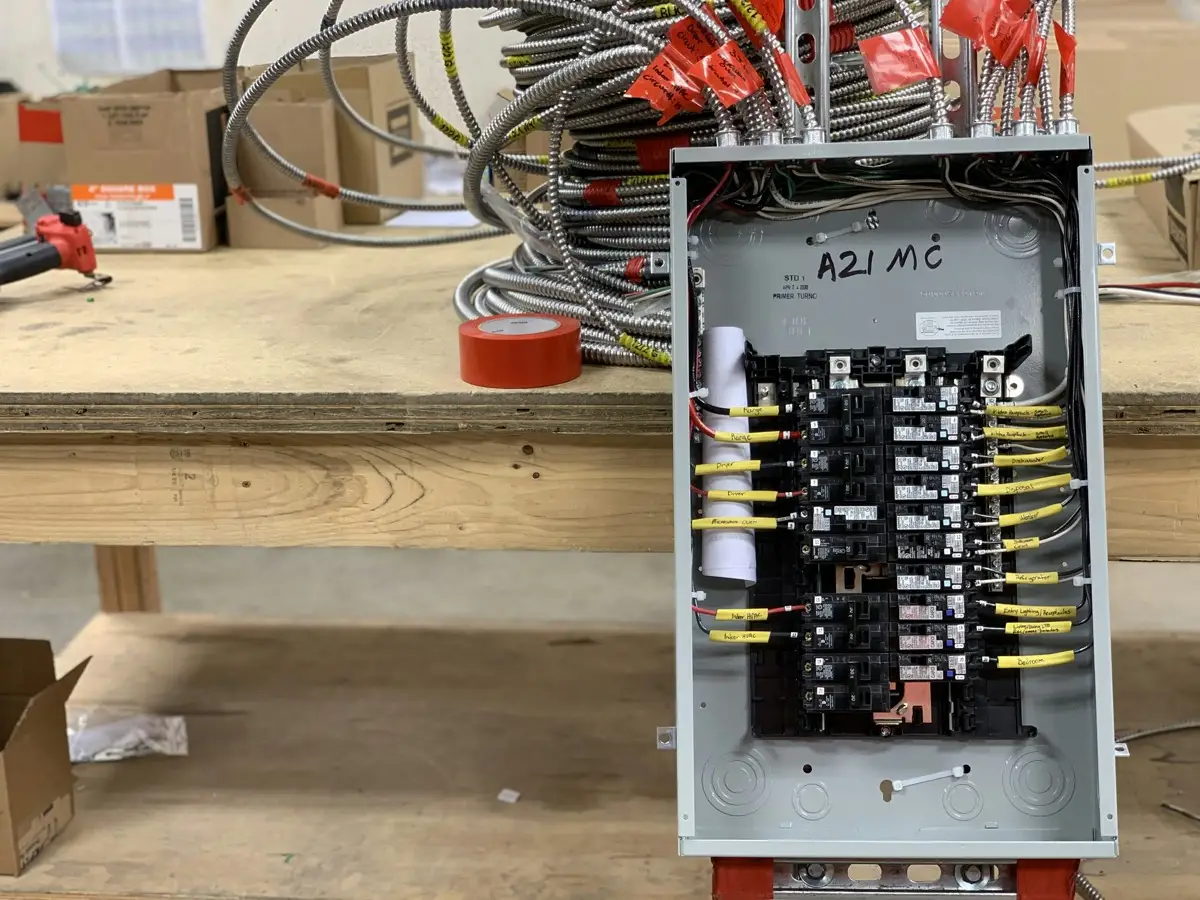
Search for an electrical panel replacement cost and the first numbers you meet are national averages between about $1,270 and $1,480. Those numbers describe a real job: an electrician opens the wall, swaps a tired panelboard for a new one of the same rating, moves the circuits over and leaves the meter, the service cable and the grounding alone. Fixr prices the panel itself at $300 to $400 for a 200-amp box, and Angi says labor is most of the bill.
The job most West Orange, Montclair and Maplewood homeowners are actually pricing is different. The house was built in the 1930s or 1950s, the service is 100 amps or a 60-amp fuse box, and the reason for the call is an EV charger, a heat pump, a finished basement or a home inspector's note about a Federal Pacific panel. That is a service upgrade: new meter socket, new service entrance conductors, new main disconnect, new panel, new grounding electrodes, bonding to the water and gas lines, the surge protective device New Jersey has required on replaced services since 2022, and, under the code the state adopted this August, an outdoor emergency disconnect. Then the town inspects it, issues a cut-in card, and the utility comes back to reconnect. This guide prices that job from what North Jersey contractors publish, then shows every line the national averages leave out, and the cost estimator adds those lines up for your town and your house.
Malfettone Electric's published Essex and Hudson County range, permit and inspection included; $3,500 to $4,800 on its Essex County page and $4,000 to $6,000 in larger Montclair and Glen Ridge homes, also with the permit (retrieved October 6, 2026; re-checked October 18).
This Old House's "most pay" band (March 2026). Angi $1,200 to $2,000, HomeAdvisor $750 to $2,000, Fixr $1,800 to $4,500 with a $3,000 typical.
Service panel 0 to 224 amps plus the meter line, from the township fee schedule, so about $200 for a straight upgrade; the first 25 devices of rough and final wiring add $100 only when new circuits go in. The panel line alone is $75 in Maplewood and $125 in Montclair.
PSE&G's published time for residential service requests. JCP&L lists four weeks from complete information to a residential service drop.
Budget from the North Jersey contractor figures, not the national average, and ask every proposal to show the meter socket, service conductors, grounding, emergency disconnect, surge device, permit and utility coordination as separate lines. A quote without those lines is a panel swap, whatever the label says.
02 / Price by job type
What North Jersey electricians publish, job by job.
Three New Jersey contractors publish their own ranges, which is rare in this trade and more useful than any national average. Malfettone Electric (Cedar Grove and Jersey City) published a 2026 guide in April and updated it in May; Voltus Energy Solutions (Essex, Union and Morris counties) published starting prices in June; Gareffa Electric publishes a residential upgrade range. Their figures are below, with what each one says the price includes. They are those companies' prices for their own work, quoted here as market evidence; they are not MDL's prices.
Swipe across the table to see every column.
| Job | Malfettone Electric (2026 guide and service pages) | Voltus Energy Solutions (June 2026) | Gareffa Electric |
|---|---|---|---|
| Like-for-like panel replacement, same amperage | $1,800 to $2,800 | From $1,500; every new panel includes a surge protector | Not published |
| 100-amp service replaced at 100 amps | $1,800 to $2,500 (100 A tier) | From $3,000, including utility paperwork, permit, water main and hot water bonding, new grounding electrode system | Not published |
| 150-amp service | $2,200 to $3,200 | Not published | Not published |
| 100-to-200-amp service upgrade | $2,800 to $5,500 across Essex and Hudson; $3,500 to $4,800 on the Essex County page; $4,000 to $6,000 in larger Montclair and Glen Ridge homes; all with the permit and inspection included | From $4,500 | $2,800 to $4,500, including utility disconnect and reconnect, new meter pan, new service cable, ground rod and bonding, permit and final inspection |
| 60-amp fuse box to 200-amp service | $2,300 to $4,800 | Not published | Not published |
| 200-to-400-amp service | $6,000 to $10,000 for a 400 A service; $5,000 to $9,000 for a two-family 400 A service split into two 200 A panels | Quoted after assessment | Not published |
| Panel upgrade plus EV charger, one permit | $4,200 to $6,600 | Not published | Not published |
| Federal Pacific, Zinsco or Pushmatic panel replacement | $3,500 to $5,500 | Not published | Not published |
| Subpanel | $1,500 to $3,500 | From $1,500 | Not published |
| Adders | Service entrance cable replaced, $800 to $1,500; new meter socket, $400 to $700. The service-page prices above (100 to 200 A, fuse box, problem panels, EV combo, two-family, 400 A) include the permit; the 2026 guide lists a permit fee of $150 to $500 by town beside its like-for-like, 100 A, 150 A and subpanel tiers without saying they include it | Not itemized | $100 estimate visit, credited to the job |
Two of those lines deserve a second look. First, Voltus's "100-amp service replaced at 100 amps" at $3,000 is double its like-for-like panel price of $1,500. That gap is the service: the meter socket, the conductors, the grounding electrode system and the bonding, which is exactly the work the national panel averages leave out. Second, Malfettone's $150 to $500 permit range, with Essex County "on the higher end ($300 to $500)," is a whole-permit figure, and the fee ordinances support it: in West Orange the service-panel line is $150 and the meter $50, so a straight upgrade permit lands about $200 before the state surcharge, and the first 25 devices of rough and final wiring add $100 when new circuits go in, which is where a $300 permit comes from. The town tables in section 06 show each line.
Malfettone's Essex County page also lists "whether subpanel or knob-and-tube remediation is involved" as a price driver, which is the right warning for Montclair and Maplewood, where more than half the housing stock was built before 1940.
New Jersey panel cost estimator: add up your own job from the published figures.
Pick the job, your town and the extras your house needs. The range starts from Malfettone Electric's published North Jersey job price and adds the extras it lists separately. Its service-upgrade, fuse-box, problem-panel, EV-combo, two-family and 400-amp prices already include the permit, so nothing is added for it. Its like-for-like, 150-amp and subpanel prices do not say so, so for those the range adds your town's panel fee from its ordinance and the state's $1.90 per $1,000 surcharge. It is arithmetic on the figures in this guide, not an MDL price or a quote.
Published-figure range$1,953 to $2,955
- Like-for-like panel replacement, same amperage (Malfettone): $1,800 to $2,800
- West Orange permit, service panel line: $150
- State training surcharge, $1.90 per $1,000 of job value: $3 to $5
Not counted: an underground lateral or trenching, which no source here prices (Fixr says it can add a few thousand dollars); rewiring, which Angi puts at $1,500 to $12,000; drywall and siding repair; and any utility fee JCP&L charges on an upgrade. The national guides are lower for the same jobs (section 03) because they average in panel swaps.
Send this job to MDL for a written scope03 / Why New Jersey runs higher
The national guides are averaging a different job in a cheaper place.
Six national cost sites publish a panel figure. Five state an average, and those run from $1,274 to $3,000: HomeAdvisor's average is $1,347, Bob Vila's $1,274, HomeGuide's $1,475, This Old House's $2,150, and Fixr's $3,000; Angi gives a range instead, $1,200 to $2,000 to update a panel. The spread between the lowest and highest is almost entirely about what the writer decided a "panel upgrade" includes. HomeAdvisor and Bob Vila are describing a panel swap; Fixr is describing a 100-to-200-amp service upgrade and says so: "most homeowners pay around $3,000 to upgrade their existing 100 amp panel to a 200 amp service."
Swipe across the table to see every column.
| Source and date | Panel replacement | 100 to 200 amps | What they add |
|---|---|---|---|
| HomeAdvisor (June 2026) | Average $1,347; typical $518 to $2,193; full range $125 to $4,500 | $750 to $2,000 | Federal Pacific or Zinsco replacement $1,500 to $4,000; fuse box to breakers $1,500 to $2,000; labor $40 to $250 an hour, four to eight hours. |
| Angi (August 2026) | Update $1,200 to $2,000; $800 to $4,000 from 100 to 400 A; like-for-like $520 to $2,200 | 200 A $1,300 to $2,000 | Subpanel $400 to $1,750; meter box $200 to $800; rewiring inside walls $1,500 to $12,000; permit $50 to $300. |
| Fixr (January 2025) | Same-amperage 200 A $1,600 to $4,000 | $1,800 to $4,500; typical $3,000 | 400 A $8,000 to $12,000; panel box $300 to $400; meter box $200 to $800; relocation $1,000 to $4,000. |
| This Old House (March 2026) | $800 to $4,000 | Most pay $1,300 to $3,000; average $2,150 | Meter box installation $1,800 to $3,500; AFCI and GFCI breakers $35 to $60 each; new 400 A $4,000 to $6,000. |
| HomeGuide (December 2024) | Average $1,475; most $1,287 to $1,707; up to $4,000 | $1,300 to $2,500 | 60 to 100 A $850 to $1,100; fuse box to breakers $1,100 to $4,000; labor $400 to $800. |
| Bob Vila (April 2024) | $522 to $2,082; average $1,274 | $750 to $2,000 | Subpanels $530 to $1,940; meter replacement $100 to $650; permit $50 to $300. |
Angi's own master electrician, quoted on its page, states the catch in one sentence: "even though you installed a new 200-amp-rated panel, the exterior wire and meter box is still only rated at 100-amp or 150-amp and will need to be upgraded to 200-amps to get the full benefit." A 200-amp panel on a 100-amp service is a 100-amp service with a bigger box. Angi's customer data says 65.7 percent of wiring and panel projects involve upgrades to existing service, which is why the honest New Jersey number starts near $3,000 and not near $1,300.
Four things push North Jersey above even Fixr's $3,000:
- The houses are old. The median West Orange home was built in 1956 and the median Montclair or Maplewood home in 1938 (Census, 2020 to 2024 American Community Survey). Old services mean old meter sockets, cloth-insulated service cable, undersized grounding and, often, a panel brand an insurer will not accept.
- The code has moved twice. New Jersey's 2020 electrical code, in force from September 6, 2022, made a Type 1 or Type 2 surge protective device (230.67) mandatory wherever dwelling service equipment is replaced, and the 2023 code the state adopted on August 17, 2026 extends the outdoor emergency disconnect rule (230.85) to replaced service equipment. Both are hardware and labor that a 2019 panel change did not carry.
- Two utilities, two procedures. Essex County is split between PSE&G and JCP&L. Each has an application, an inspection requirement and a reconnection sequence, and the electrician's time coordinating it is in the price.
- Labor rates. The national guides quote $40 to $250 an hour. The one North Jersey contractor here that publishes a rate, Malfettone Electric, puts a licensed New Jersey electrician at $50 to $150 an hour and labor at 40 to 60 percent of a panel job (2026 guide). HomeAdvisor's New Jersey town pages for Newark, Jersey City and Short Hills publish only the national averages, so the contractor prices above remain the better local evidence.
04 / What installed includes
Every line a New Jersey service upgrade has to carry, and what the public sources price it at.
A proposal for a 100-to-200-amp upgrade should read like the table below. Where a line is missing, it is not free; it is scope that will arrive later as a change order or, worse, as something the inspector finds. The published figures are the national guides' and the North Jersey contractors' own numbers for each item, retrieved October 6, 2026.
Swipe across the table to see every column.
| Line item | What it covers in New Jersey | Published cost figure |
|---|---|---|
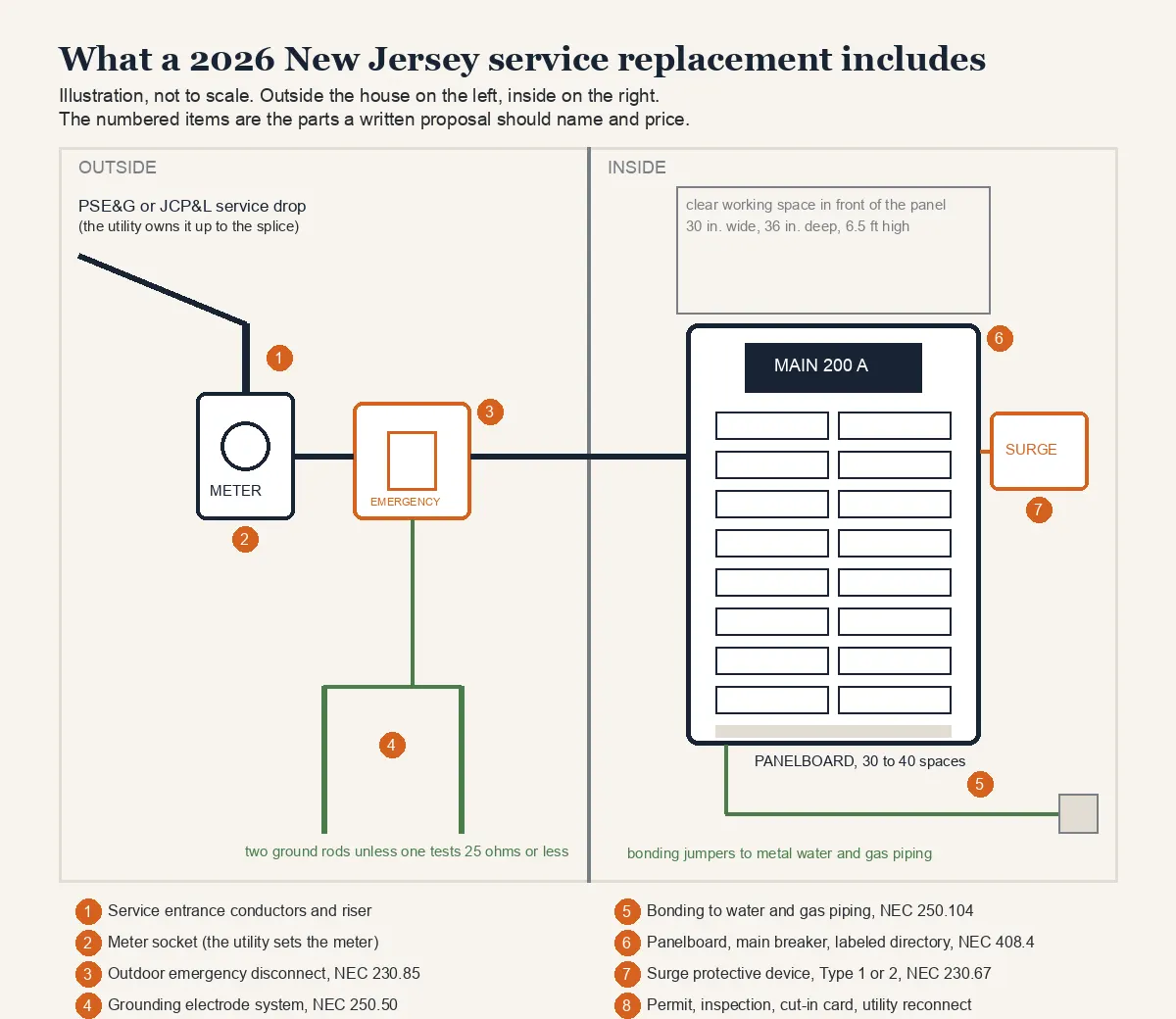
| Panelboard and main breaker | A 200-amp main breaker panel with 30 to 40 spaces, the circuit directory the code requires (NEC 408.4) and new breakers for every transferred circuit. | Panel box $300 to $400 (Fixr); $250 to $350 (Angi, This Old House). AFCI or GFCI breakers $35 to $60 each where a new or extended circuit needs them. |
| Service entrance conductors and riser | New cable or conduit from the weatherhead or lateral to the meter and from the meter to the main disconnect, sized for 200 amps. On an overhead service the utility owns the drop up to the splice; the customer owns everything after it (JCP&L customer guide). | $800 to $1,500 adder when the service cable is replaced (Malfettone). State fee for conductor-only replacement $65 up to 225 amps. |
| Meter socket | A 200-amp socket the utility will accept; PSE&G describes obtaining the assigned meter pan with the permit and project number for upgrades of 200 amps or less. The utility sets and seals the meter. | $400 to $700 (Malfettone); $200 to $800 (Angi, Fixr); $200 to $500 (HomeGuide). |
| Outdoor emergency disconnect | Required on a one- or two-family dwelling where service equipment is replaced, in a readily accessible outdoor location, marked "Emergency disconnect" (2023 NEC 230.85, adopted in New Jersey August 17, 2026). | Not itemized by any national guide, which is one reason their averages are low. Ask for it as its own line. |
| Surge protective device | A Type 1 or Type 2 device in or adjacent to the service equipment, required where dwelling service equipment is replaced since New Jersey's 2020 code (NEC 230.67); the 2023 edition adds a 10 kA minimum rating. Voltus includes one in every new panel. | Not itemized by the national guides. Ask for the device type and rating in writing. |
| Grounding electrode system | Two driven ground rods unless one tests at 25 ohms or less, with a continuous grounding electrode conductor to the main disconnect (NEC 250.50 and 250.53; JCP&L's guide requires the conductor to be continuous to both rods). | Grounding material about $1.50 a linear foot (Bob Vila); included in Voltus's and Gareffa's service-upgrade scope. |
| Bonding | Bonding jumpers to the metal water main, the water heater and the gas piping, plus an intersystem bonding terminal for the cable and phone grounds (NEC 250.104 and 250.94). | Included in Voltus's scope ("checking and updating the bonding of your water main and hot water tank"). |
| Working space | A clear space 30 inches wide, 36 inches deep and 6.5 feet high in front of the panel (NEC 110.26). New Jersey's rehabilitation subcode lets existing clearances stay on rehab work, but a new panel location must meet it. | Relocation, where the old spot cannot work: $1,000 to $4,000 (Fixr, HomeGuide); $800 to $3,000 (This Old House). |
| Permit, inspections and cut-in card | An electrical permit from the town, rough and final inspections, and the certificate of approval, the cut-in card, that tells the utility it is safe to connect. | Service panel fee $75 (Maplewood) to $150 (West Orange); state surcharge $1.90 per $1,000 of job value. Angi and Fixr quote $50 to $300 nationally. |
| Utility coordination | The PSE&G electric service application or the JCP&L contact, the disconnect and reconnect on the day, and the permanent reconnection and meter seal after the cut-in card. | Included in the North Jersey contractor prices above. PSE&G publishes no residential fee; JCP&L refers to "applicable fees" on upgrades. |
| Restoration | Patching the wall around the old panel, sealing the exterior penetration, and the drywall or siding the owner may have to finish. | Drywall repair $1.50 to $3 a square foot (HomeAdvisor). |
05 / The 2023 code, since August
New Jersey changed the electrical code on August 17, 2026. Here is what a replaced panel has to carry, and which rule is actually new.
The state Division of Codes and Standards rewrote the electrical subcode this summer: N.J.A.C. 5:23-3.16 now adopts the 2023 National Electrical Code with Tentative Interim Amendments 1 through 13, effective August 17, 2026, replacing the 2020 edition that had been in force since September 6, 2022. The adoption notice allows a six-month grace period, so a complete permit application filed before February 17, 2027 may still be reviewed under the 2020 code. Four rules decide what a 2026 panel job has to include:
- Outdoor emergency disconnect (230.85). Every one- and two-family dwelling needs an emergency disconnecting means in a readily accessible outdoor location, on or within sight of the house. The 2023 edition added the sentence that matters for existing homes: "Where service equipment is replaced, all of the requirements of this section shall apply." Replacing only the meter socket, the service conductors or their raceways does not trigger it. New Jersey kept this section as written and deleted the duplicate feeder rule in 225.41 because, in the Department's words, it "is a duplication of the emergency disconnect requirements for one- and two-family dwellings already included within Section 230.85."
- Surge protection (230.67). This one is not new. The 2020 code, which New Jersey enforced from September 6, 2022, already required a Type 1 or Type 2 surge protective device, integral to or immediately adjacent to the service equipment, on every dwelling service and wherever service equipment is replaced, and New Jersey's 2020 amendments deleted nothing in Article 230. The 2023 edition keeps the rule and adds a nominal discharge current rating of at least 10 kA. A replaced panel has carried a surge device in New Jersey for four years, whatever a quote says.
- Arc-fault protection on moved circuits (210.12(E)). The model code requires an AFCI breaker when an existing circuit is extended or modified. New Jersey deleted 210.12(E) "in its entirety," along with 406.4(D)(4), so moving your existing circuits onto a new panel does not by itself require AFCI breakers on them in New Jersey. New and extended circuits still follow the rest of 210.12, which the Department kept in full, rejecting a request to exempt kitchens and laundries because "adopting Article 210.12 increases the safety of building inhabitants."
- Grounding and working space. The grounding electrode rules (two rods unless one tests at 25 ohms or less), the bonding of metal water and gas piping and the 30-by-36-inch working space are not new, but on a 1938 house they are usually the items the old installation never had. The rehabilitation subcode lets existing working clearances and the location of existing overcurrent devices "remain without modification" on rehab work; a relocated panel does not get that allowance.
Tentative Interim Amendments 14 through 20 to the 2023 code are not adopted in New Jersey and can only be used through a variation. If a proposal cites one, ask which edition and amendments the town will review the permit under.
06 / Permit fees by town
The permit is $75 to $150 for the panel line, a few hundred dollars all in, not the $500 to $2,000 HomeAdvisor's New Jersey town pages quote.
HomeAdvisor's New Jersey town pages say electrical permits run "$500 to $2,000 depending on location." Every fee ordinance we read for Essex and Morris County towns puts the service-panel line between $75 and $150. The rest of a permit bill is the meter line, the device count for any new circuits, the minimum fee where it applies, and the state training surcharge of $1.90 per $1,000 of construction value (N.J.A.C. 5:23-4.19), which on a $4,500 upgrade is $8.55. Fees change by ordinance, so confirm the current schedule before you budget; these are the figures published on October 6, 2026.
Swipe across the table to see every column.
| Town | Service panel, up to about 200 A | Next tier | Other lines |
|---|---|---|---|
| West Orange (Ord. 2802-23) | $150 for 0 to 224 amps | $250 for 225 to 600 amps | Meter $50; rough and final wiring, first 25 devices $100; minimum electrical fee $100. |
| Montclair (Ord. O-25-04, February 2025) | $125 up to 200 amps | $150 for 201 to 1,000 amps | First 50 receptacles or fixtures $75; minimum electrical fee $85. |
| Maplewood (Ord. 4001-26, May 2026) | $75 up to 200 amps | $185 for 201 to 1,000 amps | First 50 receptacles $75; minimum fee $80; 15 percent surcharge if a third-party agency inspects. |
| Livingston (Ord. 3-2019) | $100 up to 225 amps | $175 for 226 to 1,000 amps | Fixtures 1 to 50 $57; minimum fee $75. |
| Morris Township (Ord. 21-23) | $100 up to 200 amps | $200 up to 1,000 amps | Minimum fee per subcode $85. The Town of Morristown publishes its own schedule; ask the Town's construction office. |
| Newark (§ 7:2-3.2) | $81 up to 200 amps | $460 up to 1,000 amps | First 50 receptacles $58; minimum fee $58; DCA fee $1 per $1,000. |
| City of Orange | $75 for 0 to 200 amps | $150 for 201 to 1,000 amps | Fee schedule amended October 2023. |
| State schedule (N.J.A.C. 5:23-4.20) | $65 for service equipment or a panelboard rated 225 amps or less | $129 for 226 to 1,000 amps | $65 for replacing service entrance or feeder conductors only, up to 225 amps. Applies where the state is the enforcing agency. |
A licensed electrical contractor, or you on your own single-family home
N.J.A.C. 5:23-2.15(b)2i: electrical work "shall not be undertaken except by persons licensed to perform such work pursuant to law, except in the case of a single-family homeowner on his or her own dwelling." Montclair's code repeats the rule.
Rough, final, and the cut-in card
The local inspection authority inspects the wiring, and the certificate of approval it issues after the final, which PSE&G calls the cut-in card for electric service, is what the utility needs before it sets the meter and connects the service.
66 Main Street, Room 217
Building and Construction Code Enforcement, (973) 325-4112, open 8:30 to 4:30 weekdays with field hours 9:30 to noon and 1 to 4. "Inspection requests are no longer accepted over the phone"; use the township's online form.
Five to ten business days, up to twenty
One Essex County contractor reports five to ten business days for a Montclair or Cedar Grove permit and two to four weeks from permit to final inspection; a permitting service notes New Jersey permits are typically issued within 20 business days.
07 / PSE&G and JCP&L
Which utility you have decides the application, the reconnection and the wait.
Hudson County is PSE&G. Most of Morris County is JCP&L. Essex County is split: Montclair, Newark, East Orange and Bloomfield are PSE&G, while parts of Cedar Grove, Verona and the Caldwells are JCP&L. West Orange and Maplewood are in PSE&G's electric territory. The name on your bill decides which of the two procedures below applies, and the electrician's proposal should say which one it has priced.
Online application, mandatory inspection, up to six weeks
The electric service application asks for the existing and new amperage, whether the service is overhead or underground, the request type (upgrade), the existing and new loads by appliance including electric vehicles and heat pumps, the electrician's contact details and, where it applies, an EV incentive application number. Its warning is printed in capitals: missing information will result in delay. PSE&G says residential requests "may take up to six weeks to complete," that road-opening permits and municipal inspections can stretch that, and that you must "schedule a mandatory local inspection to receive your Certificate of Approval (or cut-in card) prior to our scheduled service date." The North construction office is 1-800-722-0256, weekdays 7 a.m. to 3 p.m.
Company owns the drop, electrician may reconnect overhead, four weeks
JCP&L's June 2024 customer guide says the company "shall provide, own, install, and maintain the service drop conductors" to the point of service, while the customer owns the bracket, meter socket, service conductors and disconnect. Before upgrading or adding load, the customer contacts the company "for guidance and applicable fees." Qualified electricians may disconnect and reconnect overhead single-phase drops of 400 amps or less at the weatherhead with local company approval, and may remove and install meters on services of 200 amps or less; they may never touch an underground lateral. "All overhead and underground electrical upgrades shall be inspected prior to reconnection," and an Agreement for Temporary Uninspected Service, which lets a house be re-energized before the inspection, applies only to overhead services of 200 amps or less. The lead-time table lists four weeks for a residential service drop once the company has the main disconnect rating and any large loads such as EV charging.
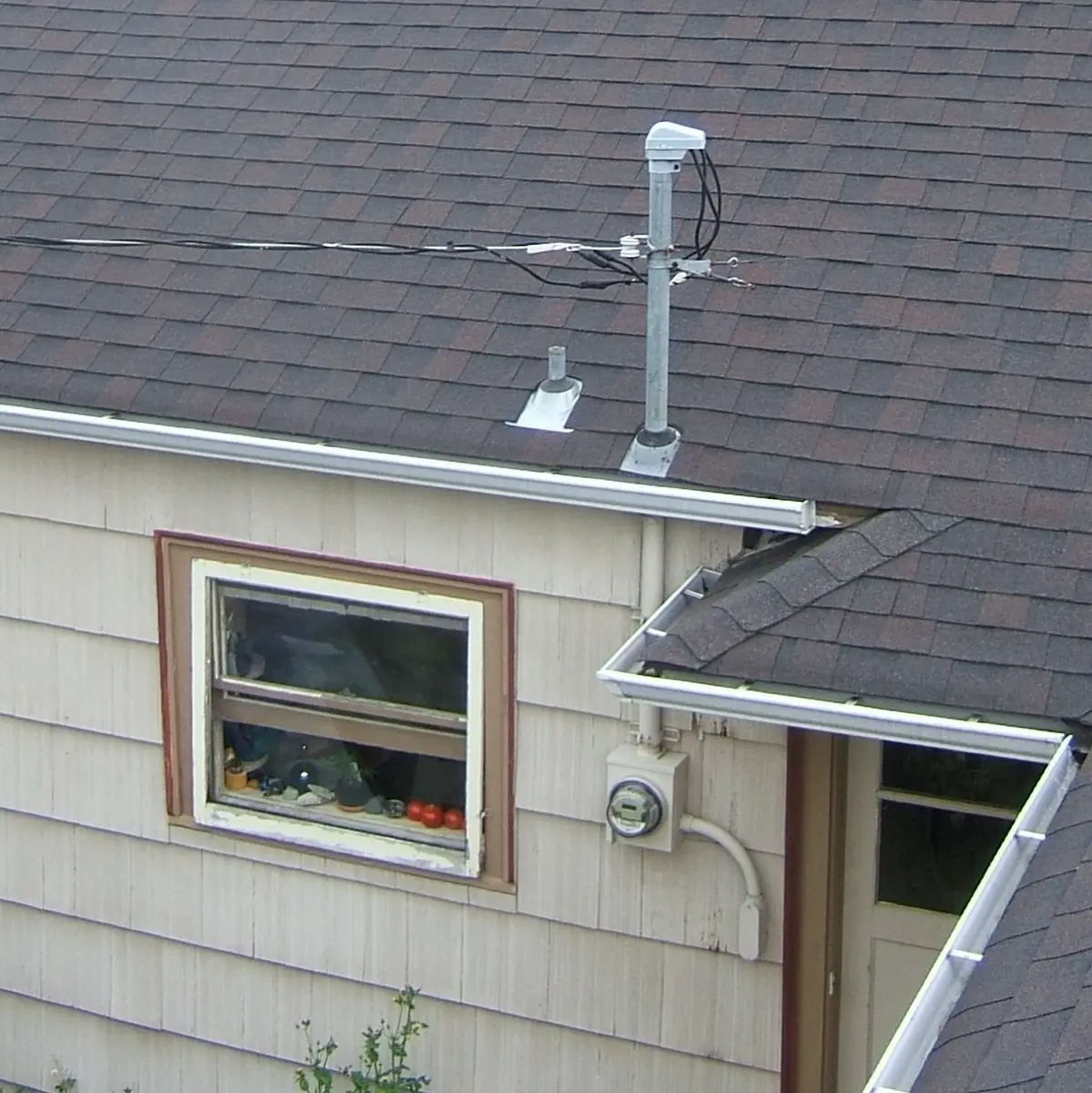
PSE&G publishes no residential fee for a service upgrade and its form has no fee field; JCP&L's guide refers to applicable fees without listing them. Neither utility page states whether it replaces an undersized overhead drop at no charge on an upgrade; ask the utility representative, and ask the proposal to say who owns that answer.
08 / Does your house need it
Half of Essex County was built before 1960. That is the whole reason this guide exists.
Nationally, a quarter of homes were built before 1960. In Essex County it is more than half, and in the towns MDL works in most it is higher still. The Census Bureau's 2020 to 2024 American Community Survey gives the picture town by town:
Swipe across the table to see every column.
| Place | Median year built | Built before 1940 | Built before 1960 | Built before 1970 |
|---|---|---|---|---|
| Montclair | 1938 | 59.4 percent (9,809 homes) | 73.9 percent | 80.7 percent |
| Maplewood | 1938 | 55.5 percent (5,019 homes) | 71.4 percent | 80.7 percent |
| West Orange | 1956 | 24.8 percent (4,435 homes) | 59.4 percent (10,606 homes) | 70.4 percent |
| Livingston | 1962 | 9.2 percent | 45.3 percent | 65.1 percent |
| Newark | 1966 | 23.7 percent | 42.9 percent | Not tabulated here |
| Essex County | 1958 | 29.1 percent (98,068 homes) | 52.6 percent (177,187 homes) | 65.1 percent |
| Union County | 1956 | 23.5 percent | 57.9 percent | 70.4 percent |
| Hudson County | 1966 | 29.7 percent | 44.4 percent | Not tabulated here |
| Morris County | 1971 | 12.4 percent | 32.9 percent | Not tabulated here |
| New Jersey | 1970 | Not tabulated here | 37.7 percent | Not tabulated here |
| United States | 1980 | Not tabulated here | 25.6 percent | Not tabulated here |
Age alone does not condemn a service; plenty of 1950s houses were upgraded to 200 amps in the 1990s. What age does is raise the odds of four specific things an inspector or an insurer will flag:
The four findings that turn a question into a job
- A 60-amp fuse box or 100-amp service. HomeGuide puts it plainly: older homes "usually" have 60-amp panels that are underrated, most homes need at least 100 amps, and newer homes 200 or more. This Old House notes most new homes have been built with at least 200-amp service as standard since 2015. Insurance brokers commonly report carriers wanting older homes brought to a minimum of 100 amps, though no New Jersey carrier publishes a written rule we could find.
- A Federal Pacific Stab-Lok panel. Installed in homes built from 1960 to 1985. The Consumer Product Safety Commission's 1980 to 1983 investigation "confirmed that these breakers fail certain UL calibration test requirements," though the Commission said it could not link the failures to a hazard and closed the file. The insurer AmTrust's loss-control bulletin cites testing in which 51 percent of Stab-Lok breakers failed to trip, with failure rates of 14 to 74 percent across tests, and "recommends all Federal Pacific Stab-Lok panels and breakers be replaced, with UL Listed Equipment"; replacing the breakers alone "is not recommended." Malfettone publishes $3,500 to $5,500 for a Federal Pacific, Zinsco or Pushmatic replacement in North Jersey. A licensed East Hanover home inspector writes that FPE panels "may still be found in thousands of homes throughout" New Jersey and that "some homeowners are finding that they cannot get insurance or cannot renew a policy unless outdated or known-problem panels are replaced."
- A Zinsco or Sylvania-Zinsco panel. Sold into the mid-1970s. Great American Insurance Group's position: "Due to the inherent design flaw, all Zinsco breakers/panels should be replaced with current, UL listed equipment." The flaw is a breaker that can weld to the aluminum bus and never trip.
- Aluminum branch wiring or knob-and-tube. Solid aluminum branch wiring was used from about 1965 to 1973; the CPSC found homes wired with pre-1972 aluminum are 55 times more likely to have a connection reach fire-hazard conditions than copper-wired homes. Knob-and-tube was common from 1880 to the end of the 1930s, which is the Montclair and Maplewood era, and the same New Jersey inspector notes insurers "may not write your policy" when it is present. Neither is fixed by a new panel; both are separate lines on an honest proposal.
The signs you can see without opening anything are the usual ones: breakers that trip repeatedly, a panel that is warm or buzzes, scorch marks or rust, a fuse box, a brand name of Federal Pacific, FPE, Stab-Lok, Zinsco or Sylvania on the cover, no spare spaces, or a home inspection report that says any of this. A damaged panel that is hot, smoking or sparking is not a quote request; use the emergency electrician page and call.
09 / EV chargers and heat pumps
The new loads that push a 100-amp house over the line, and the money that helps pay for the fix.
Most 2026 upgrade calls start with an appliance, not a panel. A Level 2 EV charger is the common one: a 48-amp charger needs a 60-amp circuit and 6 AWG copper under the code's 125 percent continuous-load rule, and draws about 11.5 kW; a 40-amp unit on a 50-amp circuit draws about 9.6 kW; a 32-amp unit on a 40-amp circuit about 7.7 kW. Qmerit's rule of thumb is that a standard Level 2 charger "adds about 7,200 watts or 30 amps," that a 200-amp panel "is ideal," and that a 60-amp panel "is usually too small." A heat pump, an induction range or a second air conditioner does the same arithmetic.
The answer is still a load calculation, not the label on the main breaker. A 32-amp charger on a 100-amp house with gas heat usually passes the NEC 220.83 calculation, by the account of a charger retailer's 2026 buyer's guide; when it fails, an EV energy-management device that throttles the charger is often the cheapest compliant fix, and MDL's EV charger installation page walks through that choice, including the Tesla Wall Connector's breaker settings from 60 amps down to 15. When the calculation fails by more than a throttle can cover, the 200-amp upgrade is the fix, and three programs help pay for it:
Up to $1,500 toward the panel and wiring
PSE&G's residential EV charging program pays "up to $1,500 per charger toward the cost of upgrading Customer-Side Make-Ready," meaning the panel and wiring, for an ENERGY STAR Level 2 smart charger. The customer "must use a New Jersey-licensed electrician," must obtain a permit and pass the inspection, and the account must be in good standing. The off-peak charging credit ended October 1, 2026; the make-ready incentive did not.
Up to $250 toward the charger
The state's in-home charger incentive pays up to $250 for an eligible Level 2 smart charger networked to a compliant provider, with proof of purchase, a serial-number photo, a New Jersey driver's license and a New Jersey EV registration at a residential address. It does not cover installation or panel work.
Up to $2,000 of a decarbonization project for electrical upgrades
PSE&G's heating and cooling program offers 0 percent on-bill repayment, up to $25,000 for an HVAC Instant Rebates project or $50,000 for a standalone building decarbonization project, and "customers are eligible to allocate up to $2,000 of this allowance for electrical upgrades"; income-qualified customers are not limited to that $2,000.
$300 to $1,000 per unit on the 2025 claim form
The utility HVAC partner claim form effective January 1, 2025 lists $300 to $450 for a Tier 1 or Tier 2 air-source heat pump, $600 for a cold-climate heat pump, and $450 for a heat pump water heater, with higher amounts in some channels. Check the current-year table before you count on it; the panel upgrade itself is funded through the on-bill allowance, not these rebates.
Whether MDL participates in any specific utility program is confirmed in the written scope for the property; this guide quotes the programs' own published terms and makes no participating-contractor claim.
10 / Panel, service, subpanel or load management
Four different fixes get sold as a "panel upgrade." Pick by the finding, not the phrase.
Swipe across the table to see every column.
| What the inspection finds | Best-fit job | Why | Published price anchor |
|---|---|---|---|
| Federal Pacific, Zinsco or a damaged panel on a 200-amp service that passes the load calculation | Like-for-like panel replacement | The service is adequate; the hazard is the panel. Replacing the service equipment still brings the surge device and the outdoor emergency disconnect with it. | $3,500 to $5,500 for a Federal Pacific, Zinsco or Pushmatic replacement (Malfettone); $1,500 to $4,000 (HomeAdvisor); $1,800 to $2,800 for a like-for-like swap of a sound brand (North Jersey) |
| 100-amp service, EV charger or heat pump planned, load calculation fails | 100-to-200-amp service upgrade | Meter socket, conductors, main, panel and grounding all change; the utility reconnects after the cut-in card. | $2,800 to $6,000 (North Jersey published); $1,300 to $4,500 (national guides) |
| 100-amp service, one new load, load calculation passes with a throttle | Dedicated circuit plus a listed load-management device | The code allows energy management to limit what the charger draws; the service stays. | Charger circuit and device priced on the EV page's scope; PSE&G make-ready up to $1,500 |
| 200-amp service, no spaces left, a basement or garage project across the house | Subpanel fed from the main | Adds breaker positions and shortens circuit runs without touching the service. | $1,500 to $3,500 (Malfettone); from $1,500 (Voltus); $400 to $1,750 (Angi) |
| 60-amp fuse box | Fuse box to 200-amp service | There is no like-for-like path a current proposal should offer; the service, grounding and bonding are all from another era. | $2,300 to $4,800 (Malfettone); $1,100 to $4,000 (HomeGuide) |
| All-electric conversion, pool, workshop, two EVs | 200-to-400-amp service | Two 200-amp panels or a 400-amp service; the utility's drop and meter equipment change. | $6,000 to $10,000 (Malfettone); $8,000 to $12,000 (Fixr); $4,000 to $6,000 new 400 A (This Old House); Voltus quotes after assessment |
| Aluminum branch wiring or knob-and-tube found during the panel work | Panel or service job plus a separate wiring line | A new panel does not cure the branch wiring; the proposal should price the remediation separately so you can see both numbers. | Rewiring inside walls $1,500 to $12,000 (Angi); $6 to $8 a linear foot (Fixr) |
Three costs the tables above do not carry. An underground service: when the utility line has to be dug up or replaced, EcoFlow's September 2026 guide says it "can double the total," and Fixr notes that trenching "can add a few thousand dollars," especially on a 400-amp upgrade; ask early who owns the underground lateral (section 07). A smart panel: Qmerit puts a smart electrical panel at "$2,000 to over $5,000" up front, worth pricing only when solar, a battery or a bidirectional EV charger is in the plan. Financing: Voltus offers monthly payments through Wisetack on projects of $500 or more after a soft credit check, and PSE&G's 0 percent on-bill repayment covers electrical work inside a heat pump project (section 09). This guide makes no claim about MDL financing; ask any contractor what it offers in writing.
Whatever the row, the next step is the same: a look at the meter and service, a documented load calculation and a written scope. MDL's panel upgrade page explains how MDL scopes that work in West Orange and Essex County, and the electrical repair page covers the tripping, flickering and dead-circuit calls that sometimes turn out to be a panel and sometimes do not.
11 / Do it yourself?
Can a New Jersey homeowner replace their own panel?
On paper, a single-family homeowner can: N.J.A.C. 5:23-2.15 exempts "a single-family homeowner on his or her own dwelling" from the licensing requirement, the permit forms have an exempt-applicant box, and Montclair's code repeats the rule. The permit, the rough and final inspections, the cut-in card and the utility application still apply.
In practice, the service is the problem. On a PSE&G service the utility disconnects and reconnects; on JCP&L only "qualified electricians" with local company approval may disconnect an overhead drop, and nobody but the company touches an underground lateral. Working on the line side of the main means working on conductors the utility has not de-energized, and the 2023 code's rules for the emergency disconnect, the surge device, the short-circuit rating and the grounding electrode system are the parts most do-it-yourself panel changes get wrong. A rental, a two-family house or a condominium removes the exemption entirely.
MDL's published credentials are a New Jersey electrical contractor license (#34EI01606200), an electrical business permit (#34EB01606200) and a master HVACR license (#19HC00308200). Anyone can check a contractor on the Division of Consumer Affairs license verification system; the license number belongs on the permit application and on the proposal.
12 / How long it takes
One day of work inside two to six weeks of calendar.
The work is a day for most houses. Malfettone publishes one to two days with the power off for most of day one; HomeAdvisor and Angi put a panel change at four to eight hours, and HomeGuide puts a panel replacement at eight to ten. The calendar around it is what surprises people:
Five to ten in Montclair and Cedar Grove by one contractor's account; the state's permitting norm is up to 20 business days.
PSE&G: residential requests may take up to six weeks. JCP&L: four weeks after the company has the main disconnect rating and the large loads.
Power off for most of the first day. Refrigerators and freezers stay closed; sump pumps and medical equipment need a plan.
After the final inspection the cut-in card goes to the utility; the permanent reconnection and meter seal follow on the utility's schedule.
Two of those clocks run at once: a good contractor files the permit and the utility application in the same week, so the six-week utility window is the long pole, not an addition to the permit time. On JCP&L, an Agreement for Temporary Uninspected Service can get an overhead 200-amp house re-energized the same day with the inspection to follow; PSE&G's published sequence puts the inspection before its service date.
13 / About this guide
Why a West Orange electrical contractor wrote a cost guide with no MDL prices in it.
Most of what a homeowner finds on this question is either a national average with no New Jersey line items or a contractor page with no figures at all. MDL Electric Cooling & Heating works from 4 Harrison Avenue in West Orange and publishes service coverage across Essex, Morris, Hudson and Union counties, and the honest way to price a panel or service job is a written scope for the actual house, after the meter, the service, the panel and the load have been looked at. Every number here is a published contractor, cost-guide, state, municipal or utility figure with its source and date. Contact MDL or use the request form below.
14 / Direct answers
Electrical panel questions New Jersey homeowners ask before they sign.
How much does it cost to replace an electrical panel in New Jersey in 2026?
North Jersey electricians who publish prices put a like-for-like panel replacement at $1,800 to $2,800 (Malfettone Electric, May 2026) or from $1,500 (Voltus Energy Solutions, June 2026), and a 100-to-200-amp service upgrade at $2,800 to $5,500 in Essex and Hudson counties or $3,500 to $4,800 on Malfettone's Essex County page, both with the permit and inspection included, or from $4,500. The national cost guides run lower, $1,300 to $3,000 for 100 to 200 amps, because they mix panel-only swaps into the average. These are published figures retrieved October 6, 2026, not an MDL quote.
How much does an electrician charge to replace an electrical panel?
The national guides put labor at $40 to $250 an hour and a panel change at four to eight hours, so labor is most of a same-rating replacement; Angi's average labor figure is $1,500 and HomeGuide's is $400 to $800. In New Jersey, Malfettone Electric publishes $50 to $150 an hour for a licensed electrician, with labor 40 to 60 percent of a panel job; the published contractor prices are otherwise per job: $1,800 to $2,800 for a like-for-like replacement and $2,800 to $6,000 for a 100-to-200-amp service upgrade, with the higher figures for larger older homes in Montclair and Glen Ridge. Ask for a written scope that lists the panel, breakers, service conductors, meter socket, grounding, surge protection, permit, inspection and utility coordination as separate lines.
How much does it cost to upgrade from 100 amps to 200 amps in NJ?
Published North Jersey prices for a 100-to-200-amp upgrade are $2,800 to $5,500 (Malfettone, Essex and Hudson counties), $3,500 to $4,800 (its Essex County page) and $4,000 to $6,000 for larger older homes, all three with the permit and inspection included, from $4,500 (Voltus, Essex, Union and Morris counties) and $2,800 to $4,500 (Gareffa). Replacing the service entrance cable adds about $800 to $1,500 and a new meter socket $400 to $700. A true 200-amp upgrade replaces the meter socket, service conductors, main disconnect, panel and grounding system, needs a permit, a local inspection and a cut-in card, and ends with the utility reconnecting the service.
How much does it cost to swap out a 200 amp panel?
A same-rating swap of a 200-amp panel, with the meter and service conductors left in place, is the cheapest version of the job: Fixr publishes $1,600 to $4,000, HomeGuide $1,800 to $2,500 for a new 200-amp panel, and North Jersey contractors $1,800 to $2,800 for a like-for-like replacement. Replacing the service equipment also requires a Type 1 or Type 2 surge protective device (230.67, mandatory in New Jersey since the 2020 code took effect in September 2022) and, under the 2023 code in force since August 17, 2026, an outdoor emergency disconnect (230.85), so a 2026 swap carries two items a 2019 swap did not.
Do I need a permit to replace an electrical panel in New Jersey?
Yes. Service equipment, panelboards and service entrance conductors are listed items on the state electrical fee schedule (N.J.A.C. 5:23-4.20), and every North Jersey town we checked publishes a service-panel fee: West Orange $150 for 0 to 224 amps, Montclair $125 up to 200 amps, Maplewood $75, Livingston $100, Morris Township $100, Newark $81 and Orange $75, plus the state training surcharge of $1.90 per $1,000 of job value. Only a licensed New Jersey electrical contractor may do the work, except a single-family homeowner on their own dwelling (N.J.A.C. 5:23-2.15). The inspector issues a cut-in card after the final inspection, and the utility will not reconnect without it.
Can you upgrade an electrical panel without rewiring the house?
Usually, yes. A panel or service upgrade replaces the service equipment and moves the existing branch circuits onto new breakers; it does not rewire the rooms. New Jersey also deleted NEC 210.12(E) from its 2023 electrical subcode, so moving an existing circuit to the new panel does not by itself require an arc-fault breaker on that circuit. Rewiring becomes part of the job only when the inspection finds something the new panel cannot fix: pre-1973 solid aluminum branch wiring, knob-and-tube, damaged conductors or a circuit that is unsafe to re-terminate. Rewiring inside walls is a separate line, $1,500 to $12,000 by Angi's range.
How much does it cost to rewire a 2,000 square foot house?
A rewire is a different project from a panel upgrade and is priced by the circuit count and access, not the panel. The national guides put rewiring inside walls at $1,500 to $12,000 (Angi), $500 to $4,500 or $6 to $8 per linear foot (Fixr) and up to $4,500 when a fuse-box replacement includes complete rewiring (HomeAdvisor). None of the New Jersey contractors in this guide publish a whole-house rewire price. If an inspection finds aluminum branch wiring or knob-and-tube, the honest proposal prices the panel and the rewiring as separate lines, so you can see what each one costs.
Should a Federal Pacific or Zinsco panel be replaced?
The insurers and inspectors who publish a position say yes. AmTrust's loss-control bulletin says Federal Pacific Stab-Lok panels were installed from 1960 to 1985, that CPSC-era testing found 51 percent of the breakers failed to trip, and that it recommends replacing the panels and breakers with UL-listed equipment, not just the breakers. Great American says all Zinsco breakers and panels should be replaced. An East Hanover home inspector reports New Jersey homeowners unable to get or renew insurance until a known-problem panel is replaced. Malfettone Electric publishes $3,500 to $5,500 for a Federal Pacific, Zinsco or Pushmatic panel replacement in North Jersey; HomeAdvisor's national range for the same job is $1,500 to $4,000.
Do I need a 200-amp service for an EV charger or a heat pump?
Not automatically. A 48-amp Level 2 charger needs a 60-amp circuit and draws about 11.5 kW; a 32-amp charger on a 40-amp circuit draws about 7.7 kW, and on a 100-amp house with gas heat it usually passes the NEC 220.83 load calculation. The answer comes from that calculation, not the panel label. If the calculation fails, the choices are a lower charger setting, a listed load-management device or a 200-amp upgrade. PSE&G's residential EV program pays up to $1,500 toward customer-side panel and wiring work for an ENERGY STAR smart charger installed by a New Jersey-licensed electrician with a permit, and the state Charge Up program adds up to $250 toward the charger itself.
How long does a panel or service upgrade take in New Jersey?
The work itself is one day for most homes, with the power off for most of it; North Jersey contractors publish one to two days. The calendar is longer: permits are issued in about five to ten business days in Montclair and Cedar Grove by one contractor's account, the state allows up to 20 business days, and the permit-to-final-inspection span is published as two to four weeks. PSE&G says residential service requests may take up to six weeks, and JCP&L's customer guide lists four weeks from complete information to a residential service drop. The utility reconnects permanently only after the inspector's cut-in card.
How much is the electrical permit for a panel upgrade in West Orange?
West Orange's construction fee schedule (Ordinance 2802-23) lists a service panel at $150 for 0 to 224 amps, $250 for 225 to 600 amps, $50 for a meter, $100 for the first 25 devices of rough and final wiring, and a $100 minimum electrical fee. The state adds a training surcharge of $1.90 per $1,000 of construction value, about $8.55 on a $4,500 job. Applications go to the Building and Construction Code Enforcement office at 66 Main Street, Room 217, and inspection requests are made through the township's online form, not by phone.
What has to happen with PSE&G or JCP&L for a service upgrade?
PSE&G requires an electric service application with the existing and new amperage, the loads including any EV charger or heat pump, and the electrician's details; it says residential requests may take up to six weeks and that a mandatory local inspection must produce a certificate of approval, the cut-in card, before its service date. JCP&L owns and installs the overhead service drop, allows qualified electricians to disconnect and reconnect overhead drops of 400 amps or less with local company approval, never underground laterals, requires every upgrade to be inspected before reconnection, and allows a temporary uninspected reconnection only for overhead services of 200 amps or less. Essex County is split between the two utilities; Hudson County is PSE&G; most of Morris County is JCP&L.
How much do electricians charge per hour in New Jersey?
Malfettone Electric's 2026 guide is the one North Jersey source we found that publishes a rate: $50 to $150 an hour for a licensed New Jersey electrician, with labor 40 to 60 percent of a panel job. The other North Jersey contractors in this guide quote per job, and the national guides give a wider hourly band: $40 to $250 an hour (HomeAdvisor, Angi), $40 to $120 (Fixr) and $50 to $150 or more (Bob Vila), with a panel change taking four to eight hours and a panel replacement eight to ten (HomeGuide). For a service upgrade the per-job figures are the better guide: $2,800 to $6,000 published in North Jersey for 100 to 200 amps. Ask for a written scope rather than an hourly estimate, because the utility, permit and inspection steps do not fit an hourly clock.
Should I upgrade to 150 or 200 amp service?
Price both tiers before deciding. Malfettone publishes $2,200 to $3,200 for a 150-amp service and $3,500 to $4,800 for 200 amps; nationally, HomeAdvisor and Angi put 150 amps at $1,300 to $1,600 and 200 amps at $1,300 to $2,000, a few hundred dollars for the extra capacity. This Old House notes most new homes have been built with at least 200-amp service as standard since 2015, and Qmerit calls a 200-amp panel ideal for an EV charger. If the meter socket, service conductors and panel are being replaced anyway, the load calculation usually decides it, and most homes adding an EV charger, a heat pump or an induction range land on 200 amps. A 150-amp service makes sense when the existing service conductors already support it and the calculated load stays well under it.
Will homeowners insurance cover electrical panel replacement?
Only when the panel was damaged suddenly by a covered event. Kin Insurance's guide (updated April 30, 2026) puts it plainly: a policy may pay to repair or replace a panel damaged by a fire, a lightning strike or a power surge under the dwelling coverage, but not a replacement driven by age, wear and tear or an upgrade, and a 100-to-200-amp upgrade counts as a home improvement, not a repair. Two add-ons change that: ordinance or law coverage pays the extra cost of meeting current code after a covered loss, which for a replaced New Jersey service includes the surge device and outdoor disconnect in section 05, and an equipment breakdown endorsement covers a panel that fails on its own, if it was in place before the failure. Insurify adds that an insurer may deny a claim on an old or poorly maintained panel and may refuse the home outright if it has knob-and-tube or aluminum wiring. The other direction matters more in Essex and Morris County housing: Kin lists Federal Pacific, Zinsco, Challenger and Pushmatic panels as ones insurers may decline or nonrenew, and an East Hanover home inspector reports New Jersey owners unable to get or renew a policy until a known-problem panel is replaced. That replacement is paid out of pocket, at the $3,500 to $5,500 Malfettone publishes for North Jersey.
Is it cheaper to repair or replace an electrical panel?
A repair is cheaper when the fault is one part. HomeGuide (June 2024) prices a single breaker at $100 to $260, a main breaker at $200 to $600 and the diagnostic visit most electricians charge first at $75 to $125; HomeAdvisor (June 2026) puts a breaker switch at $100 to $200; Angi (July 2026) says a quick fix can run as low as $100 while a main breaker replacement runs $500 to $2,000. Angi's rule of thumb is that once a repair passes $1,000 the panel is usually better replaced, and in North Jersey a like-for-like replacement of a sound panel is published at $1,800 to $2,800. Replacement is the only answer for a Federal Pacific, Zinsco or Pushmatic panel, where AmTrust says replacing the breakers alone is not recommended, for a fused service, for a panel with heat damage, corrosion or a scorched bus bar, and for a 60-amp or 100-amp service that cannot carry the loads in section 08, because money spent on a repair buys none of the capacity. A tripped or worn breaker in a 200-amp panel of a sound brand is a repair.
How long does an electrical panel last?
Cost guides put it at 20 to 40 years: HomeAdvisor (updated June 17, 2026) says a breaker panel lasts 25 to 40 years when it is maintained and inspected, and Qmerit (May 2026) says 20 to 40. InterNACHI's home life-expectancy chart lists a service panel at 60 years. Age is rarely what decides it in Essex County. The reasons a panel gets replaced here are capacity (a 60-amp or 100-amp service under new loads), brand (Federal Pacific, Zinsco, Pushmatic) and condition (heat damage, corrosion, a scorched bus bar), all covered in section 08. A fuse box installed in the 1950s is past the top of every one of those ranges.
Should a 50 year old electrical panel be replaced?
Usually, but the inspection decides it, not the date. A panel put in around 1976 is past the 20-to-40-year life the cost guides give (HomeAdvisor 25 to 40 years, Qmerit 20 to 40), though inside the 60 years InterNACHI's chart lists for a service panel. It also falls inside the 1960-to-1985 window when AmTrust says Federal Pacific Stab-Lok panels were installed. Replace it if it is a Federal Pacific, Zinsco, Challenger or Pushmatic panel, which Kin lists as panels insurers may decline or nonrenew; if it shows heat damage, corrosion or a scorched bus bar; if it is a 60-amp or 100-amp service and the NEC 220.83 load calculation fails for the charger, heat pump or induction range you plan; or if your insurer asks for it. A 50-year-old panel of a sound brand that passes the inspection and the load calculation can stay. North Jersey contractors publish $1,800 to $2,800 for a like-for-like replacement and $3,500 to $5,500 for a known-problem brand (Malfettone Electric).
What is the 80% rule for electrical panels?
It is the National Electrical Code's limit for continuous loads, ones whose maximum current runs for three hours or more. NEC 210.20(A) requires a breaker rated at least the noncontinuous load plus 125 percent of the continuous load, and 1 divided by 1.25 is 0.8, so a standard breaker may carry only 80 percent of its rating continuously: 80 amps on a 100-amp breaker. Kohler's white paper points out that it does not mean a breaker trips at 80 percent, and Kohler and Schneider Electric both note that breakers listed for 100 percent of their rating are the exception. It also does not mean a house must stay under 80 percent of its service; whether a 100-amp service can carry a new load is decided by the NEC 220.83 load calculation. Where the rule shows up in a panel job is EV charging, which the code treats as a continuous load (NEC 625.41): a 32-amp charger needs a 40-amp breaker and a 48-amp charger a 60-amp breaker.
Can you convert a fuse box to a breaker box?
Yes, and in New Jersey it is priced as a service replacement, not a box swap. The fuse panel comes out and a breaker panel goes in, and because the service equipment is being replaced, the job carries the surge protective device the state has required since September 6, 2022 and the outdoor emergency disconnect of the 2023 code adopted August 17, 2026 (section 05). HomeGuide notes that older homes usually have 60-amp panels, so the conversion is usually a 60-amp fuse box to a 200-amp service: $2,300 to $4,800 from Malfettone Electric in North Jersey, against $1,500 to $2,000 from HomeAdvisor (up to $4,500 when the wiring needs a full overhaul) and $1,100 to $4,000 from HomeGuide. The existing circuits move onto breakers unless the inspection finds knob-and-tube or damaged wiring, which belongs on the proposal as its own line.
Is there a free electrical panel upgrade or a tax credit in New Jersey in 2026?
Not for a typical single-family owner, as of October 18, 2026. The federal energy efficient home improvement credit, which covered 30 percent of a qualifying panelboard upgrade up to $600, applies only to improvements made through December 31, 2025, according to the IRS; some cost guides still advertise it. New Jersey's federally funded home energy rebates currently run M-RISE, which funds income-qualified multifamily projects, and the state's prescriptive rebate list, which names electrical and panel upgrades as a category, is marked as not yet available. The Board of Public Utilities announced in January 2025 that CP-HEAR, an electrification adder to Comfort Partners, would upgrade panels and wiring in the homes that program serves; we found no source showing it is open yet. What pays today is PSE&G's EV program, up to $1,500 toward the panel and wiring for a qualifying Level 2 charger, and PSE&G's 0 percent on-bill repayment, which can put up to $2,000 toward electrical upgrades in a heat pump project (section 09). Comfort Partners itself is free for households at or below 250 percent of the federal poverty guidelines, but it is an efficiency program, not a panel program.
15 / Source record
Sources, retrieved October 6, 2026; prices and programs re-checked October 18, 2026
Prices, fees, programs and codes change. Every figure on this page was read from the source below on October 6, 2026; the contractor and national price sources, and the tax-credit, rebate, lifespan and 80-percent-rule sources added that day, were read on October 18, 2026. Where two sources disagree, both are shown. The state-surcharge arithmetic and the kilowatt figures for chargers are our arithmetic on the sourced inputs. Nothing here is an MDL price, no contractor named here was asked or paid to appear, and their prices are quoted as market evidence only.
- Malfettone Electric — How much does a panel upgrade cost in NJ, 2026 guidePublished April 10, 2026, updated May 2026: 100, 150 and 200 A tiers, like-for-like, subpanel, permit range, one-to-two-day timeline.
- Malfettone Electric — panel upgrade cost, Essex County$3,500 to $4,800 and $4,000 to $6,000 in larger Montclair and Glen Ridge homes, both stated to include permit fees; knob-and-tube as a price driver.
- Malfettone Electric — panel upgrade service pageThe $2,800 to $5,500 Essex and Hudson range, the fuse-box tier, the Federal Pacific, Zinsco and Pushmatic figure, the cable and meter adders, the permit timeline and the utility territory note.
- Voltus Energy Solutions — cost to upgrade an electrical panel in NJPublished June 24, 2026: starting prices by job, surge protector in every panel, grounding and bonding scope.
- Gareffa Electric — panel upgrades$2,800 to $4,500 residential 100-to-200-amp range and its included scope.
- HomeAdvisor — upgrade an electrical panel costUpdated June 17, 2026: averages, amperage tiers, FPE and Zinsco, labor rate and hours, drywall. Its Newark and Jersey City town pages supply the "$500 to $2,000" permit claim.
- Angi — cost to upgrade an electrical panelUpdated August 3, 2026: ranges, labor, permit, subpanel and meter, rewiring, the master electrician's meter and wire note, the 65.7 percent figure.
- Fixr — electrical panel replacement and upgrade costUpdated January 31, 2025: upgrade and same-amperage tiers, panel box, 400 A, relocation, rewiring per foot.
- This Old House — cost to upgrade an electrical panelUpdated March 31, 2026: "most pay" band, meter box installation, AFCI and GFCI breakers, 200 A as the standard since 2015.
- HomeGuide — cost to replace an electrical panelDecember 30, 2024: averages, 60-to-100 and 100-to-200 A, fuse box, labor hours. Its electrical pricing guide supplies the 60-amp statement.
- Bob Vila — cost to replace an electrical panelUpdated April 18, 2024: range, subpanels, meter, grounding material per foot.
- Angi — cost to replace an electrical panel (updated July 15, 2026)Repair versus replace: quick fixes from $100, main breaker $500 to $2,000, breaker switch $100 to $200, and the $1,000 repair threshold.
- HomeGuide — circuit breaker replacement cost (updated June 26, 2024)Single breaker $100 to $260, main breaker $200 to $600, diagnostic fee $75 to $125, whole panel $850 to $4,000.
- Kin Insurance — does home insurance cover electrical panels? (updated April 30, 2026)Covered perils versus age, wear and upgrades; ordinance or law and equipment breakdown add-ons; the Federal Pacific, Zinsco, Challenger and Pushmatic list.
- Insurify — does home insurance cover electrical panel replacement? (updated November 8, 2024)Sudden and accidental loss under dwelling coverage; denials for old or unmaintained panels, knob-and-tube and aluminum wiring.
- N.J.A.C. 5:23-3 — subcodesSection 3.16 adopting the 2023 NEC with TIAs 1 to 13, rewritten by R.2026 d.086 effective August 17, 2026; New Jersey's deletions of 210.12(E), 225.41 and 406.4(D)(4).
- N.J.A.C. 5:23-4 — fee scheduleSection 4.20 electrical fees for service equipment and conductors; section 4.19 training surcharge of $1.90 per $1,000.
- NJ DCA — adoption notice for the 2024 model codes and 2023 NECEffective date, six-month grace period, the Department's responses on 225.41, 210.12 and TIAs 14 to 20.
- N.J.A.C. 5:23-2.15 — licensed trades and the homeowner exemptionThe single-family homeowner exception. Section 6.8 of the rehabilitation subcode supplies the existing-clearance allowance.
- N.J.A.C. 5:23-3.16 as amended through 2023 — the 2020 electrical subcodeAdoption of the 2020 NEC with Tentative Interim Amendments 1 to 9, effective September 6, 2022 (54 N.J.R. 1707(a)); the only Chapter 2 deletion was 210.12(D), so 230.67 applied as written.
- Township of West Orange — construction code fee schedule (Ord. 2802-23)Service panel tiers, meter, rough and final wiring, minimum fee.
- Township of West Orange — Building and Construction Code EnforcementOffice address, hours, phone, online-only inspection requests.
- Township of Montclair — Chapter 121, electrical fees and licensingOrdinance O-25-04 fee tiers and minimum; section 121-3 on licensed persons and single-family homeowners.
- Township of Maplewood — construction fees (Ord. 4001-26)Service panel tiers, receptacle fee, minimum, third-party surcharge.
- Township of Livingston — Chapter 110 construction feesServices and subpanels tiers, fixture fee, minimum.
- Township of Morris — Chapter 216 construction fees (Ord. 21-23)Service panel tiers and minimum fee per subcode.
- City of Newark — electrical subcode feesService panel tiers, receptacles, DCA fee, minimum.
- City of Orange Township — Chapter 74 feesService panel tiers amended October 2023.
- PSE&G — upgrades and new installationsLoad details, the six-week statement, mandatory inspection and cut-in card, North construction office contact.
- PSE&G — mandatory local inspectionsCertificate of approval before meters are set and service connected.
- PSE&G — electric service applicationForm fields: existing and new amperage, request type, loads including EVs and heat pumps, electrician, EV incentive number.
- JCP&L — Customer Guide for Electric Service, New Jersey, June 2024Service drop ownership, section 3.12 upgrades and electrician reconnection rules, temporary uninspected service, inspection before energizing, lead times, grounding electrode conductor.
- Larimer County — 2023 NEC significant code changes230.85 emergency disconnect text, location and rating, and the replacement sentence.
- Leviton — NEC code requirements for surge protection230.67 device type, location, replacement rule and the 2023 10 kA rating.
- U.S. Census Bureau via Census Reporter — American Community Survey 2020 to 2024, tables B25034 and B25035Year structure built and median year built for West Orange; the same tables supply Montclair, Maplewood, Livingston, Newark, the four counties, New Jersey and the United States.
- U.S. Consumer Product Safety Commission — FPE circuit breaker investigation, 1983, revised 2011The calibration-test finding and the Commission's closing statement.
- AmTrust — replacement of Federal Pacific Stab-Lok panels1960 to 1985 installation era, 51 percent and 14 to 74 percent failure figures, replacement recommendation.
- Great American Insurance Group — is your electric panel a fire riskZinsco replacement position.
- LookSmart Home Inspections, East Hanover — unsafe electrical panels in older NJ homesFPE prevalence in New Jersey, insurance and claims reports; its knob-and-tube page supplies the 1880 to 1930s dates and the insurer note.
- InterNACHI — aluminum wiring1965 to 1973 era and the CPSC's 55-times finding.
- Charge Up New Jersey — in-home EV charger incentiveThe $250 incentive, eligibility and documents.
- PSE&G — residential EV charging programUp to $1,500 customer-side make-ready, licensed electrician and permit requirements, off-peak credit end date.
- PSE&G — heating and cooling programsOn-bill repayment allowances and the $2,000 electrical-upgrade allocation. The utility HVAC partner claim form effective January 1, 2025 supplies the heat pump rebate tiers.
- Qmerit — load calculations when installing an EV chargerJuly 16, 2026: the 7,200-watt rule of thumb and panel-size guidance. A charger retailer's August 2026 buyer's guide supplies the breaker and wire sizes and the 220.83 note.
- Qmerit — the cost of updating your electrical panelMay 26, 2026: the 20-to-40-year panel lifespan.
- InterNACHI — estimated life expectancy chartService panel: 60 years.
- IRS — energy efficient home improvement credit30 percent of qualified expenses, $600 per item for panelboards, improvements made through December 31, 2025.
- New Jersey IRA Home Energy Rebates — prescriptive rebatesM-RISE for income-qualified multifamily projects; electrical and panel upgrades listed as a category, not yet available.
- New Jersey Board of Public Utilities — January 27, 2025 releaseCP-HEAR, the anticipated Comfort Partners electrification adder for panels and wiring.
- New Jersey Clean Energy Program — Comfort PartnersFree efficiency measures for households at or below 250 percent of the federal poverty guidelines.
- EcoFlow — cost to upgrade an electrical panel to 200 ampsSeptember 28, 2026: utility service line replacement can double the total.
- Voltus Energy Solutions — electrical panel upgrade and replacementFinancing through Wisetack on projects of $500 or more, soft credit check.
- Kohler — 80 percent vs. 100 percent rated circuit breakers (white paper)NEC 210.20(A) 125 percent rule for continuous loads; "the inverse of 125% is 80%"; a standard breaker is not a breaker that trips at 80 percent.
- Schneider Electric — circuit breaker ratings explained: 80% vs 100%Continuous load defined as three hours or more; the 100-percent-rated exception.
- Electrical Toolbox — how to size a breaker for a continuous loadEV chargers as continuous loads; a 32-amp charger needs a 40-amp breaker.
- ECalPro — the 80% NEC rule explainedFebruary 24, 2026: continuous load is three hours or more; NEC 625.41 treats EV charging equipment as a continuous load.