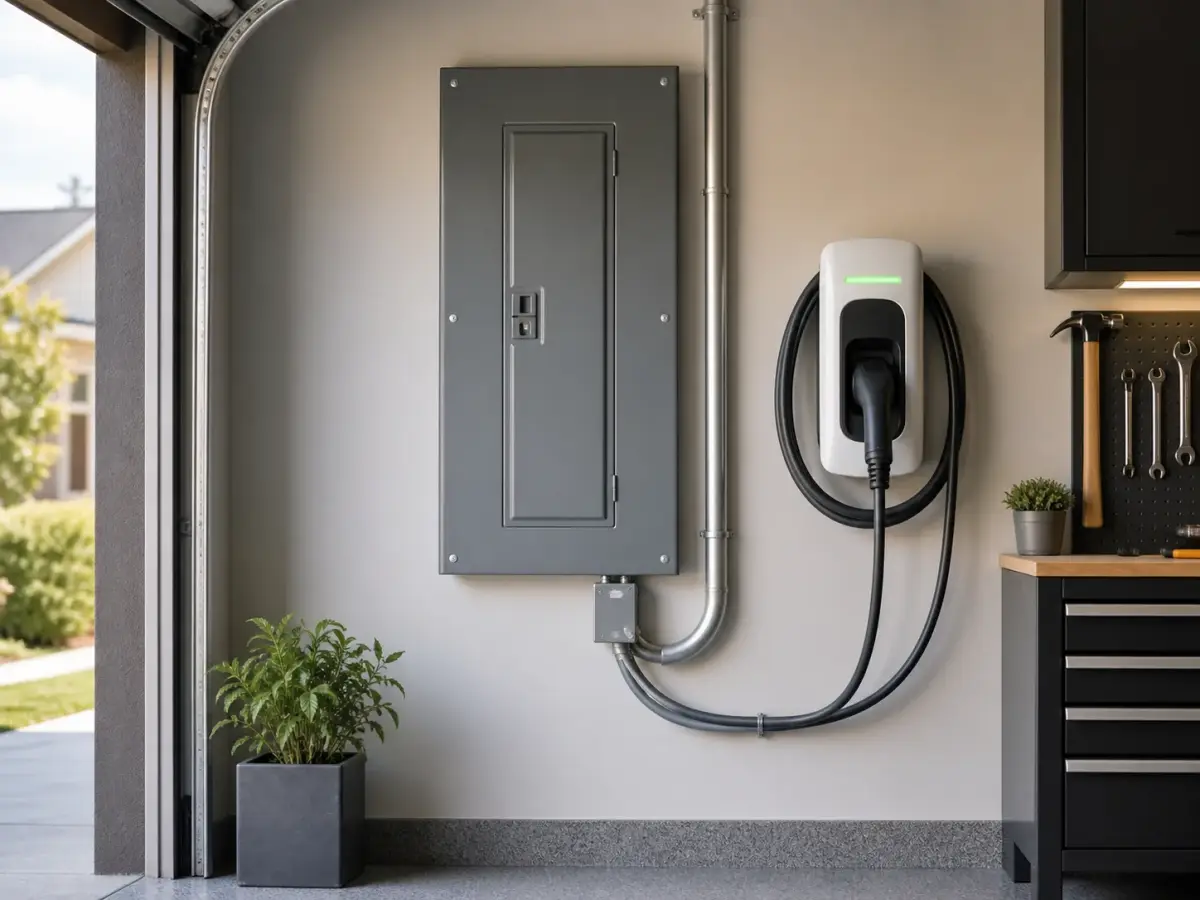
EV charger installation FAQ
Answers before you buy charging equipment or compare electrical proposals.
These answers address the Level 2, panel-capacity, permit, price, connection, Tesla Wall Connector, incentive, off-peak credit, 100-amp service, timing, and quote questions visible in current North Jersey searches without inventing flat prices, guarantees, or automatic rebates.
What is a Level 2 home EV charger?
A Level 2 charging station uses a 240-volt electrical supply and normally charges faster than a portable Level 1 cord connected to a standard 120-volt outlet. The actual charging rate is limited by the vehicle, charging equipment, circuit, temperature, and other operating conditions, so the installation should be planned from the specifications for the vehicle and the selected equipment.
Do I need a panel upgrade before installing a Level 2 charger?
Not automatically. An electrician should review the service rating, panel condition, available breaker space, other major electrical loads, the requested charging load, and the circuit route. Depending on the property and equipment, the correct path may be a dedicated circuit, compatible load-management equipment, panel work, or a service upgrade. The decision should come from the actual load and installation scope rather than the age of the home alone.
Does a New Jersey home EV charger installation require a permit?
New Jersey Department of Community Affairs guidance says installing a new 120- or 240-volt outlet or a direct electrical line for an EV charging system requires a permit and inspection and is classified as minor work. A replacement connected to an existing correctly sized outlet may be treated differently. The local enforcing agency decides the project-specific requirements, in West Orange as in any other New Jersey municipality, so the proposal should identify who handles the permit and inspection.
How much does EV charger or Tesla Wall Connector installation cost in West Orange?
MDL does not publish a flat price because the selected charging equipment, requested charging load, panel and service condition, circuit distance, wall or ceiling access, finished areas, detached structures, trenching, indoor or outdoor location, permit fees, utility requirements, and any panel or service work can change the scope. A Tesla Wall Connector follows the same rule: a full-power 60-amp circuit needs the heavier copper conductors Tesla specifies, while a lower breaker setting may avoid panel work in some homes. Incentives can offset part of the cost for eligible buyers: up to $250 from Charge Up New Jersey toward an eligible charger and up to $1,500 in PSE&G on-bill credit toward eligible customer-side work. Ask for a written proposal that separates charging equipment, electrical work, permit responsibility, restoration, commissioning, and exclusions.
Should a home EV charger be hardwired or plugged into a receptacle?
The right connection depends on the charging equipment instructions, requested load, location, exposure, cord reach, local requirements, and the property's long-term plan. Some equipment is hardwire-only: Tesla's Gen 3 Wall Connector manual requires a hardwired branch circuit and does not allow cord-and-plug connections. The electrician should confirm the permitted method and required circuit protection before work begins.
Can I use a 50-amp breaker for a Tesla Wall Connector?
Yes. Tesla's Gen 3 Wall Connector manual lists a 50-amp breaker at 40 amps of output, or 9.6 kW at 240 volts. Full output, 48 amps or 11.5 kW, needs a standard double-pole 60-amp breaker. The breaker size is programmed into the Wall Connector during commissioning, and the conductors must be sized for the breaker that is installed.
Can I install a Tesla Wall Connector myself?
Tesla's manual says the Wall Connector should only be installed by personnel who are trained and qualified to work on electrical systems. New Jersey Department of Community Affairs guidance says a new 240-volt line for an EV charging system requires a permit and inspection. PSE&G's make-ready program requires a New Jersey-licensed electrician, except that owners of single-family homes may do the work themselves; the permit, inspection, and Tesla's installation instructions still apply.
Are there New Jersey or PSE&G incentives for a home EV charger?
Programs depend on eligibility, approved equipment, utility territory, funding, purchase timing, and documentation. Charge Up New Jersey offers up to $250 for an eligible Level 2 smart charger connected to a compliant network service provider. PSE&G describes an on-bill credit of up to $1,500 per charger for eligible customer-side make-ready work and a possible reduction of up to $5,000 in a utility-side upgrade deposit, and it requires an ENERGY STAR certified Level 2 smart charger. These are not guaranteed installation discounts. Verify the current official rules before buying equipment or starting work.
Do Tesla Wall Connectors qualify for the PSE&G and Charge Up New Jersey incentives?
On October 2, 2026, both Tesla's Gen 3 Wall Connector (part 1457768) and the Universal Wall Connector (part 1734412) were on Charge Up New Jersey's eligible charger list and in the ENERGY STAR certified Level 2 charger database that PSE&G requires. Eligibility still depends on the account, network connection, documentation, and available funding, so confirm with each program before buying.
Is the PSE&G EV off-peak charging credit still available?
No. PSE&G says its Electric Vehicle Off-Peak Charging Credit was discontinued on October 1, 2026, and new enrollments stopped on January 13, 2026. PSE&G now offers a Time of Use rate it describes as EV-friendly. Compare it with the account's current rate before setting a charging schedule.
Can a 100-amp electrical service support a Level 2 charger?
The service rating by itself is not enough to answer. Existing heating, cooling, cooking, water-heating, dryer, and other loads, the requested charging load, panel condition, and applicable load calculation all matter. Some West Orange properties may have a compliant path that does not require an automatic 200-amp upgrade, while others may need panel, service, or utility work. An electrician must evaluate the actual property and equipment.
How long does a home EV charger installation take?
There is no responsible universal time promise. A short accessible circuit route and an approved permit path can be different from a detached garage, finished interior, outdoor run, trench, panel project, service change, or utility-side work. Ask the written proposal to identify permits, material availability, inspections, utility coordination, restoration, and the conditions that control scheduling.
What should I send with an EV charger quote request?
Include the West Orange or North Jersey address and property type, utility, vehicle and charging-equipment specifications, desired parking and equipment location, panel and service-label photos when safe, approximate route and obstacles, other major electric equipment, landlord or association approval needs, and desired timing. If an incentive may apply, keep the charger invoice and serial number, paid electrician invoice, permit, and final inspection records required by the current program.