
01 / The short answer
An inlet outside, a lockout inside, and a permit on file: that is a legal generator hookup in New Jersey.
When the lights go out, the tempting shortcut is a cord from the generator into a wall or dryer outlet. It is the one move that PSE&G, JCP&L's parent company FirstEnergy, and the state's Division of Fire Safety all tell homeowners never to make. The legal version has three parts: a power inlet on the outside wall that the generator cord plugs into, a device inside that makes it physically impossible for generator power and utility power to meet, and an electrical permit with an inspection.
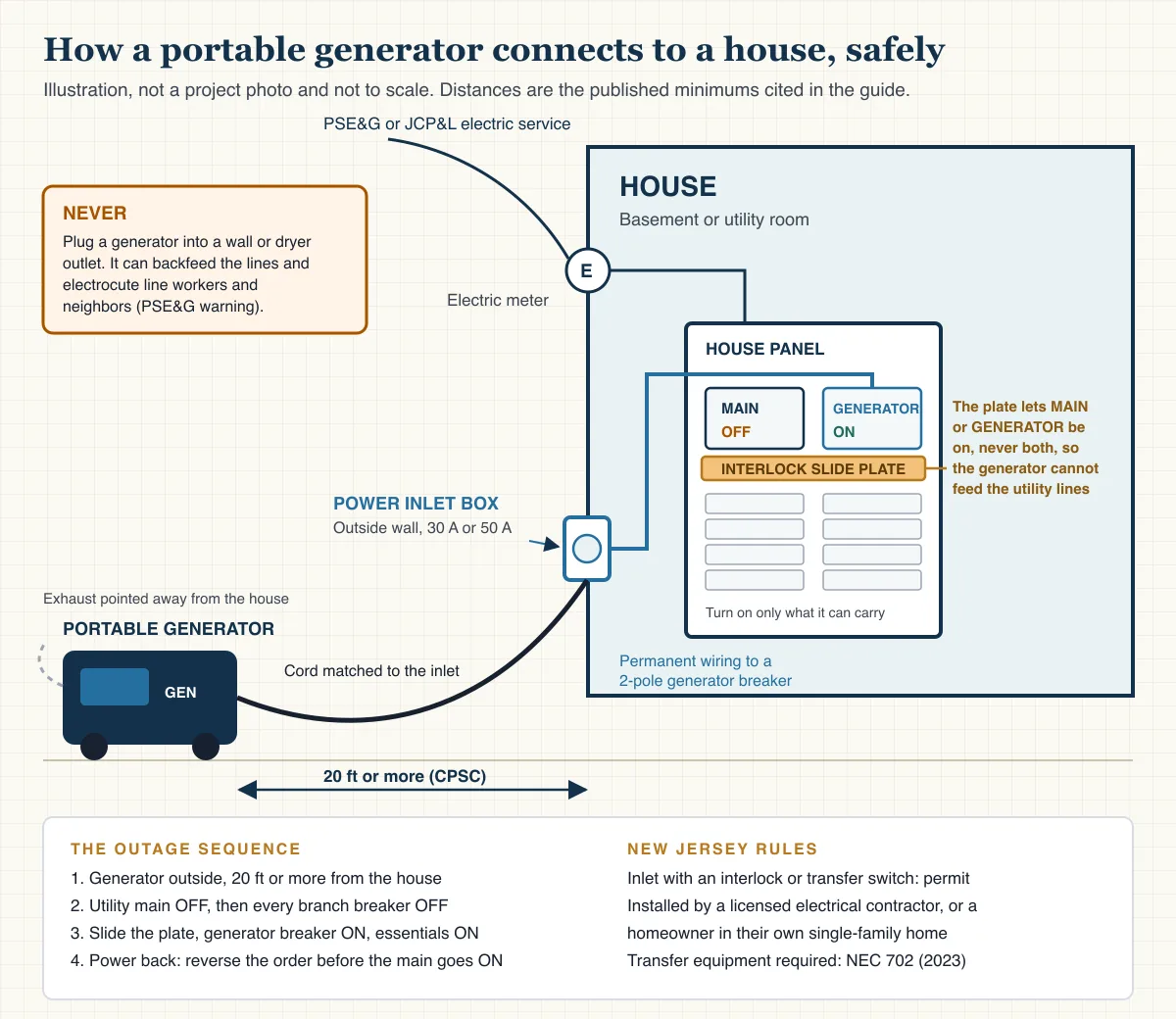
The device inside is the real decision. A panel interlock kit is a sliding plate on your existing breaker panel that lets either the main breaker or a generator breaker be on, never both. A manual transfer switch is a small separate panel, wired beside the main one, that moves a fixed set of circuits from utility power to generator power with one selector per circuit. The inlet box is not a third choice: it is the outdoor plug that both setups normally use.
Winter is when this matters most. In the Consumer Product Safety Commission's latest report, 64 percent of 2022's estimated consumer-product carbon monoxide deaths happened from November through February, and the agency links part of that to portable generators run during snow and ice outages. New Jersey has had long winter-season outages before: the Board of Public Utilities records that the October 2011 snowstorm took seven days to restore about one million customer outages.
HomeGuide's range: the kit $50 to $150, supplies such as the breaker, inlet box, and cord $200 to $400, and labor $150 to $300.
The same range appears on HomeGuide and on Angi's cost page updated July 10, 2026.
Reliance Controls rates its 30-amp L14-30 transfer equipment at 7,500 watts and its 50-amp models at 12,500 watts.
The state construction code requires a permit before regulated equipment is installed; its only portable generator exemption is for carnivals and fairs.
If your panel has a listed interlock kit and room for the generator breaker, the interlock is the lower-cost route and leaves every circuit available. If it does not, or you want the circuits fixed and labeled at installation, choose a manual transfer switch. Either way, the outdoor inlet, the permit, and the 20-foot carbon monoxide rule come with it.
02 / Never backfeed
Why a generator cord into a wall or dryer outlet can kill a lineworker down the street.
Backfeeding is generator power flowing out of the house and into the utility's wires. A double-male cord into a dryer outlet does exactly that, because nothing stops the electricity from leaving through the main breaker and the meter. Crews restoring an outage may treat those wires as dead. Generac's support article states it directly: utility workers repairing lines may assume the lines are de-energized, and backfed power from a portable generator can seriously injure or kill them. OSHA warns that a generator attached to a building's wiring without a properly installed transfer switch can energize wiring systems for great distances.
What the utilities and the state tell New Jersey homeowners
- PSE&G: "By law, you are responsible for making sure your generator's electricity doesn't feed back into PSEG's power lines." The utility adds that owners are legally responsible for safety incidents caused by improperly installed generators, and tells them to have a qualified electrician size and install the unit and a local electrical inspector check it.
- FirstEnergy, the parent of JCP&L: never connect a generator to home wiring without "a proper isolation device," because otherwise it "could start a fire and/or electrocute a service crew member working to restore your power." Plugging into a wall outlet also "bypasses some of the built-in household circuit protection devices."
- NJ Division of Fire Safety, after Ida in 2021: an improperly installed generator's backfeed "could kill or severely injure a lineman working to restore your power."
- NJ Department of Community Affairs, before Sandy in 2012: backfeeding can "electrocute anyone who comes in contact with them – even if the line seems dead."
The fix is an isolation device, and the code names it. Article 702 of the National Electrical Code, which covers optional standby systems including portable ones, requires transfer or interconnection equipment that is listed and installed to prevent the inadvertent interconnection of all sources of supply. An interlock kit and a manual transfer switch both meet that requirement when the product is listed and installed as its instructions say. A cord with two male ends meets none of it, and the CDC guidance republished by the International Association of Electrical Inspectors names it as the thing never to use.
03 / Side by side
Interlock kit, manual transfer switch, or extension cords: how the three compare.
Three ways to use a portable generator at home are legal in New Jersey. Two connect to the house wiring and need a permit. The third never touches the wiring at all: the generator stays outside and heavy cords run to the appliances. The table compares them on the questions homeowners ask first.
Swipe across the table to see every column.
| Method | What gets installed | How circuits are chosen | Published installed cost | New Jersey permit |
|---|---|---|---|---|
| Interlock kit with inlet | A listed slide plate on the existing panel, a two-pole generator breaker, an outdoor inlet box, and the wiring between them | Any breaker in the panel, switched on by hand during the outage | $400 to $850 (HomeGuide); a $50 to $150 kit plus $400 to $800 labor (Consumer Reports, January 2024) | Electrical permit; Verona requires the interlock to be listed and labeled |
| Manual transfer switch with inlet | A small separate panel wired to selected circuits, plus the inlet box and cord | Only the circuits wired to it, each with its own selector | $400 to $1,300 (HomeGuide and Angi); $500 to $1,500 (Consumer Reports) | Electrical permit; the switch must be listed |
| Extension cords to appliances | Nothing on the house; outdoor-rated cords from the generator to each appliance | Whatever is plugged into the cords | Cords only | None, if nothing connects to the house wiring (Manalapan Township FAQ) |
Consumer Reports adds a requirement that applies to both wired routes: the generator needs to be at least 5,000 watts with a 240-volt outlet. HomeGuide uses the same 5,000-watt floor for a transfer switch. A small inverter generator with only 120-volt household outlets is an extension-cord generator, whatever the house wiring looks like.
04 / Interlock kits
How a generator interlock kit works, and why your panel decides whether you can use one.
Square D's instruction bulletin for its Homeline and QO kits explains the device in one sentence: the bracket "will allow only one main circuit breaker to be in the ON (I) position at any time." The bracket slides between the handle of the utility main breaker and the handle of a second, two-pole breaker that the generator feeds through the inlet. A separate retaining bracket, in the bulletin's words, "is used to secure a generator supply branch breaker onto the interior assembly when the breaker is used as a back-fed main circuit breaker." With the main on, the generator breaker cannot be switched on; with the generator breaker on, the main cannot.
The catch is fit. Interlock kits are built for specific panel lines, not for panels in general. Square D's bulletin covers QO and Homeline load centers rated 150 to 225 amps that use QOM2 main breakers, and Home Depot's listing for the Square D HOMCGK2C says it is for "Square D Homeline main breaker indoor 150A-225A panels." Siemens' ECSBPK02 attaches to the breakers rather than the panel cover. The same Square D bulletin warns that its GFI and AFI breakers cannot serve as the back-fed generator breaker. The panel's label therefore decides the kit, and a panel with no listed kit for it cannot take an interlock at all.
Will a New Jersey inspector pass an interlock?
Generac's own support article says interlocks are "not universally accepted in all jurisdictions" and that manual transfer switches are "often preferred by inspectors." New Jersey has no statewide bulletin on the question, so the answer sits with your town's electrical subcode official. In Essex County, Verona's building department publishes its rule: an interlock on an existing panel needs a permit and "must be listed and labeled by recognized testing lab," and the applicant provides the cut sheet. Before buying a kit, find the panel's brand and model on its label and confirm a listed kit exists for it; that cut sheet is what the permit application will need.
What an interlock gives you, and what it asks of you
The advantage is choice. Every circuit in the house stays available, and during the outage you decide at the panel which branch breakers the generator carries. The cost is discipline. Nothing stops someone from switching on an electric dryer breaker while the furnace and sump pump are already running. For a manual connection, the National Electrical Code puts that responsibility on the owner: the generator must be sized to supply all the loads the user intends to operate at one time. Label the essential breakers before the first storm, and keep the switching steps from section 10 taped inside the panel door.
05 / Manual transfer switches
How a manual transfer switch works, and the limits that come with it.
A manual transfer switch is a small panel of its own, mounted beside the main panel. At installation, each circuit you want on generator power is moved so that it runs through the switch. Reliance Controls' manual describes the controls as "Circuit selector switches. These switches allow you to select either GEN (generator) or LINE (utility) as the power source for the branch circuits". Because each circuit has its own selector, the switch cannot send generator power back to the utility, and Reliance states that its Pro/Tran2 switches are UL listed to Standard 1008, the transfer-switch standard, and suitable for use under Article 702.
The common sizes are small. Reliance's 3006HDK kit carries 6 circuits at 30 amps and 7,500 watts and showed about $299 at Home Depot on October 8, 2026; its 310CRK kit carries 10 circuits for $474.86. Both kits include a 10-foot generator cord and an outdoor inlet box. Generac's HomeLink 30-amp manual transfer switch lists at $429.99, feeds 8 to 10 essential circuits, and is compatible with generators from 5 kW that have a 30-amp L14-30 outlet.
The disadvantages of a manual transfer switch
- The circuits are fixed. Only the circuits wired in at installation can run on the generator. Adding one later is new electrical work.
- The count is limited. Six or ten circuits on Reliance's 30-amp kits, eight to ten on Generac's HomeLink.
- The capacity is capped. Reliance rates its 30-amp switches at 7,500 watts and its 50-amp switches at 12,500 watts, whatever the generator can produce.
- The neutral matters. Reliance's manual says "The Protran2 does not switch the neutral wire. As such, it is intended to be used with a generator that has a floating neutral (ground and neutral not bonded) configuration." Check your generator's neutral before buying a switch.
- Someone has to be home. Manual and nonautomatic transfer switches require human intervention, so the house stays dark until a person starts the generator and moves the selectors.
- It is an electrician's install. Reliance's own warning: "Installation must be performed by a qualified electrician in compliance with all applicable electrical codes".
06 / The inlet and the cord
The inlet box and cord: match them to the generator's 240-volt outlet, then mind the 20 feet.
The power inlet is a weatherproof male receptacle mounted on the outside wall. The generator cord's female end plugs into it, and permanent wiring runs from the inlet to the interlock's generator breaker or to the transfer switch. The 2023 National Electrical Code requires the flanged inlet for a portable generator to be located outside the building, which rules out an inlet in a garage or basement.
Swipe across the table to see every column.
| Inlet | Maximum watts (Reliance rating) | Inlet box, Home Depot | Matching cord, Home Depot |
|---|---|---|---|
| 30 A, 4-prong L14-30 | 7,500 W | $64.90 (Reliance PB30) | $69.99 to $99.00 for 25 feet (FIRMAN, Champion, RIDGID) |
| 50 A, CS6375 style | 12,500 W | $62.95 (Connecticut Electric EGSPI50) | $189.99 for a 10-foot Generac 50-amp cord; Reliance lists its 50-amp cords as CS6364 / CS6365 |
Reliance's ratings assume 250 volts: 30 amps times 250 volts is 7,500 watts, and 50 amps times 250 volts is 12,500 watts. At 240 volts the same arithmetic gives 7,200 and 12,000 watts, which is why other sources quote slightly lower figures. In practice the generator's largest 240-volt outlet sets the size: a generator with an L14-30 outlet pairs with a 30-amp inlet and cord, and the generator breaker in the panel is sized to match.
The warning sign at the inlet, and why the neutral is on it
The code requires a warning sign next to a power inlet that states which kind of generator may be connected: either "FOR CONNECTION OF A SEPARATELY DERIVED (BONDED NEUTRAL) SYSTEM ONLY" or "FOR CONNECTION OF A NONSEPARATELY DERIVED (FLOATING NEUTRAL) SYSTEM ONLY." Some portable generators bond the neutral to the frame and some leave it floating, and the house wiring has to be set up for one or the other. A generator bought after the hookup should match the sign, not the other way around. Where the house has the outdoor emergency disconnect that newer services require, a second sign there must show where the generator disconnect is.
How far can the generator be from the inlet or transfer switch?
The sources behind this guide set no maximum, but they are firm on the minimum, and the cord sets the practical limit. The CPSC says to run a portable generator outside only, at least 20 feet from the house, and not on a porch or in a carport. PSE&G says at least 20 feet from doors, windows, and vents. The CDC says more than 20 feet from windows, doors, and vents, and never in a garage even with the door open. Three brands of L14-30 cord on Home Depot's shelf were 25 feet long, and the transfer switch kits ship with 10-foot cords. So the inlet's location has to let the generator stand 20 feet from every opening and still reach the inlet. Pick the safe generator spot in the yard first, then put the inlet where a cord from that spot arrives; on a narrow Essex County side yard or a townhouse with an attached garage, that decision shapes the whole job.
07 / What it will run
What a 7,500-watt hookup will actually run in a New Jersey winter outage.
Because a portable hookup is a manual connection, the code sizes it to what you choose to run at once, not to the whole house. Reliance prints a load table in its transfer switch manual with the running watts of common appliances and the extra watts each motor needs for a moment as it starts. These are the loads a North Jersey household usually wants back first in a winter outage.
Swipe across the table to see every column.
| Load | Running watts | Added watts to start |
|---|---|---|
| Furnace blower, gas or oil, 1/3 hp | 700 | 1,400 |
| Furnace blower, gas or oil, 1/2 hp | 875 | 2,100 |
| Sump pump, 1/3 hp | 800 | 1,300 |
| Sump pump, 1/2 hp | 1,050 | 2,150 |
| Refrigerator or freezer | 800 | 2,300 |
| Shallow well pump, 1/2 hp | 1,000 | 2,350 |
| Microwave oven | 600 to 1,500 | 0 |
| Television | 100 to 300 | 0 |
| Clothes dryer, gas | 700 | 1,800 |
Here is a worked example using the table, our arithmetic rather than Reliance's statement. A half-horsepower furnace blower, a half-horsepower sump pump, a refrigerator, and a half-horsepower shallow well pump add up to 3,725 running watts. Add the largest single starting surge, the well pump's 2,350, and the worst moment is about 6,075 watts. That fits under a 30-amp inlet's 7,500-watt rating as long as the big motors are not all started at the same instant. Reliance's own advice is to "Alternate use of larger loads (furnace motors, well pumps, refrigerators, etc.) to balance the load" and not to exceed the switch's maximum wattage.
For scale, Generac lists an 8,000-watt portable with its COsense carbon monoxide shutdown at $1,159, rated 10,000 starting watts and about 10 hours of run time at half load. A generator that size has headroom over the example above; a 5,000-watt unit would need the loads taken in turns.
Will a portable generator run a modern furnace or boiler?
Often, but check first. Champion, a portable generator maker, says its conventional portables put out power with about 12 to 20 percent total harmonic distortion, while its inverter and home standby lines stay under 3 percent. It tells owners of a high-efficiency furnace control board to ask the appliance manufacturer whether the board needs low distortion to run properly. Look in the furnace or boiler manual, or ask its maker, before relying on a conventional portable for heat; an inverter generator answers the question if the manual asks for clean power.
08 / What it costs
What the hookup costs: the parts at today's retail prices, and what the installed ranges cover.
Two kinds of numbers are public. Retail prices for the parts show what the hardware costs; installed ranges from cost publishers show what finished jobs have cost elsewhere. Neither is a quote for your panel. The parts below were priced at Home Depot's Montville, New Jersey store on October 8, 2026, and they change daily.
Swipe across the table to see every column.
| Part | Example model | Price |
|---|---|---|
| Interlock kit, Square D Homeline 150 to 225 A | HOMCGK2C | $96.35 |
| Interlock kit, Siemens | ECSBPK02 | $53.64 (out of stock that day) |
| 30 A inlet box, L14-30 | Reliance PB30 | $64.90 |
| 50 A inlet box | Connecticut Electric EGSPI50 | $62.95 |
| 25-foot 30 A cord, L14-30 | Champion 100395 | $83.99 |
| 6-circuit 30 A transfer switch kit with cord and inlet box | Reliance 3006HDK | About $299 |
| 10-circuit 30 A transfer switch kit with cord and inlet box | Reliance 310CRK | $474.86 |
| 30 A manual transfer switch | Generac HomeLink 6853 | $429.99 list price at generac.com |
Swipe across the table to see every column.
| Source | Interlock installed | Manual transfer switch installed | Labor and permit notes |
|---|---|---|---|
| HomeGuide (figures last modified April 2023) | $400 to $850 | $400 to $1,300 | Electricians $50 to $130 an hour plus a $75 call-out fee, 2 to 4-plus hours; permits $50 to $350 |
| Angi (updated July 10, 2026) | Not priced separately | $400 to $1,300 | $50 to $100 an hour for 2 to 4 hours; permits $50 to $350 |
| Consumer Reports (updated January 2024) | $50 to $150 kit plus $400 to $800 labor | $500 to $1,500 | Generator of at least 5,000 watts with a 240-volt outlet |
A note on dates: HomeGuide's page carries a 2026 title, but its structured data shows the figures were last modified on April 5, 2023, so treat them as 2023-era numbers. Angi's page was updated this July and agrees with HomeGuide on the manual transfer switch.
New Jersey permit fees
Each municipality sets its own construction fees by ordinance (N.J.A.C. 5:23-4.17). West Orange's schedule sets a $100 minimum electrical fee, and plan review, where it applies, adds 36 percent of the permit fee. Montclair's Ordinance O-25-04 raised its electrical minimum to $85 in 2025. Where the state's Division of Codes and Standards is the enforcing agency, its own table charges $50 for the first block of 1 to 50 devices and $15 for each receptacle rated 30 to 50 amps. Which line a town applies to an inlet, interlock, or transfer switch is the local office's call, so ask when you file.
The published ranges assume a panel that accepts the equipment. If your panel has no listed interlock kit or no room for a generator breaker, the job becomes a transfer switch, or panel work first; the panel upgrade guide explains that path. Compared with a home standby unit, which the whole house generator cost guide prices from Generac's own lists, a portable hookup is a fraction of the spend, and it asks more of the person at home.
09 / New Jersey rules
Permit, installer, and inspection: what New Jersey requires for a generator inlet and interlock.
A permit is required
The Uniform Construction Code makes it unlawful to install or alter regulated equipment without first applying to the construction official and obtaining the permit (N.J.A.C. 5:23-2.14(a)). The state's no-permit ordinary maintenance list covers like-for-like replacement of receptacles, switches, and fixtures, and its electrical minor-work list covers items such as five or fewer outlets on adequate circuits. Neither list mentions a generator inlet, interlock, or transfer switch, and the only portable generator exemption in the code is for carnivals and fairs. The Division of Codes and Standards has no bulletin that names these devices, so the plainest statements come from the towns themselves.
- Verona, Essex County: "Portable generators require a permit for the male receptacle, transfer switch or interlock on existing panel, interlock must be listed and labeled by recognized testing lab (provide cut sheet for interlock)." The same checklist requires the installation to comply with NEC Article 702 and a load calculation under Article 220.
- Manalapan, Monmouth County: if the generator only feeds appliances through extension cords, no permit is required; if it connects to the home's electrical system, it needs a transfer switch or interlock with an inlet, "an electrical permit and installation by a NJ Licensed Electrical contractor or a Homeowner residing in their own single family home."
Who may do the work
Your own single-family home
The construction code lets licensed-trade work be done by "a single-family homeowner on his or her own dwelling" (N.J.A.C. 5:23-2.15), and the electrical licensing law exempts work a person does on a dwelling occupied solely as a residence for that person or immediate family (N.J.S.A. 45:5A-18(n)). The homeowner files as an exempt applicant. The permit and every inspection still apply. Because the code's wording is single-family, the owner of a two-family house should ask the construction office before filing that way.
A licensed electrical contractor
New Jersey's licensing law says "Any single act or transaction shall constitute engaging in the business of electrical contracting" (N.J.S.A. 45:5A-9), so wiring a neighbor's or a relative's interlock takes a licensed electrical contractor with a business permit. The state has one electrical license category, and the contractor's seal and signature go on the electrical technical section of the permit application.
What the inspector will check
- The permit covers each part: the inlet, the interlock or transfer switch, and the generator breaker, as Verona's checklist lists them.
- Listed equipment: an interlock listed and labeled for that panel, with its cut sheet, or a listed transfer switch.
- No path between sources: the equipment must prevent generator and utility power from ever connecting (NEC 702.5).
- An outdoor inlet with its sign: the flanged inlet outside the building, with the bonded or floating neutral warning sign beside it.
- The load calculation: Verona asks for a load calculation of everything connected to the generator under Article 220.
- The disconnect sign: where the house has the outdoor emergency disconnect required at one- and two-family dwellings, a sign there showing where the standby disconnect is.
The code edition, and the inspection calls
New Jersey adopted the 2023 National Electrical Code, with Tentative Interim Amendments 1 through 13, as its electrical subcode effective August 17, 2026, so a hookup inspected now is judged against the 2023 edition's Article 702. Calling for the inspections is not optional either. West Orange's construction office, at 66 Main Street, Room 217, warns that homeowners and contractors face monetary penalties starting at $2,000 for failing to call for all rough and final inspections.
10 / Switching over
The outage sequence, step by step, and the way back to utility power.
Square D's bulletin lists the switch-over for its interlock in five steps. Before them, set the generator outside at least 20 feet from the house, connect its cord to the generator and the inlet, and start it as its own manual directs.
With an interlock kit
- Turn OFF the breaker marked Utility, the main.
- Turn OFF all branch circuit breakers.
- Slide the interlock bracket up.
- Turn ON the breaker marked Standby, the generator breaker.
- Turn ON the branch breakers for essential circuits, alternating the larger motor loads rather than starting them together.
When utility power returns, undo it in the reverse order, which is our reading of the bulletin rather than a printed step: branch breakers off, the generator breaker off, the bracket back down, the main on, then the branch breakers. Shut the generator down and disconnect the cord only after the house is back on the utility.
With a manual transfer switch
With the generator running and connected, move each circuit selector on the switch from LINE to GEN, one circuit at a time, watching the switch's capacity. When utility power is back, return each selector to LINE, then shut the generator down. The selectors make it impossible for a circuit to be on both sources, which is the point of the device.
11 / Carbon monoxide
Carbon monoxide: the 20-foot rule, the alarms New Jersey requires, and the shutoff feature to look for.
A correct hookup removes the backfeed danger. Carbon monoxide is the danger that remains, and it is why the generator's location matters as much as the wiring.
The CPSC's May 2026 report estimates generators were involved in 93 of the 274 consumer-product carbon monoxide deaths in 2022.
An estimated 174 of 2022's 274 deaths happened in November, December, January, and February.
The CPSC: outdoors only, at least 20 feet from the house, and not on a porch or in a carport.
PSE&G: "Generators can produce 100 times more carbon monoxide (CO) than a car."
The CPSC says never to run a portable generator inside a home, garage, basement, crawlspace, shed, or other enclosed space, and the CDC adds that this holds even with doors and windows open. New Jersey's Division of Fire Safety warns against running one in any enclosed or partially enclosed structure. Generator-only carbon monoxide deaths averaged 98 a year from 2020 to 2022 in the CPSC's estimates, and 892 deaths since 2012 have involved generators alone.
When buying, look for a carbon monoxide shutoff. The CPSC tells owners to look for portable generators with a CO shut-off safety feature, and says models certified to the PGMA G300-2023 and UL 2201-2023 standards include carbon monoxide safety technologies, with UL 2201 models also cutting CO emissions. A federal mandatory rule is still not final: the CPSC's fall 2025 regulatory agenda lists staff weighing whether to adopt those voluntary standards instead.
The alarms New Jersey requires
In one- and two-family homes that contain a fuel-burning device or have an attached garage, New Jersey's fire code requires carbon monoxide alarms in the immediate vicinity of the sleeping areas, listed to UL 2034, and they may be battery-operated, hard-wired, or plug-in (N.J.A.C. 5:70-4.19). The Division of Fire Safety's bulletin reads "in the vicinity of" as within 10 feet, and its post-Ida advice is to use ten-year sealed battery alarms. The CDC tells generator users to keep a battery-powered or battery-backup CO detector in the home. A plug-in alarm with no battery is silent on the night the generator runs.
12 / Which one fits
Which hookup fits your house: pick by the panel and the people at home.
Swipe across the table to see every column.
| Your situation | Best fit | Why |
|---|---|---|
| Panel has a listed interlock kit and room for the generator breaker | Interlock kit with a 30 A or 50 A inlet | The lowest published installed range, and every circuit stays available during the outage. |
| No listed kit for your panel, or the inspector prefers a switch | Manual transfer switch | A UL 1008 listed switch sidesteps panel fit; the circuits are chosen once, at installation. |
| Generator over 7,500 running watts, or a 240-volt well pump to run | A 50 A inlet with equipment rated to match | Reliance rates its 50-amp models at 12,500 watts against 7,500 for 30-amp models. |
| Renting, or the hookup cannot be permitted yet | Extension cords to individual appliances | No permit when nothing connects to the house wiring; the 20-foot rule still applies. |
| House often empty, or someone depends on powered medical equipment | A home standby generator with an automatic transfer switch | A portable hookup needs a person to start it and switch over; only an automatic system covers an empty house. |
| Full, old, or unlisted panel | Panel work first | The hookup needs a panel that accepts listed equipment and has space for the generator breaker. |
Whichever row fits, the first step is the same: the panel's brand, model, and main breaker rating from its label, the generator's wattage and largest outlet, and the short list of circuits the household needs. MDL's generator and backup power page explains how MDL scopes generator work in West Orange and across Essex County, and storm damage at the house goes to the emergency electrician line before any generator is started.
13 / About this guide
Who wrote this hookup guide, and why it quotes no MDL price.
MDL Electric Cooling & Heating works from 4 Harrison Avenue in West Orange. Its published credentials are a New Jersey electrical contractor license (#34EI01606200), an electrical business permit (#34EB01606200), and a New Jersey master HVACR license (#19HC00308200); anyone can check them on the Division of Consumer Affairs license verification system. Brands and models appear here to show real products and real retail prices; they are not dealer or certification statements, and no manufacturer or retailer paid or asked to appear. The prices are public figures, not MDL quotes. MDL confirms which parts of a hookup it performs in a written scope after seeing the panel. Contact MDL or use the request form below.
14 / Direct answers
Portable generator hookup questions New Jersey homeowners ask.
Can I plug a generator into a wall or dryer outlet to power my house?
No. Plugging a generator into a wall or dryer outlet backfeeds power into the utility lines. PSE&G warns that this puts utility workers, neighbors, and your own household at risk of electrocution, and says that by law the owner is responsible for keeping generator power off its lines. FirstEnergy, the parent of JCP&L, adds that it bypasses household circuit protection. Use an outdoor power inlet with a listed interlock kit or manual transfer switch, installed under an electrical permit.
What is a generator interlock kit?
A generator interlock kit is a listed sliding plate mounted on your breaker panel that lets either the main breaker or a generator breaker be on, never both. Square D's bulletin says the bracket will allow only one main circuit breaker to be in the ON position at any time. The generator feeds a two-pole breaker through an outdoor inlet, and you choose which branch circuits to turn on. Kits are made for specific panel lines, so the panel's label decides which kit, if any, fits.
How much does it cost to install a generator interlock kit in New Jersey?
HomeGuide puts an interlock at $400 to $850 installed: the kit $50 to $150, supplies such as the breaker, inlet box, and cord $200 to $400, and labor $150 to $300, from figures last modified in 2023. Consumer Reports gives $50 to $150 for the kit plus $400 to $800 for labor. On October 8, 2026, Home Depot listed the Square D HOMCGK2C kit at $96.35 and a Reliance 30-amp inlet box at $64.90. Add the town's electrical permit: West Orange's minimum electrical fee is $100 and Montclair's is $85.
Is an interlock kit or a manual transfer switch better?
It depends on the panel. An interlock costs less to install ($400 to $850 against $400 to $1,300 on HomeGuide) and leaves every circuit available, but it needs a listed kit made for your panel and some inspectors prefer switches; Generac says interlocks are not universally accepted. A manual transfer switch works with any panel and fixes the circuits at installation, usually 6 to 10 of them. Both need an outdoor inlet, an electrical permit, and listed equipment in New Jersey.
What are the disadvantages of a manual transfer switch?
Only the circuits wired into it at installation can run on the generator, usually 6 or 10 on Reliance's 30-amp kits and 8 to 10 on Generac's HomeLink. Capacity is capped at the switch rating, 7,500 watts for Reliance's 30-amp models. Reliance's Pro/Tran2 does not switch the neutral, so it is meant for floating-neutral generators. Someone has to be home to start the generator and move the selectors, and Reliance says a qualified electrician must install it.
Do I need a permit to install a generator inlet and interlock in New Jersey?
Yes. The Uniform Construction Code requires a permit before regulated electrical equipment is installed, and a generator inlet, interlock, or transfer switch is not on the state's ordinary maintenance or minor work lists. Verona's building department requires a permit for the inlet, transfer switch, or interlock and a listed, labeled interlock with its cut sheet, and Manalapan's FAQ says the same. Extension cords run straight to appliances need no permit.
Can I install a generator interlock myself in New Jersey?
On the single-family home you own and live in, yes, with a permit and inspections. The construction code allows licensed-trade work by a single-family homeowner on his or her own dwelling, and the electrical licensing law exempts work on a home occupied by you and your immediate family. Doing it for anyone else requires a licensed electrical contractor, because New Jersey law says any single act or transaction counts as electrical contracting. Owners of two-family houses should ask the construction office first.
How far away can a generator be from the transfer switch or inlet?
The cord length sets the practical limit, and the safety rules set the minimum. The CPSC says to run a portable generator outdoors at least 20 feet from the house, not on a porch or in a carport, and PSE&G says at least 20 feet from doors, windows, and vents. Common L14-30 cords are 25 feet long, and transfer switch kits ship with 10-foot cords, so place the outdoor inlet where a cord from a safe spot 20 feet out can reach it.
What size generator do I need to run a furnace, sump pump, and refrigerator?
Add the running watts, then the largest starting surge. Using Reliance's table, a half-horsepower furnace blower (875), a half-horsepower sump pump (1,050), and a refrigerator (800) run on about 2,725 watts, and the refrigerator's 2,300-watt start brings the peak to about 5,025 watts. Add a half-horsepower well pump and the peak is about 6,075 watts. A generator in the 7,500-watt class on a 30-amp inlet covers that if the big motors start one at a time.
Can a portable generator switch on automatically when the power goes out?
No. An interlock kit and a manual transfer switch both require a person to start the generator and switch over, and the code calls manual and nonautomatic transfer switches equipment that requires human intervention. Automatic start needs a home standby generator with an automatic transfer switch, which is a larger project with its own gas, permit, and zoning steps in New Jersey.
Does a transfer switch need to match my main panel's amp rating or the generator?
The generator. A manual transfer switch for a portable carries only the circuits wired to it, so it is sized to the generator's outlet and the inlet, not to the main panel. Generac's HomeLink 30-amp switch is made for generators from 5 kW with a 30-amp L14-30 outlet, and Reliance rates its 30-amp switches at 7,500 watts and its 50-amp switches at 12,500 watts.
15 / Source record
Sources, all retrieved October 8, 2026
Codes, prices, and utility guidance change. Every figure and quotation on this page was read from the source below on October 8, 2026. The wattage examples and the volt-amp arithmetic are our calculations on the sourced inputs, and the reverse switching order is our reading of Square D's steps. NFPA's own text of the 2023 code requires a login, so the Article 702 wording comes from Mike Holt's 2023 restatement. Nothing here is an MDL price, and no source was paid or asked to appear.
- N.J.A.C. 5:23-2 — Uniform Construction Code administrationPermit requirement, ordinary maintenance, minor work, the carnival exemption, and the homeowner rule.
- NJ DCA — current construction codesThe 2023 National Electrical Code with TIAs 1 to 13, effective August 17, 2026.
- N.J.A.C. 5:23-4 — enforcing agency feesMunicipal fee ordinances and the state's own electrical fee table.
- N.J.S.A. 45:5A-9 and 45:5A-18, as amended by P.L.2021, c.479Electrical contracting license, the single-act rule, and the homeowner exemption.
- NJ Board of Examiners of Electrical Contractors — FAQOne electrical license category in New Jersey.
- Township of Verona — generator permit requirementsPermit for the inlet, transfer switch, or interlock; listed interlock and cut sheet; Article 702 and Article 220.
- Manalapan Township — generator FAQNo permit for extension cords; permit and installer rule for an inlet with an interlock or transfer switch.
- Township of West Orange — construction code enforcementInspection calls and penalties; the township fee schedule supplies the electrical minimum and plan review rate.
- Township of Montclair — Ordinance O-25-04Electrical permit minimum of $85.
- Mike Holt — 2023 NEC generators and standby power systemsArticle 702 scope, listed transfer and interconnection equipment, outdoor inlet, inlet warning sign, disconnect sign, and manual load sizing.
- Square D (Schneider Electric) — generator interlock kit bulletin 40273-809-02How the interlock works, panel fit, breaker limits, and the switch-over steps.
- Reliance Controls — manual transfer switch instructionsCircuit selectors, the neutral, the installer warning, wattage ratings by inlet, and the appliance wattage table.
- Reliance Controls — Pro/Tran2 catalogUL 1008 listing and 50-amp cord types.
- Generac — HomeLink 30-amp manual transfer switchList price, circuit count, and generator compatibility.
- Generac — what is an interlock kitInterlocks not universally accepted; manual switches often preferred by inspectors.
- Generac — why you should never back feed your electric panelThe danger backfeed poses to utility crews.
- Generac — 8,000-watt portable with COsenseList price, starting watts, and run time.
- Champion Power Equipment — total harmonic distortionDistortion figures and the furnace control board advice.
- The Home Depot — hookup partsInterlock kits, inlet boxes, cords, and transfer switch kits at the Montville store.
- HomeGuide — generator transfer switch installation costInterlock and manual transfer switch installed ranges, labor, and permits; figures last modified April 2023.
- Angi — generator transfer switch cost, updated July 10, 2026Manual transfer switch installed range, labor, and permits.
- Consumer Reports — why a portable generator needs a transfer switchInterlock and transfer switch costs and the 5,000-watt, 240-volt requirement; updated January 2024.
- PSE&G — generator safetyBackfeed warning, legal responsibility, inspection advice, distance, and the comparison with a car's carbon monoxide.
- FirstEnergy — using backup generatorsIsolation device requirement and the wall-outlet warning for JCP&L's parent company.
- NJ Division of Fire Safety — generator safety after Ida, 2021Backfeed danger to linemen, enclosed spaces, and ten-year sealed battery alarms.
- NJ Department of Community Affairs — generator advisory before Sandy, 2012Backfeeding can electrocute anyone in contact with the lines.
- OSHA — portable generator fact sheetAttaching a generator without a transfer switch can energize wiring for great distances.
- IAEI Magazine — winter electrical safety and generators (CDC guidance)Never connect a generator to branch circuits with a double-male cord.
- CPSC — non-fire carbon monoxide deaths, 2022 estimates (May 2026)Generator deaths, the 2020 to 2022 average, the total since 2012, and the cold-month share.
- CPSC — winter storm safety release, December 2025The 20-foot rule, porches and carports, enclosed spaces, and the CO shut-off feature.
- CPSC — generator hazards release, May 2026PGMA G300-2023 and UL 2201-2023 carbon monoxide safety technologies.
- CPSC — portable generator rule, fall 2025 regulatory agendaThe mandatory standard is not final.
- CDC — carbon monoxide poisoning basicsMore than 20 feet from openings, never in a garage, and a battery or battery-backup detector.
- N.J.A.C. 5:70-4.19 — smoke and carbon monoxide alarmsCO alarms near sleeping areas in one- and two-family homes with a fuel-burning device or attached garage.
- NJ Division of Fire Safety — Bulletin 2017-1, carbon monoxide"In the vicinity of" read as within 10 feet.
- NJ Board of Public Utilities — outage restoration recordThe October 2011 snowstorm's seven-day restoration of about one million customer outages.