
01 / The short answer
The generator is about a third of the bill. The rest is what makes it legal to switch on in New Jersey.
People who search for a whole house generator cost usually find one of two numbers: a list price for the machine, or a national installed average that does not say what it includes. Neither tells a West Orange, Montclair, or Livingston homeowner what the finished job will cost, because the finished job includes a transfer switch, wiring into the electrical service, a gas line, a pad, permits from the town, and a gas service application to PSE&G.
Generac's own installation page describes the split plainly: the generator is roughly one third of its installed estimate, and installation, system equipment, and materials are the other two thirds. That is why this guide starts with the list prices, then walks through every line a New Jersey installed price has to carry, with the source and date for each figure.
10 kW generator only to 28 kW with a 200-amp transfer switch, generac.com MSRP, retrieved September 23, 2026.
Generac's published range for a home standby install, including the generator, system equipment, materials, and installation.
Electrical fee for a 10.1 to 35 kW generator plus the gas piping fee in the township fee schedule; other electrical and plumbing minimums can apply.
PSE&G requires an application to add gas generator load and says these projects can take up to six weeks.
Budget from the list price up, not from a national average down. Then ask every proposal to show the transfer switch, service work, gas line, pad, permits, and PSE&G step as separate lines.
02 / Price by kW
Generac list prices by size, with and without the transfer switch.
Generac publishes a manufacturer's suggested retail price on every home standby product page. The current air-cooled range comes in each size as a generator alone or as a bundle with a 200-amp, service-rated automatic transfer switch. The kilowatt ratings below come from Generac's spec sheets, which rate every size except the 14 kW lower on natural gas than on propane. West Orange and Montclair are in PSE&G's gas territory, so for a house with gas service the second rating is the one to size against.
Swipe across the table to see every column.
| Size | Rating, propane / natural gas | Generator only | With 200 A automatic transfer switch |
|---|---|---|---|
| 10 kW | 10 kW / 9 kW | $3,769 (model 7257) | $4,619 (model 7321) |
| 14 kW | 14 kW / 14 kW | $4,889 (model 7258) | $5,949 (model 7323) |
| 18 kW | 18 kW / 17 kW | $5,709 (model 7259) | $6,769 (model 7324) |
| 22 kW | 22 kW / 21 kW | $6,309 (model 7260) | $7,369 (model 7325) |
| 24 kW | 24 kW / 22.5 kW | $6,729 (model 72610) | $7,789 (model 7326) |
| 26 kW | 26 kW / 24 kW | $7,159 (model 7327) | $8,219 (model 7328) |
| 28 kW | 28 kW / 25 kW | $8,159 (model 7282) | $9,509 (model 7329, includes a smart thermostat) |
Retail prices can sit below list. On the same day, Home Depot listed the 22 kW bundle (7325) at $7,229 and Lowe's showed it at $6,506.10; we could not confirm whether the Lowe's figure was a temporary sale. Generac still sells its earlier Wi-Fi range alongside the current one: the familiar 22 kW model 7043 with a 200-amp smart switch lists at $6,979, and Home Depot showed it at $6,839.
Swipe across the table to see every column.
| Brand and size | Rating, propane / natural gas | Generator only | With transfer switch |
|---|---|---|---|
| Kohler 14 kW | 14 kW / 12 kW | $5,098 (14RCA) | $6,066 (14RCAL) |
| Kohler 20 kW | 20 kW / 18 kW | $6,016 (20RCA) | $6,984 (20RCAL) |
| Kohler 26 kW | 26 kW / 24 kW | $7,546 (26RCA) | $8,515 (26RCAL, 200 A service-entrance switch) |
| Briggs & Stratton 22 kW | 22 kW / 22 kW | $6,037 (PowerProtect) | Not stated on the product page |
| Briggs & Stratton 26 kW | 26 kW / 24 kW | $6,970 (PowerProtect) | Not stated on the product page |
| Cummins 13 kW and 20 kW | Not listed with the price | From $3,957 (13 kW) and $5,438 (20 kW) | Switch and installation extra, and possibly fuel storage, per Cummins |
List prices are the manufacturers' own published figures and exclude installation. Kohler's 26RCA page contradicts itself on whether the switch is included; its spec sheet places the 200-amp switch in the 26RCAL package, which is what the table shows. Lowe's listed the Cummins RS20A at $6,093.78.
03 / What installed includes
Published installed ranges disagree because they are not pricing the same job.
Every major cost site publishes an installed range, and they spread from about $1,500 to $25,000. That is not because one is right and the rest are wrong. They mix partial-house and whole-house units, propane and natural gas, short and long gas runs, and new electrical service work in different proportions. Read each range as that source's own number for that source's own mix of jobs.
Swipe across the table to see every column.
| Source | Their installed range | What they say it covers |
|---|---|---|
| Generac (manufacturer) | $8,000 to $16,000 | Generator, system equipment and materials, and installation; the generator is about one third of the total. |
| HomeGuide (2026) | $6,000 to $11,000; $9,500 to $24,000 for long runs or over 20 kW | Whole house unit installed; labor alone $3,000 to $5,000 on average. |
| This Old House (Angi data) | $7,178 to $13,959 | Unit, installation averaging $4,520, and transfer switch installation averaging $1,200. |
| The Home Depot (no year stated) | $5,000 to $12,500 by unit size | Air-cooled installation and materials average $6,897; a propane tank can add $5,000 to $8,000. |
| Angi (2026) | Most pay $1,513 to $8,805; average $5,158 | Based on 4,364 Angi projects; the same page quotes other averages as well. |
| ConsumerAffairs (September 2026) | $10,000 to $25,000 | Varies with size, fuel type, installation complexity, and location. |
One quick test separates the ranges that describe a whole-house job from the ones that do not. Angi's $5,158 national average is lower than the list price of Generac's own 22 kW bundle, so its project mix either includes smaller or partial-house systems or leaves out part of the equipment. For a 20 kW-plus whole-house install on natural gas, the relevant bands are Generac's $8,000 to $16,000 and HomeGuide's $9,500 to $24,000 for larger or longer-run jobs.
The line items a New Jersey installed price has to carry
The table below lists every item that belongs in a written New Jersey proposal, what it involves here, and the cost figures that public sources publish for it. A blank line on a proposal is not free work; it is scope nobody has priced yet.
Swipe across the table to see every column.
| Line item | What it covers in New Jersey | Published cost figure |
|---|---|---|
| Generator and transfer switch | The unit plus a 200-amp service-rated automatic transfer switch, or a separate switch sized to the service. | $4,619 to $9,509 as a Generac bundle (list). |
| Transfer switch installation | Mounting and wiring the switch at the service. When a service-rated switch becomes the new service equipment, the 2023 National Electrical Code's outdoor emergency disconnect and surge-protection rules for replaced service equipment apply. | About $1,200 (Angi); $600 to $2,500 (HomeGuide); $500 to $2,000 (ConsumerAffairs). |
| Panel or service work | Older 100-amp services and crowded panels. Replacing service equipment triggers the code's outdoor emergency disconnect and surge-protection rules. | Panel upgrade $1,000 to $2,200 if needed (ConsumerAffairs); subpanel $500 to $2,000 (Angi). |
| Gas piping | A line from the meter sized for the generator's full-load input, run through its own regulator rather than off the end of an existing low-pressure line (Generac manual). | $12 to $25 per foot (HomeGuide); $500 to $2,000-plus per run (ConsumerAffairs). |
| PSE&G gas service | An Adding Load application with the generator spec sheet; PSE&G decides whether the meter or service pressure must change. | PSE&G's generator page names no fee; Elizabethtown Gas says upgrade charges may apply in its territory. |
| Pad and placement | Pea gravel, crushed stone, or a concrete pad, sited for manufacturer clearances and town setbacks. | $150 to $600 (ConsumerAffairs); $150 to $400 (HomeGuide); about $1,000 for a poured 3 by 6 foot pad (Angi). |
| Permits and inspections | Electrical, gas piping, and zoning, filed with the town's construction office, plus utility cut-in cards that DCA requires on every generator installation. | West Orange: $200 generator (10.1 to 35 kW), $100 gas piping. Montclair: $125 generator (over 10 to 45 kW), $46 gas piping. National: $50 to $200 (Angi), $80 to $500 (ConsumerAffairs). |
| Propane tank, only without natural gas | A full permit and a pressure test before use under DCA Bulletin 09-1; containers may not sit directly on the ground. | $5,000 to $8,000 (Home Depot); $400 to $1,800 (HomeGuide). The gap reflects very different tank scopes. |
| Startup, registration, maintenance | Startup and exercise settings, warranty registration, and the first 25-hour oil change Generac requires. | Maintenance $80 to $300 (Angi); $200 to $600 a year (ConsumerAffairs). |
Where the unit can sit on a North Jersey lot
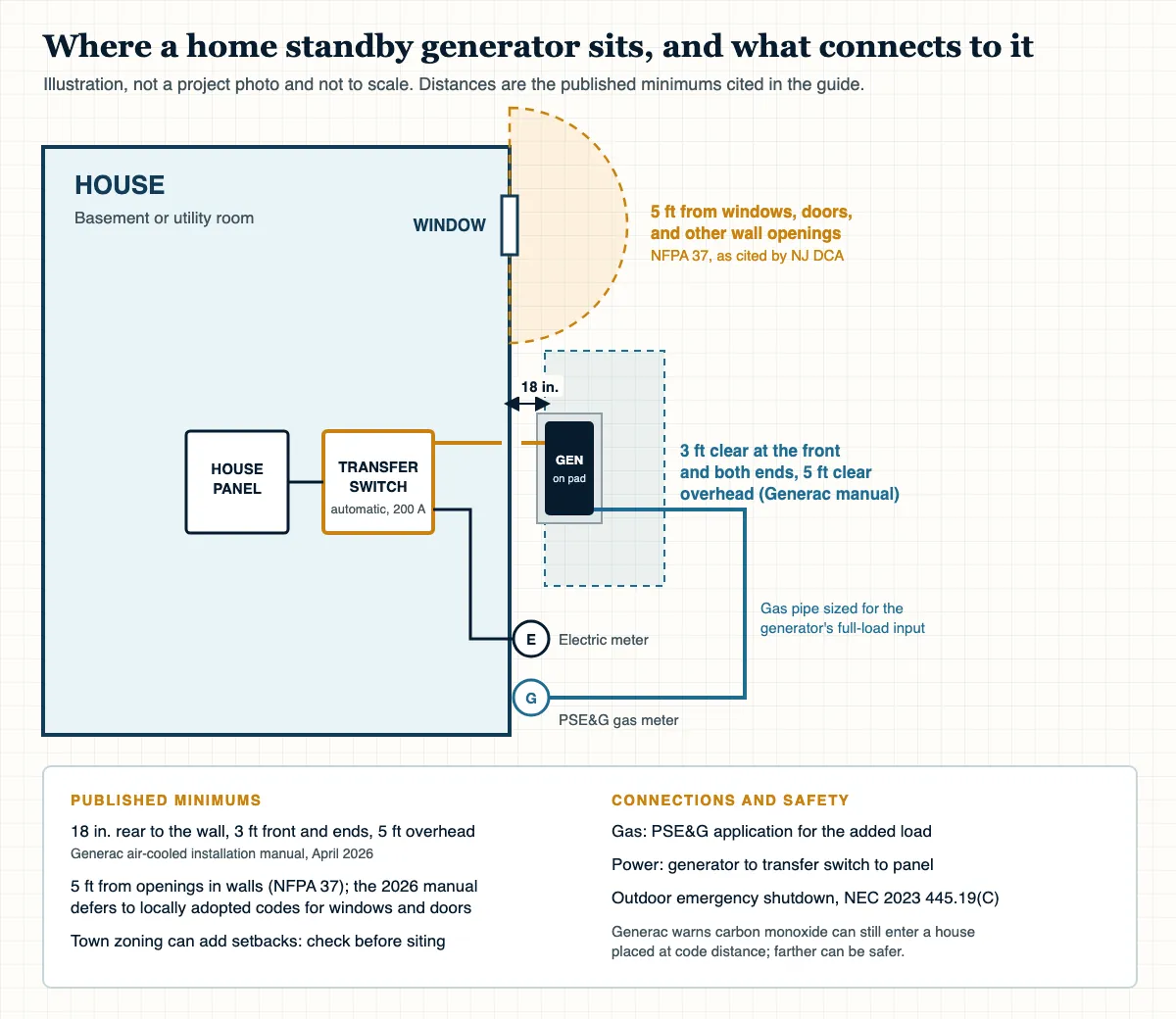
Placement drives the gas-line length, the wire run, and whether the town will approve the spot, so it drives cost. Generac's April 2026 installation manual for its 10 to 28 kW air-cooled units requires 3 feet of clearance at the front and ends, 18 inches at the rear, and 5 feet of clear space overhead. The 18-inch rear figure relies on Southwest Research Institute testing; it does not reduce the distance to windows, doors, or other openings, which the new manual leaves to locally adopted codes. New Jersey's Division of Codes and Standards reads the fuel gas code as sending inspectors to NFPA 37 and the manufacturer's instructions, where the baseline is five feet from openings in a wall.
Generac's manual adds a warning that belongs in every siting decision: a unit placed at code distance may still let carbon monoxide into the house, so it may need to go farther away. On a narrow Essex County side yard, the town's setbacks can be the tighter limit, which is covered in the next section.
04 / New Jersey permits and PSE&G
Three approvals and one utility application sit between delivery and the first start.
The New Jersey Uniform Construction Code requires a permit before anyone installs equipment the code regulates (N.J.A.C. 5:23-2.14). A standby generator does not appear on the state's ordinary-maintenance list or its minor-work list, and the Division of Codes and Standards has said that if any part of a project falls outside minor work, the whole job needs a full permit. Plan on a full permit application with these parts:
Generator, transfer switch, and service
Filed on the electrical technical section (form F120), which has its own generator inspection line. DCA requires utility cut-in cards for all generator installations.
Mechanical inspector on existing homes
On an existing one- or two-family home, N.J.A.C. 5:23-3.4(d) assigns standby generators and gas piping to the mechanical inspector (form F145), or to the plumbing official where no mechanical inspector is assigned.
Where the town allows the unit
West Orange lists standby power generators among work that needs prior zoning approval, with a property survey. Montclair's zoning officer reviews the building permit instead of issuing a separate zoning permit.
A tank is its own full permit
DCA Bulletin 09-1 makes a new propane vapor system under 2,001 gallons a full permit with a pressure test before use, handled by the mechanical subcode at an existing home.
The code edition changed this summer
New Jersey adopted the 2023 National Electrical Code as its electrical subcode effective August 17, 2026, replacing the 2020 edition. For six months after a subcode revision, a complete permit application may still be reviewed under the previous code, so a job filed now could be reviewed under either edition. Four sections matter most for a generator:
- Outdoor emergency shutdown (445.19(C)). Any generator at a one- or two-family home, other than a cord-and-plug portable, needs an emergency shutdown device outside the house. A switch on the generator enclosure can satisfy it.
- Outdoor emergency disconnect (230.85). Where service equipment is replaced, the home needs a readily accessible outdoor emergency disconnect. A service-rated automatic transfer switch that becomes the service disconnect is marked as both. New Jersey deleted the separate feeder rule in 225.41 as a duplicate.
- Surge protection (230.67). Where dwelling service equipment is replaced, a Type 1 or Type 2 surge-protective device is required.
- Standby capacity (702.4 and 702.5). Transfer equipment is required. With automatic transfer, the generator must carry the full connected load unless an energy management system limits what it picks up.
West Orange and Montclair, side by side
Construction office, 66 Main Street, Room 217
Zoning approval is required for standby power generators. The township fee schedule lists $200 for a 10.1 to 35 kW generator, $100 for gas piping, a $100 electrical minimum, a $150 plumbing minimum, and $150 for a service panel up to 224 amps. Inspection requests go through the township's online form. A 2016 township ordinance set 10-foot distances from side and rear lot lines and from operable windows and doors and limited self-tests to 9 a.m. to 7 p.m.; that section no longer appears in the current online code, so ask the zoning officer which rule applies to your lot.
Building Department, 205 Claremont Avenue
Applications are hand-delivered, and the zoning officer reviews them as part of the building permit. Ordinance O-25-04 (February 2025) lists $125 for a generator over 10 and up to 45 kW, $46 for gas piping, and $85 minimums for electrical and plumbing permits. Montclair's code has no generator-specific section; accessory structures in the R-1 zone need 6-foot side and rear setbacks, and Zoning Board resolutions show front-yard generators going through variances, sometimes with testing-hour conditions.
A state bill that would let automatic standby generators skip zoning approval at certain homes (A3401) was introduced in 2024 and has not become law. Fees change by ordinance; confirm the current schedule with the construction office before you budget.
PSE&G has to approve the gas side
West Orange and Montclair are in PSE&G's territory for both gas and electric service. PSE&G states that residential customers must apply to add or increase service for gas generators. The online Gas Service Application has an Adding Load request type, asks for the existing connected load and the new generator load, offers standard 1/4 PSI service or 1 or 2 PSI, requires the generator's specification sheet where the unit needs 7 inches of water column or more, and asks for the plumber's contact details. PSE&G says gas generator projects can take up to six weeks.
This step catches people who assume the existing meter can simply feed one more appliance. Generac's manual tells installers to confirm that the meter can supply the generator and every other gas appliance at once, and to size the pipe for the generator's full-load input. An NFPA electrical inspector writing about dwelling generators noted that installers often had not asked the utility whether the meter was large enough. If you are served by Elizabethtown Gas, it quotes four to six weeks for upgrade work; New Jersey Natural Gas reviews generator requests within 15 business days and allows about six weeks for upgrades.
05 / What size you need
Size the generator to the loads. Square footage is only the starting guess.
Generac's own sizing guide says most homes need a generator sized around the appliances and systems they want to keep running, not square footage alone, and it gives a simple formula: the sum of the running wattages plus the single largest starting surge. The square-footage rules that cost sites publish disagree with each other by a factor of two, which is the clearest sign that floor area cannot size a generator by itself.
Swipe across the table to see every column.
| Home | Generac's guidance | What pushes it up or down | Generac list with 200 A switch |
|---|---|---|---|
| About 1,500 square feet | 10 to 18 kW for a 1,550-square-foot home | 10 kW covers essential circuits; 14 to 18 kW runs central air or a well pump; an electric heat pump points to 18 kW. | $4,619 to $6,769 |
| About 2,000 square feet | 20 or 22 kW for whole-home coverage | Gas heat and cooking keep the load down; central air, an electric range, or a heat pump push it up. | $7,369 (22 kW) |
| 2,500 to 3,000 square feet | 22 kW, which Generac calls the industry standard for whole-home protection | Two air conditioners or electric heat raise the load; a larger unit or load managers cover it. | $7,369 to $9,509 |
Three New Jersey details change the answer. First, the natural gas rating is lower: Generac's 22 kW unit is rated 21 kW on natural gas and its 26 kW unit 24 kW, so size against the gas figure. Second, the code sets a floor under an automatic system: with an automatic transfer switch, NEC 702.4 requires the generator to carry the full automatically connected load unless an energy management system limits it. Third, central air is the load that decides most North Jersey sizing, because Generac notes a 3-ton unit needs about 3.5 to 5 kW to run but can demand 15 to 18 kW to start.
That is where load management pays for itself. Generac's spec sheets say load managers can reduce the overall size and cost of the system, and its sizing guide describes pairing a 14 or 18 kW unit with a load manager or a soft-start kit so a smaller generator can still run the air conditioner. Angi prices smart load management at $150 to $300. For a 2,000-square-foot house on gas heat, the difference between an 18 kW bundle ($6,769) and a 22 kW bundle ($7,369) is $600 at list, so the right answer depends on the loads, not on saving the smallest possible number.
06 / Natural gas or propane
Natural gas or propane: in PSE&G gas territory, the gas service usually decides it.
Where PSE&G gas is already at the house, natural gas avoids a tank, fuel deliveries, and the separate tank permit; it costs a PSE&G application, a properly sized pipe, and on most sizes a little output, since every Generac size except the 14 kW is rated lower on natural gas. Propane makes sense where there is no gas main or where the meter cannot be upgraded, and it runs the generator at its full rating.
The fuel numbers from Generac's current 22 kW spec sheet show the trade. On natural gas it burns 221 cubic feet an hour at half load and 311 at full load, and needs 3.5 to 7 inches of water column at the generator inlet. On propane it burns 2.45 gallons an hour at half load and 3.71 at full load, at 10 to 12 inches of water column. By our arithmetic on those figures, every 100 gallons of propane in the tank is about 41 hours at half load or 27 hours at full load, which is why propane owners in a long outage watch the gauge and the delivery truck.
A propane install also adds its own approvals: DCA Bulletin 09-1 treats a new propane system under 2,001 gallons as a full permit with a pressure test, and published tank costs run from $400 to $1,800 (HomeGuide) to $5,000 to $8,000 (Home Depot) depending on what the source includes. Generac also notes that the primary propane regulator is not included with the generator.
07 / Is it worth it
Is a whole house generator worth it in New Jersey? The outage record says long failures are rare, but real.
The honest case for a standby generator here is not the everyday outage. PSE&G reports that when the power goes out, its customers are restored within 62 minutes on average. The case is the handful of storms that leave North Jersey dark for days:
The NJ Board of Public Utilities reports 2.8 million electric customers lost power and full restoration took 14 days. PSE&G says about 90 percent of its 2 million electric customers lost power.
BPU staff counted over 1.3 million customers out at the peak and about 1.6 million affected; PSE&G peaked at 472,878 out, and full restoration took about seven days.
PSE&G reports 215,000 of its customers lost power. The State Climatologist counts about 30 New Jersey deaths, mostly flash-flood drownings; Maplewood recorded 8.39 inches of rain.
PSE&G restored more than 380,000 customers between July 1 and 7, which it called one of the largest storm restoration efforts in its history.
Ida is the storm that matters most for Essex County basements. Newark Airport's peak hour of rain that night ran at a rate the State Climatologist rates as a 1-in-1,000-year event, and the National Weather Service describes catastrophic flash flooding over portions of central and northern New Jersey. A sump pump without power is the most expensive way to learn what an outage costs.
So a standby generator is usually worth it when at least one of these is true: the house has a finished basement that depends on a sump pump; someone at home relies on powered medical equipment or works from home; the gas furnace or boiler needs electricity for its controls, blower, or circulators and the house cannot sit cold for days; or the house is often empty, so an automatic start protects it without anyone there. It is usually not worth it for a household that can leave for a day or two, rents, or rarely loses power for more than a few hours. For those homes the portable path below, or PSE&G's new home battery pilot, which offers a $5,000 incentive toward a qualifying battery, may be the better spend.
08 / Generac disadvantages
The disadvantages of a Generac generator, stated plainly.
This is one of the most asked questions about Generac, and the answers are mostly in Generac's own documents. None of them is a reason to rule the brand out; they are the costs and limits to price in before signing.
What to weigh before you buy
- The machine is the smaller part of the bill. Generac's own chart puts the generator at about a third of its $8,000 to $16,000 installed range.
- Professional installation is a warranty condition. Generac says professional installation is required, not optional, and its warranty excludes damage caused by improper installation.
- Maintenance is scheduled, not optional. Oil and filter after the first 25 hours; oil, filter, and a battery check every two years or 200 hours; air filter and spark plugs every four years or 400 hours; oil yearly in cold weather or long hot runs. Generac recommends an authorized service dealer do the work.
- Coverage narrows over five years. Generac's published five-year limited warranty covers parts, labor, and travel in years one and two, parts in year three, and only engine and alternator parts in years four and five. Briggs & Stratton lists seven- and ten-year comprehensive warranties on its 22 and 26 kW units.
- It makes noise next to your neighbors. The current 22 to 28 kW units are rated 67 dB(A) at 23 feet under normal load and 55 dB(A) in the low-speed exercise, measured from the front.
- Less power on natural gas. Every current size except the 14 kW is rated lower on natural gas than on propane, and output falls further in heat and at altitude.
- It needs watching in a long outage. The owner's manual calls for checking the oil daily when the unit runs continuously.
- It is not life support. Generac's owner's manual states the product is not intended for critical life-support applications.
09 / Install it yourself?
Can you buy a Generac and install it yourself in New Jersey?
Legally, a homeowner has more room than most people expect. New Jersey's electrical licensing law exempts work a person does on the dwelling they live in (N.J.S.A. 45:5A-18(n)), the plumbing law exempts a single-family homeowner working on their own dwelling (N.J.S.A. 45:14C-12.4), and the construction code lets a single-family homeowner do licensed-trade and propane work on their own home (N.J.A.C. 5:23-2.15). The permit forms have an Exempt Applicant box for exactly this. The permits, inspections, zoning review, and PSE&G application still apply.
Practically, three things push the job to licensed contractors. Generac says professional installation is required, not optional, and that the warranty demands it; its installation manual says only qualified service personnel may install the unit and that the fuel connection must be made by a qualified professional. PSE&G's gas application asks for the plumber's name and contact details. And the job touches the electric service itself: DCA requires a utility cut-in card for every generator installation. New Jersey's Division of Codes and Standards confirms that licensed electrical contractors may install generators, and that licensed electrical contractors, licensed HVACR contractors, and licensed master plumbers may install the gas piping to a generator and sign and seal the mechanical technical section.
MDL's published credentials are a New Jersey electrical contractor license (#34EI01606200), an electrical business permit (#34EB01606200), and a New Jersey master HVACR license (#19HC00308200), the license types DCA names for generator and generator gas-line work. Anyone can check a contractor on the Division of Consumer Affairs license verification system. MDL confirms which parts of a specific project it performs in the written scope.
10 / Running cost and upkeep
What it costs to run on PSE&G natural gas, with the math shown.
The cost to run a standby generator is fuel plus maintenance. For fuel, take the gas use from the spec sheet, convert it to therms, and multiply by the PSE&G rate. PSE&G's residential gas tariff effective September 1, 2026 sets the supply price at $0.363424 per therm and the delivery charges, with the riders PSE&G bills together, at $0.689930 per therm, including sales tax: $1.053354 per therm in total. PSE&G converts cubic feet to therms with a factor printed on each bill; its sample bill uses 1.038.
Swipe across the table to see every column.
| Unit and load | Gas use (Generac spec sheet) | Therms an hour | Cost an hour | Cost a day |
|---|---|---|---|---|
| 22 kW, half load | 221 cubic feet an hour | 2.29 | About $2.42 | About $58 |
| 22 kW, full load | 311 cubic feet an hour | 3.23 | About $3.40 | About $82 |
| 10 kW, half load | 98 cubic feet an hour | 1.02 | About $1.07 | About $26 |
| 10 kW, full load | 132 cubic feet an hour | 1.37 | About $1.44 | About $35 |
At half load, a three-day outage on the 22 kW unit costs about $174 in gas, and a 14-day outage the length of Sandy's statewide restoration about $812. The math excludes the $10 monthly service charge, which a gas customer already pays, and the October-to-May balancing charge of $0.097699 per balancing therm, which applies to part of winter use. PSE&G has asked the BPU to keep the supply price flat from October 1, 2026, and the tariff allows limited supply increases each December and February, so re-run the numbers with your own bill. On propane, the same 22 kW unit uses about 59 gallons a day at half load and 89 at full load.
Upkeep and the weekly exercise
A standby unit starts itself on a schedule to prove it works. Generac's current controller offers weekly, every-other-week, or monthly exercise, runs 5 minutes by default (adjustable to 20), and uses a low-speed quiet test. Maintenance follows the schedule in the disadvantages list above, and a yearly fuel-system leak test and water-intrusion check are also on Generac's schedule. Published maintenance costs run $80 to $300 (Angi) and $200 to $600 a year (ConsumerAffairs).
11 / The cheaper alternative
The cheaper alternative: a portable generator, an inlet, and an interlock or transfer switch.
If your outages are mostly short and someone is usually home, a portable generator connected the right way covers the essentials for far less. Generac lists portables with carbon monoxide shutdown at $939 for a 6,500-watt GP6500, $1,159 for an 8,000-watt GP8000E, and $1,289 for a tri-fuel GP9500E rated 9,500 running watts on gasoline that can also run on propane or natural gas. The house connection is where the safety and the cost sit:
Uses your existing panel
A panel interlock kit, such as the Siemens ECSBPK02 at $53.64 or Square D HOMCGK2C at $96.35 at Home Depot, plus a 30-amp inlet box ($64.90 for a Reliance PB30). HomeGuide puts an interlock at $400 to $850 installed. The kit must match your panel.
Pre-selected circuits
Generac's HomeLink 30-amp manual transfer switch with an inlet box lists at $429.99 and feeds 8 to 10 essential circuits. HomeGuide and Angi both put a manual transfer switch at $400 to $1,300 installed.
In New Jersey, either connection is new electrical work at the panel. The state code exempts portable generators from permits only for carnivals and fairs, and Manalapan Township's published guidance says an inlet with an interlock or a transfer switch requires an electrical permit and installation by a licensed electrical contractor or a homeowner in their own single-family home; Lambertville also requires an electrical permit for it. Because the connection is manual, NEC 702.4 lets you size the portable to the loads you choose to run at one time, and the inlet needs a warning sign stating which generator may be connected.
The trade-offs are real. Someone has to be home to wheel it out, start it, switch the interlock, refuel it, and shut it down. It powers only the circuits you choose. And carbon monoxide is the leading danger: the CPSC's latest report estimates that generators were involved in 93 of 274 consumer-product carbon monoxide deaths in 2022, and the agency tells owners to run portables outside only, at least 20 feet from the house. PSE&G warns that plugging a generator into a wall outlet backfeeds the lines and can electrocute utility workers and neighbors; never do it. If a storm leaves damaged wiring or a hazard at the house, use MDL's emergency electrician line rather than a generator.
12 / Decision table
Standby, managed standby, portable, or nothing: pick by the house, not the brochure.
Swipe across the table to see every column.
| Your situation | Best-fit path | Why | Published price anchor |
|---|---|---|---|
| Finished basement with a sump pump, gas heat, central air, 200-amp service | 20 to 22 kW standby with a 200-amp automatic switch | Starts itself during a flood-season outage and carries the whole house, including the air conditioner. | $7,369 list (22 kW bundle); $8,000 to $16,000 installed (Generac) |
| Same house on a 100-amp service, or a tighter budget | 14 to 18 kW standby with load managers | NEC 702.4 allows a smaller automatic system when load management caps what it picks up. | $5,949 to $6,769 list; load management $150 to $300 (Angi) |
| All-electric or heat-pump home | 22 to 28 kW standby, sized to the heat pump | Heating becomes the largest load; Generac steps up the size for homes that rely on a heat pump. | $7,369 to $9,509 list |
| House often empty, older relative, or work that cannot stop | Automatic standby of any size that covers the essentials | Only an automatic transfer protects the house when nobody is there to start a portable. | From $4,619 list (10 kW bundle) |
| Short outages, someone usually home | Portable with an interlock or manual transfer switch | Covers the refrigerator, sump, furnace, and lights for a fraction of the cost, with a permit. | $939 to $1,289 portable; $400 to $850 interlock installed (HomeGuide) |
| Small lot where the town's setbacks rule out a standby spot | Portable, or a home battery | Zoning may not allow a fixed unit; PSE&G's battery pilot offers an incentive toward backup storage. | $5,000 PSE&G incentive toward a qualifying battery |
| Rare, short outages and no critical loads | No generator for now | PSE&G's average restoration is 62 minutes; spend on surge protection and a plan instead. | No equipment cost |
Whatever the path, the next step is the same: a load list, a look at the service and panel, and a site check against the manufacturer's clearances and the town's setbacks. MDL's generator installation, repair, and maintenance page explains how MDL scopes that work in West Orange and Essex County, and the panel upgrade guide covers what to do when the service or panel is the limit.
13 / About this guide
Why a West Orange electrical and HVAC contractor wrote a cost guide with no MDL prices in it.
Generac is named throughout because it is the brand most New Jersey homeowners search for; this guide is not a dealer or certification statement, and the prices here are public list, retail, and cost-site figures, not MDL quotes. MDL Electric Cooling & Heating works from 4 Harrison Avenue in West Orange and publishes service coverage across Essex, Morris, and Hudson counties. The honest way to price a generator is a written scope for the actual house, and that starts with the address, the loads, and the service. Contact MDL or use the request form below.
14 / Direct answers
Whole house generator questions New Jersey homeowners ask before they buy.
How much does a whole house generator cost installed in New Jersey in 2026?
Generac lists its home standby generators at $3,769 (10 kW) to $8,159 (28 kW), or $4,619 to $9,509 with a 200-amp automatic transfer switch (generac.com MSRP, retrieved September 23, 2026). Generac's own installed range is $8,000 to $16,000 including the generator. HomeGuide puts most jobs at $6,000 to $11,000 and long-run or over-20 kW jobs at $9,500 to $24,000. A New Jersey price also has to carry the electrical and gas piping permits, the town's zoning review, and the PSE&G application for the added gas load. These are published figures, not an MDL quote.
How much is a whole house generator for a 2,000-square-foot house?
Generac says a 2,000-square-foot house typically needs a 20 or 22 kW unit for whole-home coverage. Its current 22 kW with a 200-amp transfer switch (model 7325) lists at $7,369, and Home Depot listed the same model at $7,229 on September 23, 2026. Generac's installed range is $8,000 to $16,000. The loads matter more than the floor area: central air, an electric range, or a heat pump push the size up, and load managers can bring it down.
What size generator do I need for a 1,500-square-foot house?
Generac's guidance for a home of about 1,550 square feet is 10 to 18 kW: 10 kW for essential circuits, 14 to 18 kW to run central air or a well pump, and 18 kW if the house relies on an electric heat pump. On natural gas, read the gas rating, which is lower: Generac's 18 kW unit is rated 17 kW on natural gas. With an automatic transfer switch, the National Electrical Code requires the generator to carry the full connected load unless a load-management system limits it.
Is a whole house generator worth it in New Jersey?
It depends on what a multi-day outage would cost you. Superstorm Sandy cut power to 2.8 million New Jersey customers in 2012, and full restoration took 14 days (NJ Board of Public Utilities). Tropical Storm Isaias left more than 1.3 million without power at its peak in 2020, and the remnants of Ida cut power to 215,000 PSE&G customers in 2021. Yet PSE&G reports that its customers are restored within 62 minutes on average. A standby unit earns its cost when a sump pump, medical needs, working from home, or an often-empty house make those rare long outages expensive.
What are the disadvantages of a Generac generator?
The main ones are cost, upkeep, and rules. The generator is only about a third of Generac's own installed estimate. Generac requires professional installation for the warranty and recommends that an authorized service dealer do the maintenance: an oil change after the first 25 hours, then oil, filter, and battery every two years or 200 hours, and air filter and spark plugs every four years or 400 hours. Its published five-year limited warranty narrows after year two. The 22 to 28 kW units are rated 67 dB(A) at 23 feet under normal load, produce less power on natural gas than on propane, and are not intended for life-support use.
Can I buy a Generac generator and install it myself in New Jersey?
New Jersey law lets a homeowner do electrical and plumbing work on the single-family home they live in, with permits and inspections (N.J.S.A. 45:5A-18, N.J.S.A. 45:14C-12.4, and N.J.A.C. 5:23-2.15). Generac, however, says professional installation is required, not optional, and that its warranty demands it, and its installation manual says the fuel connection must be made by a qualified professional. PSE&G's gas application also asks for the plumber's details. The New Jersey Division of Codes and Standards says licensed electrical contractors may install generators and the gas piping to a generator.
Do I need a permit for a standby generator in West Orange or Montclair?
Yes. The Uniform Construction Code requires a permit before installing regulated equipment, and a standby generator is not on the state's minor-work or ordinary-maintenance lists. Expect an electrical permit, a gas piping permit, and a zoning review. West Orange lists standby power generators among work that needs prior zoning approval, and its fee schedule shows $200 for a 10.1 to 35 kW generator and $100 for gas piping. Montclair reviews zoning inside the building permit, and its 2025 fee ordinance lists $125 for a generator over 10 and up to 45 kW and $46 for gas piping. Confirm current fees with each office before you budget.
Do I have to contact PSE&G before installing a natural gas generator?
Yes. PSE&G says residential customers must apply to add or increase service for gas generators. Its online Gas Service Application has an Adding Load request, asks for the existing and new connected load and the service pressure, and requires the generator's specification sheet. PSE&G says gas generator projects can take up to six weeks. Generac's installation manual also says to verify that the gas meter can supply the generator plus every other gas appliance, and to size the pipe for full load.
How much does it cost to run a whole house generator on natural gas?
On PSE&G's residential gas rate in effect September 1, 2026, a current Generac 22 kW burning 221 cubic feet an hour at half load costs about $2.42 an hour, or about $58 a day. At full load, 311 cubic feet an hour, it costs about $3.40 an hour, or about $82 a day. That math uses $1.053354 per therm for supply and delivery and the 1.038 therms per 100 cubic feet shown on PSE&G's sample bill. The factor on your own bill and the October to May balancing charge change the result slightly.
Is a portable generator with an interlock a cheaper, safe option?
It can be, if it is installed and used correctly. Generac lists 6,500- to 9,500-watt portables at $939 to $1,289, and HomeGuide puts a panel interlock kit at $400 to $850 installed. The inlet and interlock are electrical work on the panel, so plan on an electrical permit. Someone has to be home to start and switch it, it powers only the circuits you choose, and it must run outdoors at least 20 feet from the house (CPSC). Never plug a generator into a wall outlet: PSE&G warns that backfeeding can electrocute utility workers and neighbors.
15 / Source record
Sources, all retrieved September 23, 2026
Prices, rates, and rules change. Every figure on this page was read from the source below on September 23, 2026. Where two sources disagree, both are shown. The running-cost figures and the propane hours are our arithmetic on the sourced inputs. Nothing here is an MDL price, and no source was paid or asked to appear.
- Generac — home standby product pages and MSRPList prices for the 10 to 28 kW air-cooled range, with and without the 200-amp switch.
- Generac — 22 to 28 kW spec sheet, revision D, August 2026Propane and natural gas ratings, fuel use, gas pressure, sound levels, and load managers. The 10 to 18 kW spec sheet supplies the smaller sizes.
- Generac — air-cooled installation manual, April 2026Clearances, NFPA 37 and SwRI testing, gas meter and pipe sizing, qualified-installer language.
- Generac — air-cooled owner's manual, April 2026Maintenance schedule, exercise settings, service dealer recommendation, life-support statement.
- Generac — backup generator installationThe $8,000 to $16,000 installed range and the one-third equipment share.
- Generac — what size generator do I needSizing by home and load, central-air starting load, and professional installation.
- Generac — five-year limited warranty for air-cooled standby generatorsCoverage by year and installation exclusions.
- Kohler (Rehlko) — home generator list prices14, 20, and 26 kW MSRP and package models.
- Briggs & Stratton — PowerProtect list prices22 and 26 kW MSRP, ratings, and warranty terms.
- Cummins — home standby generatorsStarting MSRP for 13 and 20 kW models.
- The Home Depot — generator installation costInstalled range, air-cooled average, propane tank cost; retail prices for models 7325 and 7043.
- HomeGuide — whole house generator costInstalled ranges and line items; its transfer switch page supplies the interlock and manual switch costs.
- Angi — whole-house generator cost, 2026 dataNational average, transfer switch, pad, permits, load management, and maintenance.
- This Old House — standby generator installationInstalled range sourced from Angi data.
- ConsumerAffairs — whole house generator costInstalled range and line items, updated September 2026.
- NJ DCA — current construction codes2023 National Electrical Code with TIAs 1 to 13, effective August 17, 2026.
- N.J.A.C. 5:23-2 — Uniform Construction Code administrationPermit requirement, minor work, ordinary maintenance, licensed-trade and homeowner rules.
- N.J.A.C. 5:23-3 — subcodes and inspector responsibilitiesMechanical inspector for standby generators and gas piping; New Jersey's NEC amendments.
- NJ DCA — Construction Code Communicator, Spring 2022Which licensed trades may install generators and generator gas piping. The Summer 2021 and Fall 2022 issues cover cut-in cards and generator distance.
- NJ DCA — Bulletin 09-1, LP-gas installationsFull permit and pressure test for new propane systems.
- Township of West Orange — construction code enforcementZoning approval for standby generators; the township fee schedule supplies the permit fees.
- Township of Montclair — zoning permitsZoning review inside the building permit; Ordinance O-25-04 supplies the permit fees.
- PSE&G — gas generators and hot water heatersApplication requirement, specification sheet, and the six-week lead time.
- PSE&G — gas tariff, effective September 1, 2026Residential supply, delivery, rider, and balancing charges.
- NJ Board of Public Utilities — Sandy outage record2.8 million customers out and 14 days to full restoration. The BPU's Isaias staff report supplies the 2020 figures.
- PSE&G — Ida outage record215,000 customers out; PSE&G's July 2026 releases supply the heat-wave restoration count.
- Office of the New Jersey State Climatologist — IdaDeaths, Essex County rainfall, and the Newark rainfall rate.
- U.S. Consumer Product Safety Commission — carbon monoxide information centerThe 20-foot distance rule for portable generators.
- U.S. Consumer Product Safety Commission — non-fire carbon monoxide deaths, 2022 estimatesGenerator-related deaths in the May 2026 report.
- Generac — portable generators and HomeLink transfer switchPortable list prices and the 30-amp manual transfer switch; Home Depot supplied the interlock kit and inlet box prices.
- HomeGuide — generator transfer switch installation costInterlock and manual transfer switch installed costs.
- PSE&G — GridSmart home battery pilotThe $5,000 incentive toward a qualifying home battery, published September 4, 2026.
- PSE&G — reliability overviewThe 62-minute average restoration time.
- PSE&G — generator safetyBackfeed warning and permit note.
- NJ Board of Public Utilities — Tropical Storm Isaias staff reportStatewide and PSE&G outage peaks and restoration time, 2020.
- National Weather Service Mount Holly — Ida event reviewFlash flooding across central and northern New Jersey.
- PSE&G — July 2026 restoration updateMore than 380,000 customers restored after the heat wave and storms.
- NFPA — electrical inspectors and generators for existing dwellingsEmergency shutdown, service-rated transfer switch marking, load calculation, and the gas meter question.
- Elizabethtown Gas — generatorsMeter review, upgrade charges, and four-to-six-week lead time.
- New Jersey Natural Gas — generator review15-business-day review and about six weeks for upgrades.
- Manalapan Township — generator FAQElectrical permit and installer rules for a portable generator inlet with an interlock or transfer switch.