
01 / The short answer
A chirp is maintenance. A repeating beep is an emergency. Everything on this page follows from telling them apart.
It is 3 a.m. and something in the hallway chirps once, goes quiet, and chirps again. That single, spaced chirp is the alarm reporting on itself: a battery that is low, a battery that is missing or badly seated, a sensor that has reached the end of its life, or on a hardwired alarm, household power that is not reaching it. A real smoke alarm sounds different. First Alert describes its smoke emergency as three beeps and a pause, repeated, and its carbon monoxide emergency as four beeps and a pause. Those two patterns mean leave the house; the lone chirp means fix the alarm.
Most chirps end with a battery. The ones that do not end there are the reason this page exists. The National Fire Protection Association's rule is blunt: chirping that continues after the battery has been replaced means the alarm is at the end of its life and the unit must be replaced. And a hardwired alarm that keeps chirping, or keeps eating a backup battery every few weeks, is usually telling you the circuit feeding it is dead at a tripped breaker or a loose wire, which Kidde's own support page says to have an electrician check.
- Find the chirping unit. Stand under each alarm, including the basement, the attic hallway and the garage, and watch for the light that flashes with the chirp. In an interconnected string, only the unit with the problem chirps.
- Battery first. The type printed on the label, polarity right, pull tab gone, drawer snapped shut.
- Reset. With the battery out, hold the test button for about 15 seconds to drain the residual charge, then put the battery back.
- Read the date. The manufacture date is printed on the back. At 10 years the alarm is replaced, not re-batteried. Carbon monoxide alarms expire sooner.
- Hardwired? Check the green light. A steady green light means the alarm has AC power. No green light with the breaker on is a wiring problem.
NFPA: nearly three out of five home fire deaths were in properties with no smoke alarms (43 percent) or alarms that failed to operate (16 percent).
NFPA's estimate for 2018 to 2022, with 403 deaths a year. Missing, disconnected or dead batteries were the most common reason.
How often each kind operated in fires large enough to set them off, per NFPA. A chirping hardwired alarm is worth keeping hardwired.
The CDC counts more than 400 unintentional non-fire CO deaths and more than 100,000 emergency visits a year in the United States.
Change the battery, reset, read the date. If the alarm is 10 years old, replace it, and in New Jersey a hardwired alarm is replaced with a hardwired alarm. If the chirp comes from a hardwired alarm with no green light, from several hardwired units at once, or from an alarm whose backup battery dies every month, stop buying batteries: the circuit is the problem. That is the work described on MDL's smoke and CO detector installation page.
02 / Chirp or alarm
The sound table: what First Alert, Kidde and NFPA say each pattern means.
Two manufacturers sell most of the alarms in North Jersey houses, and both publish their patterns. The table collects them. Where a brand says a pattern varies by model, the row says so; the model number on the back of your alarm and its manual decide the exact code.
Swipe across the table to see every column.
| What you hear | Device | What it means | What to do | Source |
|---|---|---|---|---|
| 3 beeps, a pause, 3 beeps, repeating | Smoke alarm | Smoke detected | Get everyone out, call 911 from outside, do not go back in until cleared | First Alert |
| 4 beeps, a pause, 4 beeps, repeating | Carbon monoxide alarm | Carbon monoxide detected | Move to fresh air outside, call 911, keep everyone out until the fire department clears the house | First Alert; Kidde (four short beeps, five seconds of silence) |
| 1 chirp every 30 or 60 seconds | Smoke alarm | Low battery; on an old alarm, end of life | Fresh battery of the listed type; if the chirp continues, the alarm is at end of life | NFPA; First Alert |
| 1 chirp every 60 seconds | Kidde CO alarm | Low battery | Replace the batteries | Kidde |
| 1 chirp every 30 seconds that will not stop | Kidde CO alarm | End of life, seven years after first power-up; the same chirp can also mean a malfunction | Replace the alarm; it can no longer detect CO in end-of-life mode | Kidde |
| 1 beep every minute | First Alert CO alarm | Low battery | Replace the batteries | First Alert |
| 5 beeps every minute | First Alert CO alarm | End of life | Replace the alarm | First Alert |
| Long continuous squeal | Kidde plug-in CO alarm | Tamper warning: unplugged or loose from the outlet, or a malfunction | Reseat it in the outlet; if it continues, replace it | Kidde |
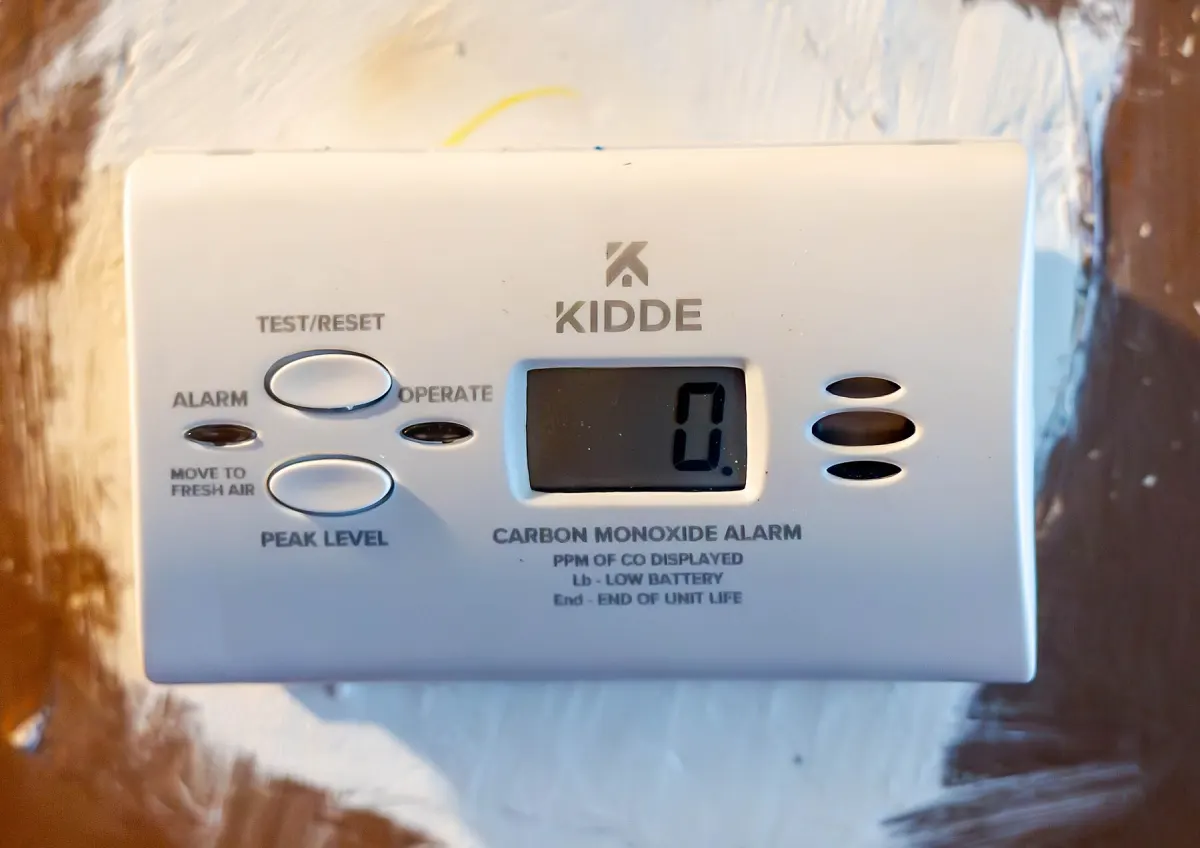
| "Lb" on the display | Kidde CO alarm with display | Low battery | Replace the batteries | Kidde |
| Any number on the display | CO alarm with display | Carbon monoxide is being measured | Assume it is CO: leave the home and call 911 | Kidde |
| Random chirps with no pattern | Smoke or CO alarm | Dust, steam, condensation, a loose hardwired connection, temperature swings | See the random chirps section below | First Alert; Kidde |
Two details trip people up. First, the low-battery chirp and the end-of-life chirp are the same sound on many smoke alarms; First Alert says its low battery or end-of-life chirp means "replace your smoke alarm's batteries or the smoke alarm itself" and sends owners to the manual for the model's specific code. The date on the back settles which one you have. Second, the flashing light is not the chirp: Kidde's battery alarms give a quick flash every 30 to 45 seconds in normal operation, silently, and its hardwired alarms show a steady green light when they have AC power.
03 / Low battery
The low-battery chirp, why it starts at 2 a.m., and the battery you cannot change.
NFPA's description is the one to memorize: a single chirp every 30 or 60 seconds means the battery is low and must be changed. First Alert recommends new batteries at least every six months in battery alarms and in hardwired alarms with a battery backup, and New Jersey's Division of Fire Safety ties the change to the clock change each spring and fall. The chirp will not stop until the alarm sees a battery it accepts, which is why the swap has four parts and not one.
- The type on the label. First Alert lists the wrong battery type, "a specific size or chemistry", among the reasons a new battery still chirps. Most older alarms take a 9-volt; many newer ones take two or three AA cells.
- Polarity. A reversed battery makes no contact. Match the plus and minus marks.
- The pull tab. New alarms and some replacement batteries ship with a plastic tab that has to come out.
- The drawer. First Alert: "Many alarms will keep chirping unless the drawer is shut completely." On many models the drawer will not close with no battery in it, on purpose.
Why the chirp waits until the middle of the night
Both big manufacturers answer this. Kidde: as a battery nears the end of its charge its internal resistance rises, a drop in room temperature raises it further, and "most homes are the coolest between 2 a.m. and 6 a.m.", so the alarm enters low-battery chirp mode at night and stops when the house warms a few degrees. First Alert's version is the chemistry: when temperature drops the reactions inside the cell slow, ions move more slowly through the electrolyte, internal resistance rises and the voltage at the terminals falls, which registers as a low battery. A thermostat setback in a West Orange or Montclair house in January is exactly the drop that does it. The alarm is not broken; the battery is nearly done, and the alarm is telling you a few weeks early.
The battery you cannot change: ten-year sealed alarms
Since January 1, 2019, the battery smoke alarms New Jersey requires in one- and two-family homes are ten-year sealed units listed to UL 217 (N.J.A.C. 5:70-4.19). There is no battery door. The Division of Fire Safety's instruction for these is short: "If the alarm chirps, warning that the battery is low, replace the entire smoke alarm right away." The same is true of sealed ten-year carbon monoxide alarms. A sealed alarm that chirps before its ten years are up is a warranty question for the manufacturer, and a reason to buy the replacement today rather than live with a dead alarm.
04 / End of life
The chirp that means the alarm, not the battery, is finished.
Every source on this page agrees on the number. NFPA: all smoke alarms must be replaced 10 years after their manufacturing date. The U.S. Fire Administration: replace the entire smoke alarm every 10 years. Kidde: replace all smoke alarms, battery and hardwired, every 10 years, and carbon monoxide and combination alarms every 7 to 10 years depending on the model. First Alert: all alarms should be replaced at least every 10 years from the manufacture date on the back, and its carbon monoxide alarms last between 5 and 7 years, with every CO detector replaced after 7 years because the sensor is wearing out even if the battery is fine.
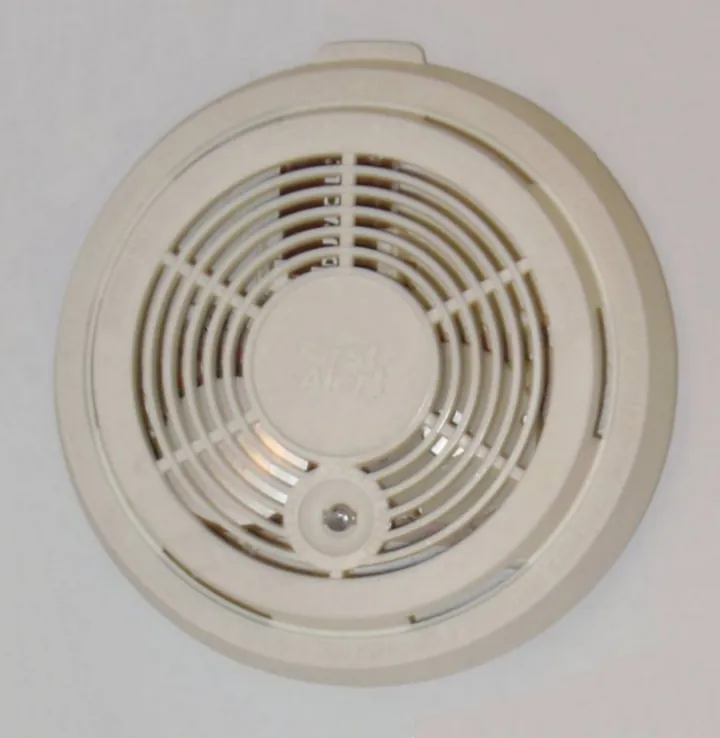
How to tell an end-of-life chirp from a low battery
- Take the alarm down and read the back. First Alert's steps: remove the unit from its bracket, find the manufacture date on the back label, and replace the whole unit if it is near or past 10 years. If the label is missing or unreadable, First Alert says to replace the alarm.
- A fresh battery did nothing. NFPA: chirping that continues after the battery has been replaced means the alarm is at the end of its life. First Alert: "a fresh battery cannot fix an expired sensor."
- The pattern changed. On First Alert CO alarms, end of life is five beeps every minute instead of one. On Kidde CO alarms, the chirp moves to every 30 seconds seven years after first power-up and does not stop until the unit is powered off.
- The house is from before 2016. If the alarms came with the house, or with a renovation more than 10 years ago, they are due whether or not they have started chirping. Kidde's hint for CO alarms is five to seven years.
In a house full of hardwired alarms that went in together, the first end-of-life chirp is a forecast: the rest of the string was made the same month. Replacing them as a set, with alarms listed to work together, is the normal job, and in New Jersey each of them stays hardwired. The smoke and CO detector installation page covers what that involves, including the adapter and brand-matching checks an electrician makes before the first alarm comes down.
05 / Chirps with a new battery
Still chirping after a new battery: the seven reasons First Alert lists, and the reset.
This is the question behind the Reddit thread Google ranks for this search, "replaced the battery three times and it still won't stop," and First Alert's support page answers it directly: "In many cases, the new battery is not actually the problem." Its list of causes, in its order:
- The battery is installed incorrectly. Reversed, or not making proper contact.
- The drawer or compartment is not fully closed.
- The alarm needs a reset. Residual electrical charge inside the unit keeps the chirp active after a battery change.
- The wrong battery type. Some alarms want a specific size or chemistry.
- The alarm is hardwired and has another power issue. "On hardwired units, the backup battery is only one part of the system."
- The unit has reached end of life. A new battery will not clear the warning.
- The sensor or internal electronics have a fault. The alarm needs replacing.
The 15-second reset
First Alert's reset, which clears the residual charge that keeps an alarm chirping with a good battery in it: remove the battery, hold the test button for 15 seconds, then install the battery. On a hardwired alarm the same reset is done with the alarm's breaker off and the battery out; First Alert's reset page says a reset may help when "you replaced the battery but the warning condition did not clear," and warns not to assume an alarm that is sounding for smoke or carbon monoxide only needs a reset. Treat every full alarm as real until you know the air is clear.
If the alarm chirps again within a day or two of a fresh, correctly installed battery and a reset, stop. Read the date on the back. If it is under 10 years old and battery-only, the alarm itself has failed and should be replaced. If it is hardwired, the next section is the one you need.
06 / Hardwired alarms
Hardwired alarms: the chirp after a power outage, the battery that dies every month, and the wire an electrician looks for.
A hardwired alarm runs on a 120-volt circuit and carries a backup battery so it works through an outage. Most of the time that backup battery is the chirp, and the fix is the one above. The cases below are the ones where it is not, and where buying another battery is throwing money at a wiring problem. Three of them come straight from Kidde's support pages.
- Chirping after a power outage or a surge. First Alert lists "power surges, outages, or loose wiring on AC-powered units" among the chirp causes, and a hardwired CO alarm can start chirping after an outage or any electrical interruption. With the power back, give the alarm a reset at the test button; if it keeps chirping with the breaker on, read on.
- The backup battery lasts only a month. Kidde: if the battery lasts about a month, "it's usually because the alarm is running solely on battery power due to the absence of AC power. This can happen if the circuit breaker has been tripped or if the black wire has become loose in the wire nut." The alarm will run about 25 days on its battery, then chirp. Kidde's instruction is to check whether the alarm shows AC power, inspect the breaker, "or have an electrician check the circuit."
- No green light. Kidde's hardwired alarms show a steady green LED when AC power is present. A hardwired alarm with no green light and the breaker on has lost its feed somewhere between the panel and the ceiling box.
- Several hardwired alarms chirp or fail together. One dead battery is one alarm. A string of alarms complaining at once points at the shared circuit or the interconnect wiring.
- The alarm sounds the instant it is connected to the wiring, but not on battery alone. Kidde says this can be a non-Kidde unit on the same circuit, or a loose white wire in the wire nut.
- The breaker trips when the alarms are reconnected. That is a fault on the circuit, not the alarm.
Where the homeowner stops
Looking at the panel directory and switching a breaker is fine. Pulling an alarm off its bracket to read the date is fine with the breaker off. Opening the ceiling box, remaking a wire nut on the black, white or interconnect conductor, or tracing why a circuit is dead is electrical work, and in New Jersey, work on anyone's home but your own single-family residence takes a licensed electrical contractor. This is also the point where replacement, not repair, is usually the right call: a hardwired alarm old enough to have a loose wire nut is often an alarm past its 10 years, and the state fire code says an A/C-powered alarm from the original construction may not be replaced with a battery one (N.J.A.C. 5:70-4.19). A like-for-like swap of a hardwired alarm is ordinary maintenance with no permit under N.J.A.C. 5:23-2.7; adding a new fire detection device where none was is minor work under N.J.A.C. 5:23-2.17A and gets reported to the town.
MDL's smoke and CO detector installation page describes how an electrician handles a hardwired replacement: breaker off, every alarm on the string checked for brand and adapter fit, power restored, and every alarm tested together. A dead circuit that feeds more than the alarms is an electrical repair call. A burning smell, a scorched ceiling box, or an alarm that trips the breaker is the emergency electrician line, and if there is smoke, 911 first.
07 / Interconnected alarms
When every alarm in the house sounds, or only one of them does.
Interconnected alarms are wired, or wirelessly linked, so that when one detects smoke they all sound; NFPA calls this the best protection, and the U.S. Fire Administration says to choose interconnected alarms so that when one sounds, they all sound. The design changes how a chirp behaves and how a false alarm is traced.
- A chirp stays local. A low-battery or end-of-life chirp comes from the one alarm with the problem; the others stay quiet. Finding it means standing under each one.
- A full alarm travels. When the whole house goes off, one unit started it. On most models the originating alarm shows a different light pattern from the followers; find it, then look for smoke, steam or dust at that unit before anything else.
- The test tells you whether the string is intact. Kidde: in an interconnected installation, all interconnected alarms should sound when the test button on any one of them is pressed. "If only the unit you push the test button on signals, there may be an issue with the interconnect circuitry either in the wires or in the alarm." On combination alarms, press and release the test button and the signal passes from unit to unit, testing the interconnect wiring as well as the horn.
- Brands are listed together, not in general. Kidde's alarms are tested and listed by UL Solutions and Intertek to work with the specific compatible Kidde models named in each user guide. "When alarms from different manufacturers are interconnected, the system has not been tested or listed as a complete system." A mixed string that chirps or will not pass a test is a reason to replace the string with one listed set, not to keep swapping single units.
- Twelve on a line. The money page quotes Kidde's note of an NFPA limit of 12 smoke alarms on one interconnected line; a large older house that has had alarms added over the years can be over it.
An interconnected string that fails Kidde's test, where only the pressed unit sounds, is wiring work: the interconnect conductor is the third wire in each ceiling box, and finding the open connection means opening boxes along the run. That is the hire moment described on the smoke and CO detector installation page.
08 / Random chirps and false alarms
Chirps with no pattern, and alarms that go off with no fire.
A chirp that comes at random, or a full alarm that sounds for a few seconds and stops, is a different problem from the metronome chirp of a low battery. First Alert's list of random-chirp causes is dust, insects or debris in the sensing chamber, power surges or loose wiring on hardwired units, and environmental interference. Kidde adds the ones that matter in a New Jersey winter.
- Steam and condensation. Kidde: high humidity, steam and condensation can cause false alarms, and "rapid shifts in temperature can lead to condensation forming inside the alarm." A hallway alarm outside a bathroom door is the classic case.
- A cold ceiling box. Kidde: "If your alarm is installed in a non-insulated electrical box mounted on a ceiling beneath an attic, condensation can form. In this case, it's advisable to move the alarm to a different location." Top-floor hallways under an unheated attic do this in January.
- Temperature range. Kidde's smoke and CO alarms are made to perform between 40 and 100 degrees Fahrenheit. An alarm in an unheated garage, porch or attic is outside its rating on a cold night.
- Cooking. The New Jersey Division of Fire Safety's fact sheet says cooking fires are the leading cause of fire in the state, and tells owners of a nuisance-prone alarm to move it away from the kitchen or bathroom, to buy an alarm with a silencing mode, and to consider a photoelectric alarm, which it says is less likely to false-alarm from common causes.
- Dust and insects. First Alert: vacuum gently around the openings with a soft brush attachment, never use cleaners, paints or aerosols near the unit, and cover or remove alarms during heavy construction or sanding, then put them back.
A random chirp from a hardwired alarm that cleaning, a battery and a reset do not cure is treated as a loose connection until proven otherwise, which puts it back in the hardwired section above. A random chirp from a battery alarm that is under 10 years old and clean is a failed alarm; replace it.
09 / Silence and reset
How to silence a chirping alarm for the night, how to reset it, and the one thing not to do.
The test button on most modern alarms is also the hush button. First Alert's support page says to press the test or silence button to stop a chirp temporarily, and Kidde's test instruction is to hold the Test/Hush button for at least five seconds, which sounds the alarm if the circuitry, horn and battery work. Hush buys time; it does not fix the cause, and the chirp comes back.
- Make sure it is a chirp. First Alert: if the full alarm sounds, exit the building and call 911; troubleshoot only from a safe place.
- Press hush. The chirp pauses on most models for a set period. Use the quiet to do the next steps.
- Battery out, test button held 15 seconds, battery in. First Alert's reset for residual charge. On a hardwired alarm, turn its breaker off first.
- Read the date, then decide. Under 10 years and the chirp returns: a failed battery alarm is replaced; a hardwired alarm goes to the wiring checks above. At or past 10 years: the alarm is replaced whatever it does.
- Hardwired: breaker back on, test every alarm. Kidde says to restore power and press each test button so every interconnected alarm sounds.
Do not pull the battery and leave it out
The chirp is irritating; a dead alarm is the thing NFPA's numbers describe. Of the 19,119 home fires a year in which smoke alarms failed to operate, the most common reasons were missing or disconnected batteries, dead batteries and disconnected hardwired alarms. A hardwired alarm with the battery out keeps chirping anyway, because the missing battery is a fault it reports. If the alarm has to come down tonight, buy the replacement tomorrow.
10 / Carbon monoxide beeping
Carbon monoxide detector beeping: four beeps means leave; one chirp means the alarm needs you.
Carbon monoxide alarms chirp for the same maintenance reasons smoke alarms do, and their emergency pattern is the one you must never wait out. First Alert: four beeps and a pause means carbon monoxide has been detected; move to fresh air and call 911. Kidde: four short beeps, five seconds of silence, four short beeps, repeating. The New Jersey Division of Fire Safety's instruction when a CO alarm sounds and anyone feels ill: leave immediately, dial 911 from outside, and do not re-enter the building. The CPSC's symptom list is headache, dizziness, weakness, nausea, vomiting, sleepiness and confusion; if you suspect CO poisoning, get outside to fresh air immediately and then call 911.
The CPSC's estimate of unintentional non-fire carbon monoxide deaths involving consumer products in 2022. Heating equipment was the second largest cause, with 76 deaths, 28 percent.
More than half of the CO deaths in the CPSC's 2020 to 2022 average happened in November, December, January and February, when furnaces, boilers and generators run.
Emergency department visits for unintentional CO poisoning in the United States, with more than 14,000 hospitalized and more than 400 deaths.
First Alert's life for a CO alarm, with every unit replaced after 7 years. The CDC says to replace a CO detector per the manufacturer or every 5 years.
The CO chirps that are not an emergency
- One chirp a minute. Low battery on both brands (Kidde: once every 60 seconds; First Alert: one beep every minute). Replace the batteries, then test.
- Five beeps every minute (First Alert). End of life. Replace the alarm.
- A chirp every 30 seconds that will not quit (Kidde). End of life, starting seven years after the alarm was first powered up; Kidde says it cannot detect CO once it is in this mode and must be replaced at once. The same 30-second chirp can also be a malfunction, and an ERR code on the display is explained in the manual.
- A long continuous squeal (Kidde plug-in). The unit has been unplugged or has come loose from the outlet.
- "Lb" on the display. Low battery. "End" on the display is the end of unit life; the photo below shows both codes printed on the alarm's face.
- A number on the display with no alarm. Kidde: assume it senses carbon monoxide. Leave the home and call 911.
- Random chirps. First Alert lists a battery compartment not fully closed, a hardwired power interruption after an outage, residual charge after a battery change, and a sensor fault.
When the alarm sounds and nobody feels ill
The Division of Fire Safety's fact sheet separates the two cases. If no one feels ill: turn off the CO alarm, turn off all appliances or sources of heat, ventilate by opening windows and doors, and call a qualified service person to check out any heat source. If someone does feel ill: leave immediately, establish who is ill, dial 911 from outside, and do not re-enter. The sources the Division names are gas-fired appliances, wood-burning stoves, fireplaces and a motor vehicle in the garage, and its standing advice is a yearly service and inspection of every appliance burning propane, natural gas or oil. In a North Jersey house that usually means the furnace or boiler, which is why the CO section of this guide sits next to the heating season. A gas furnace or boiler that set off the alarm is an HVAC call, not a homeowner repair: MDL's heating repair page covers it, and a suspected gas leak goes to PSE&G or 911 before anyone.
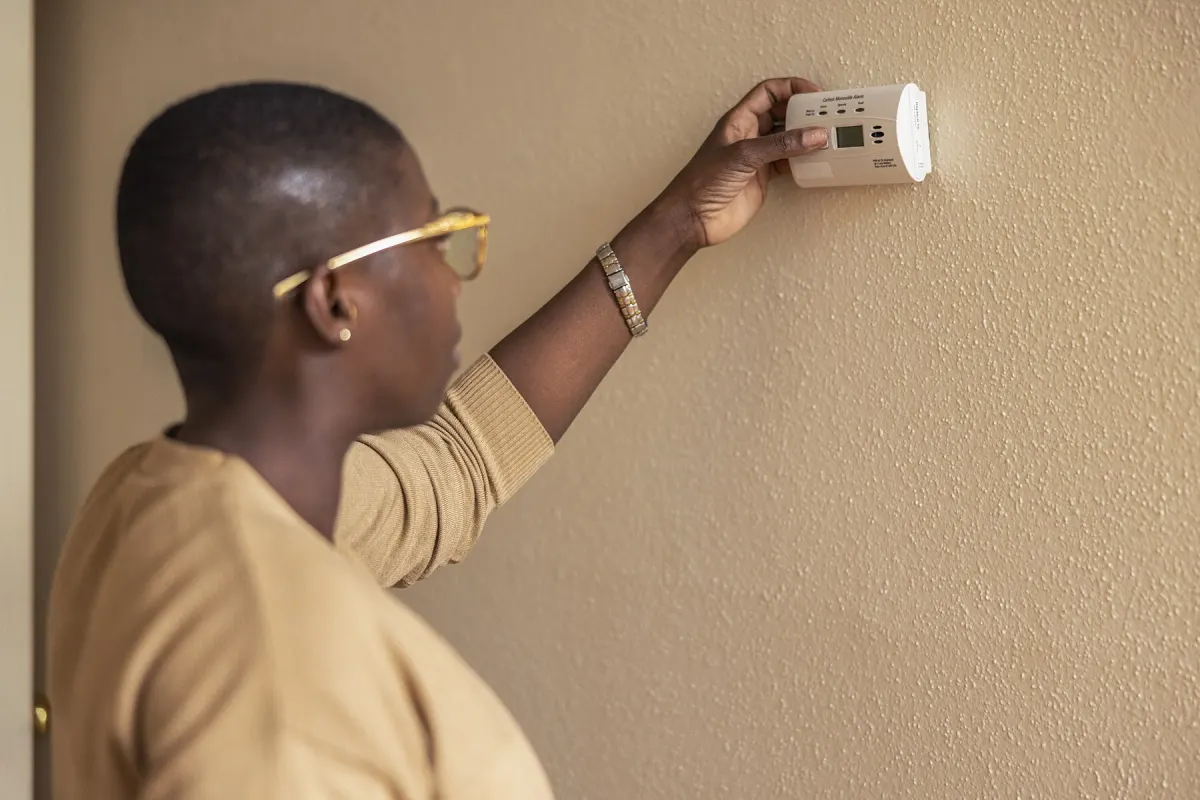
Where New Jersey puts them, and what kind
In one- and two-family homes with a fuel-burning device or an attached garage, the state fire code requires carbon monoxide alarms in the immediate vicinity of the sleeping areas; they may be battery-operated, hardwired or plug-in, and must be listed to UL 2034 (N.J.A.C. 5:70-4.19). The CDC's advice is a battery-operated or battery-backup detector near every sleeping area, a digital readout if you can get one, and a battery check at each clock change. A plug-in alarm with no battery backup is silent during the outage in which a portable generator is running; the portable generator hookup guide covers that case. A combination smoke and CO alarm on a hardwired string is replaced on the CO sensor's clock, which is shorter than the smoke sensor's.
11 / New Jersey rules
The New Jersey rules a chirping alarm runs into: the sale certificate, sealed batteries, hardwired stays hardwired, and the heating season.
Most of the country can answer a chirp with whatever alarm is on the shelf. New Jersey has four rules that change the answer, and a chirping alarm in a house that is about to be sold or rented runs into all of them.
- The certificate at every sale or new tenant. The Division of Fire Safety's own words: "As of January 1, 2019, the New Jersey Uniform Fire Code requires a certificate of smoke alarm compliance before any person may sell, lease or change occupancy of any one-family or two-family dwelling in the state." The owner gets it only through the borough or township, and it is valid for six months. The regulation behind it, N.J.A.C. 5:70-2.3, covers smoke alarms and carbon monoxide alarms, requires a new application if the change of occupancy slips past six months, and allows no certificate where a required UL 2034 CO alarm is missing. P.L. 2025, c.19, approved February 3, 2025, took the portable fire extinguisher out of the state certificate. The town's fire official or construction office issues it; West Orange folds the alarm check into its Certificate of Continued Occupancy, and the smoke and CO detector installation page lists the fees and steps in West Orange, Montclair and the rest of Essex County.
- Battery alarms are ten-year sealed. N.J.A.C. 5:70-4.19: ten-year sealed battery single-station smoke alarms listed to UL 217. A chirping sealed alarm is replaced, not opened.
- Hardwired alarms stay hardwired. The same section: A/C-powered alarms installed as part of the original construction or a rehabilitation project may not be replaced with battery-powered alarms. An inspector writing the certificate looks for exactly that substitution.
- Permits. Replacing a smoke alarm, smoke detector or heat detector head with a like device, installing battery smoke alarms, and installing battery or plug-in CO alarms are ordinary maintenance with no permit (N.J.A.C. 5:23-2.7). Installing any fire detection device in a one- or two-family home is minor work (N.J.A.C. 5:23-2.17A).
Why the chirps cluster in winter here
The New Jersey Board of Public Utilities' Winter Termination Program runs from November 15 to March 15, which is as good a definition of the state's heating season as any. In those months three things happen to alarms at once. Night-time setbacks drop hallway temperatures and push weak batteries into the chirp, per Kidde and First Alert. Furnaces, boilers, fireplaces and, in an outage, generators run, and the CPSC's figures put 59 percent of carbon monoxide deaths in the four cold months, with heating equipment behind 76 of the 274 deaths counted in 2022. And the clocks change on the first Sunday of November, the date the Division of Fire Safety uses to tell residents to check and change alarm batteries. A chirp in November is the cheap warning; the CO alarm that is quiet because its battery was pulled in August is the expensive silence.
12 / When to call
Which chirps you fix yourself, and which ones are an electrician's job.
Swipe across the table to see every column.
| What is happening | Who fixes it | Why |
|---|---|---|
| One battery alarm chirps every 30 to 60 seconds; the alarm is under 10 years old | You | Battery of the listed type, polarity, drawer, 15-second reset. |
| A sealed ten-year alarm chirps | You | Replace the whole alarm; the state requires sealed battery alarms and the Division of Fire Safety says to replace it right away. |
| The date on the back is 10 or more years ago (CO: 5 to 7) | You for a battery alarm; an electrician for a hardwired one | End of life. A hardwired alarm must be replaced with a hardwired alarm in New Jersey, and the rest of its string is the same age. |
| A hardwired alarm chirps with the breaker on and no green light | Electrician | No AC power at the alarm: a tripped breaker you cannot reset, a loose black wire, or a dead circuit, per Kidde. |
| The backup battery in a hardwired alarm dies every month | Electrician | Kidde: the alarm is running on battery alone because AC power is absent; about 25 days per battery. |
| Only the pressed alarm sounds on test in an interconnected string | Electrician | Kidde: a fault in the interconnect wiring or an alarm. Finding it means opening boxes along the run. |
| Several hardwired alarms chirp or fail together, or the breaker trips when they are reconnected | Electrician | The shared circuit, not a battery. |
| Burning smell, scorching at the ceiling box, or smoke | 911, then the emergency line | Fire first. Then the circuit is made safe before anything is replaced. |
| A CO alarm sounds four beeps, or shows a number | Everyone out, 911, then the gas utility or an HVAC technician | Carbon monoxide. The heat source is found and fixed before anyone sleeps there. |
| The house is being sold or rented and alarms are chirping or past date | Electrician, before the inspection | The certificate inspection checks every alarm, its age, its type and whether hardwired units are still hardwired. |
For the electrician rows, the work is the one described on the smoke and CO detector installation page: the string of alarms, their age and brand, the circuit that feeds them, and the certificate if a sale or new tenancy is coming. A dead circuit that feeds more than the alarms is electrical repair. Anything scorched or smoking is the emergency electrician line.
13 / About this guide
Who wrote this guide, and why it quotes manufacturers rather than guessing.
MDL Electric Cooling & Heating works from 4 Harrison Avenue in West Orange and serves Essex, Morris and Union County. Its published credentials are a New Jersey electrical contractor license (#34EI01606200), an electrical business permit (#34EB01606200), and a New Jersey master HVACR license (#19HC00308200); anyone can check them on the Division of Consumer Affairs license verification system. Kidde and First Alert appear here because they publish their chirp patterns and most New Jersey houses have one or the other; naming them is not a dealer or certification statement, and no manufacturer paid or asked to appear. Nothing on this page is an MDL price. MDL confirms the scope of alarm work in writing after seeing the house. Contact MDL or use the request form below.
14 / Direct answers
Chirping alarm questions New Jersey homeowners ask Google.
How do I get the smoke detector to stop chirping?
Find the unit that is chirping, then work in this order: put in a fresh battery of the type on the label, with the polarity right and the drawer snapped shut; hold the test button for about 15 seconds with the battery out to clear the residual charge, as First Alert instructs; check the manufacture date on the back and replace the whole alarm if it is at or past 10 years; on a hardwired alarm, confirm the steady green power light is on. If the chirp survives all four, the alarm is at end of life or the hardwired circuit has a fault.
Why is my house beeping every 40 seconds?
A single chirp at a steady interval of roughly 30 to 60 seconds is the low-battery or end-of-life signal of a smoke or carbon monoxide alarm; NFPA puts the low-battery chirp at once every 30 or 60 seconds, and Kidde's CO alarms chirp every 60 seconds for a low battery and every 30 seconds at end of life. Stand under each alarm in turn, including any in the basement, attic hallway and garage, and watch for the flashing light that accompanies the chirp. Do not confuse it with the quick flash a battery alarm gives every 30 to 45 seconds, which is silent.
Why did my Kidde fire alarm randomly go off in the middle of the night?
Kidde's own explanation is temperature. A battery near the end of its charge has higher internal resistance, a drop in room temperature raises that resistance, and most homes are coolest between 2 a.m. and 6 a.m., so the alarm enters low-battery chirp mode at night and stops when the house warms up. A full alarm, rather than a chirp, in the small hours points to steam, condensation in a cold ceiling box, dust or insects in the chamber, or an alarm past 10 years. Kidde says to replace every smoke alarm, battery or hardwired, at 10 years.
Why is my Kidde smoke and carbon monoxide alarm beeping?
Read the pattern. Four short beeps, five seconds of silence, four short beeps is Kidde's carbon monoxide alarm: leave the house and call 911. A chirp once every 60 seconds is a low battery. A chirp every 30 seconds that will not stop until the unit is powered down is the end-of-life warning Kidde CO alarms give seven years after first power-up, and the same 30-second chirp can also mean a malfunction. A long continuous squeal is the tamper warning on a plug-in unit that has come loose. A digital display showing Lb means low battery; any number on the display should be treated as carbon monoxide.
Do hardwired smoke detectors have batteries?
Almost all of them do. A hardwired alarm runs on a 120-volt circuit and carries a backup battery, either a replaceable 9-volt or AA cell or a sealed 10-year cell, so it still works in an outage. That is why a hardwired alarm chirps: the backup battery is low, or the alarm has lost its AC power and is draining the battery. Kidde says an alarm with no AC power runs on its battery for about 25 days before it needs replacement, and that a backup battery lasting only a month usually means a tripped breaker or a loose black wire in the wire nut.
Why is my smoke alarm still chirping with a new battery?
First Alert lists the reasons: the battery is reversed or not making contact, the battery drawer is not fully closed, the alarm still holds a residual charge and needs a reset, the battery is the wrong size or chemistry, the alarm is hardwired and has a separate power problem, the unit has reached end of life, or the sensor has a fault. Reset it by holding the test button for 15 seconds with the battery removed, then reinstall the battery. NFPA's rule is simple: chirping that continues after the battery has been replaced means the alarm is at the end of its life and the unit must be replaced.
Why does my hardwired smoke detector chirp with no battery in it?
Because a missing backup battery is itself a fault the alarm reports. A hardwired alarm expects its battery, and with the battery out it chirps the same low-battery warning, so removing the battery never silences a hardwired unit for long. Put in a fresh battery of the listed type, reset the alarm, and if the chirp continues check the manufacture date and the green AC light. A hardwired alarm that has been pulled off its bracket with the wires still live is also a reason to call an electrician, not a fix.
What does it mean when a smoke alarm gives three quick beeps then stops?
On First Alert alarms, three beeps and a pause is the smoke alarm itself: smoke has been detected and the household should get out and call 911 from outside. A short burst of three beeps that stops on its own is most often a brief nuisance alarm from steam, cooking vapor or dust clearing the chamber, but check for smoke first every time. Kidde and First Alert both say the patterns differ by model, so the model number on the back of the alarm and its manual settle what a specific burst means.
How many beeps mean carbon monoxide?
Four. First Alert describes the CO emergency as four beeps and a pause, and Kidde as four short beeps, five seconds of silence, then four short beeps again. Move everyone outside to fresh air and call 911 from outside; the New Jersey Division of Fire Safety's advice is to leave immediately and not re-enter. A single chirp every minute is a low battery, and five chirps every minute on a First Alert CO alarm is the end-of-life signal.
Why is my carbon monoxide detector beeping three times and then stopping?
Neither Kidde's nor First Alert's published CO pattern lists include a three-beep code, so a burst of three on those brands is not the carbon monoxide emergency pattern, which is four beeps repeated. Kidde says a chirp every 30 seconds can be a malfunction and that an ERR code on the display is explained in the manual. Treat any repeated beeping you cannot identify as serious: if the display shows a number, or anyone has a headache, dizziness or nausea, get outside and call 911; otherwise find the model number and read its manual, and replace a CO alarm that is more than seven years old.
What can falsely set off a carbon monoxide detector?
Low levels of real carbon monoxide are the usual cause, not a broken alarm. The New Jersey Division of Fire Safety names the sources in a home: gas-fired appliances, wood stoves, fireplaces and a vehicle running in an attached garage. Kidde's instruction is that any number on a digital CO display should be assumed to be carbon monoxide. If the alarm sounds and nobody feels ill, the Division's steps are to turn off fuel-burning appliances, open windows and doors, and have a qualified service person check every heat source; if anyone feels ill, leave and call 911 from outside.
Why does my smoke alarm chirp only at night in winter?
Cold. First Alert explains that when room temperature drops several degrees the chemical reactions inside a battery slow, internal resistance rises and the voltage at the terminals falls, which is enough to trigger a low-battery chirp from a battery that is near its end anyway. Kidde adds that homes are coolest between 2 a.m. and 6 a.m., so the chirp starts at night and stops once the house warms. A winter-only night chirp is a battery or an old alarm, not a ghost; replace the battery, and if the alarm is at 10 years replace the alarm.
Do I need a permit to replace smoke detectors in New Jersey?
Not for a like-for-like swap. The state construction code lists the replacement of a smoke alarm or detector with a like device, the installation of battery-powered smoke alarms, and the installation of battery or plug-in carbon monoxide alarms as ordinary maintenance that needs no permit (N.J.A.C. 5:23-2.7). Installing a new fire detection device in a one- or two-family home, such as adding a hardwired alarm where none was, is minor work under N.J.A.C. 5:23-2.17A, which still has to be reported to the town. A hardwired alarm that came with the house may not be replaced with a battery alarm under N.J.A.C. 5:70-4.19.
Can I just replace my hardwired smoke alarms with battery ones?
Not in New Jersey. The state fire code says A/C-powered smoke alarms installed as part of the original construction or a rehabilitation project may not be replaced with battery-powered alarms (N.J.A.C. 5:70-4.19). New battery alarms added elsewhere in the house must be ten-year sealed units listed to UL 217. So a hardwired alarm past 10 years is replaced with a hardwired alarm, which is the work MDL's smoke and CO detector installation page describes.
15 / Source record
Sources, all read October 31, 2026
Every pattern, interval, lifespan, rule and statistic on this page was read from the source below on October 31, 2026. Manufacturer patterns are quoted from Kidde's and First Alert's own support pages and apply to their alarms; other brands publish their own. New Jersey rules are from nj.gov and the state's legislature, with the fire code sections read in the Legal Information Institute's copy of the New Jersey Administrative Code. Nothing here is an MDL price, and no source was paid or asked to appear. Photos: "Smoke alarm" by Sweetie candykim (Wikimedia Commons, CC0); older alarm by Oleg Alexandrov (public domain); woman testing a CO alarm by the U.S. Consumer Product Safety Commission (public domain); CO alarm display by the City of Detroit (Wikimedia Commons, public domain). None is an MDL job.
- First Alert — Why is my smoke detector beeping?Three beeps and a pause, the low battery or end-of-life chirp, batteries every six months, replacement 10 years from the manufacture date.
- First Alert — Why is my carbon monoxide detector beeping?Four beeps and a pause, one beep a minute, five beeps a minute, 5 to 7-year life, replace after 7 years.
- First Alert — Why does your smoke alarm chirp in the middle of the night?Temperature, internal resistance and voltage drop.
- First Alert Store — Smoke alarm chirps and beep patternsCauses, chirp vs full alarm, the 15-second reset, the manufacture date, cleaning, patterns vary by model.
- First Alert Store — Still chirping with a new batteryThe seven causes and the reset.
- First Alert Store — How to reset a smoke or CO alarmWhen a reset helps and the warning not to assume a sounding alarm only needs one.
- First Alert Store — CO alarm chirps and beep patternsHardwired power interruption, battery compartment, residual charge, sensor fault.
- Kidde — Why do smoke alarms chirp in the middle of the night?Coolest hours 2 a.m. to 6 a.m., replace smoke alarms at 10 years, CO end-of-life chirp after 7 to 10 years, 40 to 100 degree operating range.
- Kidde — Why is my carbon monoxide alarm beeping or chirping?The four-beep pattern, 60-second and 30-second chirps, the squeal, Lb, a number on the display.
- Kidde — Why does my battery only last one month?No AC power from a tripped breaker or a loose black wire, about 25 days on battery, have an electrician check the circuit, the loose white wire.
- Kidde — How do I check that my smoke alarm is working?Steady green LED for AC power, the silent flash on battery units, the interconnect test.
- Kidde — Interconnecting Kidde alarms with other brandsListed only with named compatible models; mixed brands untested as a system.
- Kidde — Humidity and smoke alarmsSteam, condensation, temperature swings, the non-insulated ceiling box under an attic.
- Kidde — Alarm replacement guideSmoke alarms every 10 years; CO and combination alarms every 7 to 10.
- NFPA — Smoke alarmsOne chirp every 30 or 60 seconds, replace at 10 years, chirping after a new battery means end of life, interconnected alarms, monthly testing.
- NFPA — Smoke Alarms in US Home Fires59 percent, 19,119 fires and 403 deaths a year, 94 vs 85 percent, battery problems as the leading failure, 2018 to 2022.
- U.S. Fire Administration — Smoke alarmsTest monthly, backup battery yearly, replace the alarm every 10 years, choose interconnected alarms.
- CDC — About carbon monoxide poisoningMore than 400 deaths, 100,000 emergency visits and 14,000 hospitalizations a year; detectors near every sleeping area; replace per the manufacturer or every 5 years.
- CPSC — Carbon monoxide information centerSymptoms; get outside to fresh air, then call 911.
- CPSC — Non-fire carbon monoxide deaths, 2022 annual estimates274 deaths in 2022, 76 from heating equipment, 59 percent of the 2020 to 2022 average in November through February.
- NJ Division of Fire Safety — November 1, 2019 releaseThe certificate since January 1, 2019, through the town, valid six months; replace a chirping sealed alarm right away; batteries at the clock change.
- NJ Division of Fire Safety — Fire Safety Facts: carbon monoxideWhat to do when a CO alarm sounds, the sources in a home, yearly appliance service.
- NJ Division of Fire Safety — Fire Safety Facts: smoke alarmsChange batteries when it chirps, nuisance alarms, silencing mode, photoelectric alarms, cooking fires.
- N.J.A.C. 5:70-4.19 — Smoke alarms, carbon monoxide alarmsTen-year sealed alarms, hardwired alarms not replaced with battery, CO alarms near sleeping areas.
- N.J.A.C. 5:70-2.3 — Certificate of smoke alarm and carbon monoxide alarm complianceThe certificate, the six months, the CO alarm condition.
- P.L. 2025, c.19Approved February 3, 2025; the portable fire extinguisher removed from the state certificate.
- N.J.A.C. 5:23-2 — Uniform Construction Code administrationOrdinary maintenance (5:23-2.7) and minor work (5:23-2.17A) for alarms.
- NJ Board of Public Utilities — Winter Termination ProgramNovember 15 to March 15.