
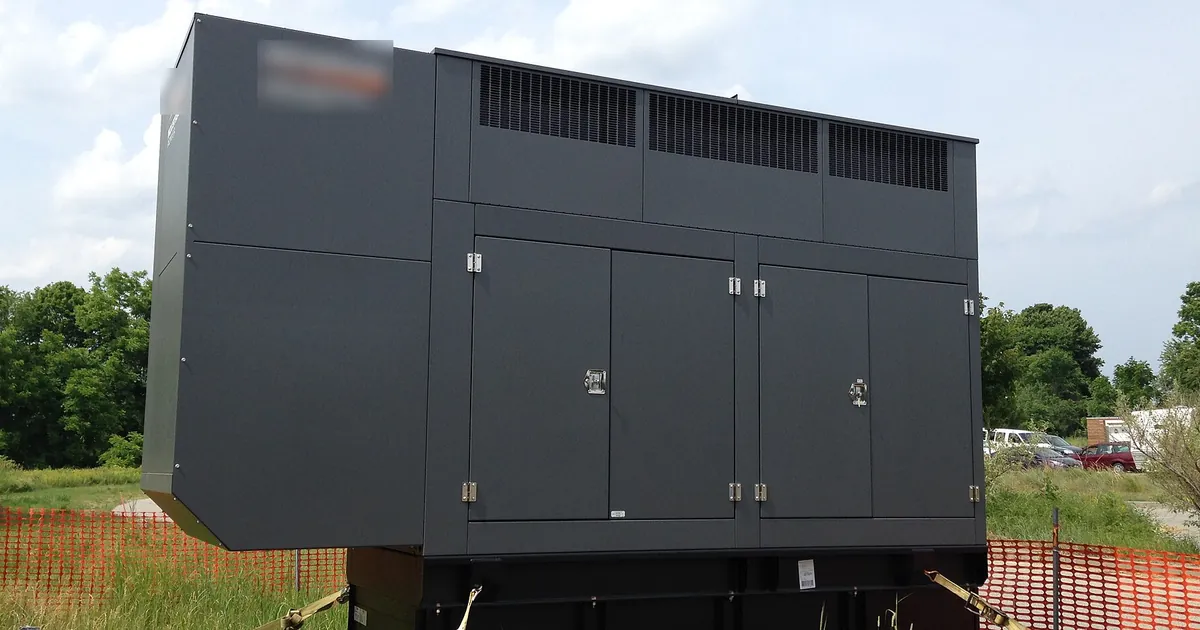
01 / Prices by size
What a business generator costs, by size, in 2026's published figures.
Search for commercial generator cost from West Orange and the top three results are an Alberta equipment dealer's sales page, a 2023 cost article about restaurants and a Long Island dealer's inventory list. None of them deals with New Jersey's permits, New Jersey's fuel prices or what a building in Essex County has to keep running. The published price figures that do exist come from generator sellers and cost sites, and every one of them prices by kilowatts.
| Band | Size | Generator alone | Installed total | Typical buildings, in the source's words |
|---|---|---|---|---|
| Small commercial | 22 to 60 kW | $6,000 to $25,000 | $12,000 to $45,000 | Retail, small offices, clinics |
| Mid-range | 70 to 150 kW | $25,000 to $65,000 | $50,000 to $110,000 | Warehouses, mid-size manufacturing |
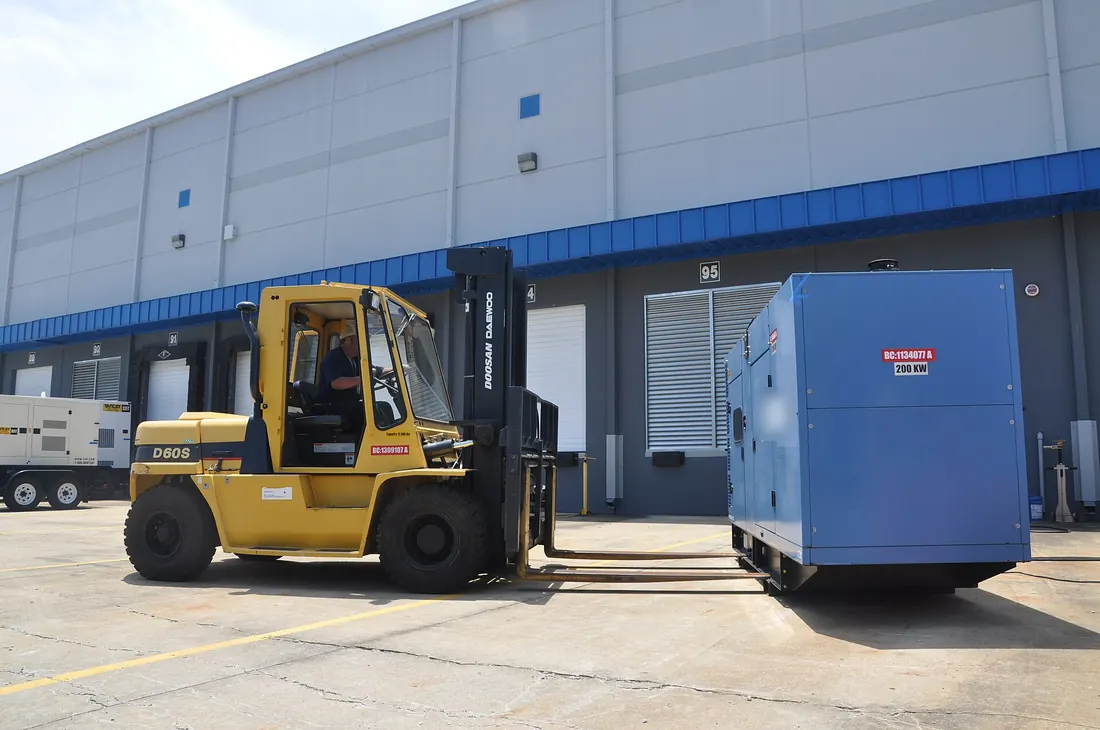
| High-capacity standby | 200 to 500 kW | $70,000 to $180,000 | $150,000 to $300,000 or more | Data centers, cold storage, multi-tenant |
| Megawatt | 1,000 kW and up | $250,000 or more | $500,000 to $1 million or more | Large hospitals, industrial campuses |
A second published source runs lower. Kompareit, in an article Google dates May 3, 2023, says industrial generators average $400 per kW for the unit, installation, warranty and service agreement. Its unit-only averages are $16,000 for 50 kW, $26,000 for 100 kW, $30,000 for 150 kW and $85,000 for 400 kW. Generator Source's 2026 table, published September 29, 2026, puts a new 100 kW diesel set alone at $35,000 to $60,000. The two are three years apart, and only the newer one reflects 2026 equipment prices. Both are shown here so you can see the spread a buyer meets.
22 to 60 kW; generator $6,000 to $25,000 of that. Generator Source, May 7, 2026.
70 to 150 kW; generator $25,000 to $65,000 of that. Generator Source, May 7, 2026.
Diesel $35,000 to $60,000; natural gas $40,000 to $69,000, with enclosure. Generator Source, September 29, 2026.
Heat input at which an emergency generator needs an NJDEP permit; general permit registration $1,090.
A band gives the order of magnitude. Where your building falls inside it, or whether it falls in that band at all, depends on the list of what must keep running in an outage, the fuel and the approvals. The rest of this guide prices each of those.
02 / Size by business
Restaurant, medical office, shop or apartment building: the loads set the kilowatts, and the kilowatts set the price.
Kompareit's sizing method for a restaurant works for any business. List every item that must keep running in an outage, read its kW from the nameplate, the manual or the maker's site, and add them up. Where a label gives amps instead of kW, multiply amps by volts. For a ballpark, Kompareit starts at 50 kW and adds 5 watts per square foot, so a 10,000-square-foot restaurant comes to 100 kW. It also says hiring an electrician is the surest way to get the size right and stay within the National Electrical Code.
| Building | What the sources say about size | Published installed band |
|---|---|---|
| Restaurant, 4,000 sq ft (worked example) | Kompareit's ballpark: 50 kW plus 4,000 × 5 watts = 70 kW. The real load list decides the final figure. | $50,000 to $110,000 (Generator Source, 70 to 150 kW); $28,000 at Kompareit's 2023 average of $400 per kW |
| Shop or small office | Generator Source lists retail and small offices in its 22 to 60 kW band. | $12,000 to $45,000 |
| Medical or dental office, clinic | Generator Source lists clinics in its 22 to 60 kW band and large hospitals in its 1,000 kW-and-up band. | $12,000 to $45,000 for a clinic; $500,000 to $1 million or more for a large hospital |
| Apartment building, several stories | New Jersey's 2021 building code edition calls for standby power for elevators where its elevator sections require it, for common kitchen and dryer exhaust in multistory buildings, and in high-rise buildings (Sections 2702.2.2, 2702.2.5 and 2702.2.11). Generator Source lists multi-tenant buildings in its 200 to 500 kW band. | $150,000 to $300,000 or more for 200 to 500 kW |
| Warehouse or cold storage | Warehouses sit in Generator Source's 70 to 150 kW band, cold storage in its 200 to 500 kW band. | $50,000 to $110,000; $150,000 to $300,000 or more |
The restaurant row shows why two published figures for the same building can sit far apart. Kompareit's 2023 average gives $28,000 for 70 kW; Generator Source's 2026 band for 70 to 150 kW starts at $50,000. Kompareit's figure is three years older and is one average across sizes, so treat it as the floor of what buyers have seen, not a 2026 price.
The code article changes the price, too
The National Electrical Code files standby power under three articles: Article 700 for emergency systems, Article 701 for legally required standby systems and Article 702 for optional standby systems. New Jersey enforces the 2023 edition (N.J.A.C. 5:23-3.16). Two rules show why the article matters to the budget:
- A witnessed test. New Jersey's Department of Community Affairs notes that Articles 700.3(A) and 701.3(A) require the local enforcing agency to conduct or witness the test of the complete system, while Article 702 has no similar requirement.
- Fuel on site. Under the 2023 NEC, an emergency system's engine needs an on-site fuel supply for at least 2 hours of operation, and it may not depend solely on the public gas system unless the authority having jurisdiction approves it (700.12(C)). So a natural gas generator for an emergency system needs either that approval or fuel stored on site.
The codes that require the system decide its article, and the local construction office confirms it. MDL's commercial generator installation page walks through all three articles.
03 / Price a size
Price a size before anyone visits the building.
Commercial generator price and upkeep estimator
Pick a generator size and a fuel. The estimator reads the published figures in this guide: Generator Source's 2026 prices by model size, its installed bands, Kompareit's 2023 average, and the planning estimates in Generac's ownership-cost white paper. It is arithmetic on those figures. It is not a load calculation on your building, and it is not an MDL price.
Generator alone, 2026 published range$40,000 to $69,000
- Installed band for this size (Generator Source, May 2026): $50,000 to $110,000 for 70 to 150 kW
- At Kompareit's 2023 average of $400 per kW, installed: $40,000
- Cabling and transfer equipment at Generac's planning figure of $150 per kW: $15,000
- Gas piping to the generator at Generac's $10 to $20 per kW: $1,000 to $2,000
- Yearly service at Generac's planning figure of $500 plus $1 per kW: $600
- One load bank test at Generac's planning figure of $1,000 plus $1.50 per kW: $1,150
- NJDEP air permit: at 100 kW and up, Generac's sets reach the 1,000,000 Btu-an-hour line, so plan on a general permit registration ($1,090) unless the engine's rated heat input is lower.
Sources: Generator Source (September 29 and May 7, 2026), Kompareit (2023), Generac's white paper and spec sheets, NJDEP. Sizes with no published price for a fuel say so. The installed bands have gaps (for example 175 kW), and the estimator says when a size falls between them.
Start a commercial generator request04 / Inside the installed price
The installed price, broken into the lines a proposal should show.
No source we found prices a New Jersey commercial generator job as a whole. The lines below are published figures for its parts, from a generator seller and a generator maker. They are quoted as market evidence. None of them is an MDL price.
| Line | Published figure | Source | What it covers |
|---|---|---|---|
| Generator set, 100 kW | Diesel $35,000 to $60,000; natural gas $40,000 to $69,000 | Generator Source, September 29, 2026 | The set with a weather or sound enclosure, certified for emergency standby. Installation, transfer switches and site work are separate. |
| Automatic transfer switch | $2,000 to $15,000 or more | Generator Source, May 7, 2026 | An industrial switch for a 400 to 3,000-amp service. |
| Cabling, transfer and distribution equipment | About $150 per kW | Generac white paper | Generac's initial planning estimate; it says the installing electrical contractor must bid the actual site. |
| Electrical labor | $5,000 to $25,000 | Generator Source, May 7, 2026 | Tying the generator into the main distribution panel; the top of the range is for several switches. |
| Fuel connection | $3,000 to $10,000; gas piping alone $10 to $20 per kW | Generator Source; Generac | A high-pressure gas connection or a 1,000-gallon diesel tank with containment (Generator Source); regulators, isolation valves and piping (Generac). |
| Concrete pad | $50 to $75 per square foot | Generator Source, May 7, 2026 | A level, reinforced pad; $2,500 to $5,000 for a 500 kW unit. |
| NJDEP general permit | $1,090 | NJDEP general permits page | Registration for an emergency generator at or above 1,000,000 Btu an hour of heat input (section 06). |
| Construction permit | Set by each town | N.J.A.C. 5:23-4.17 | Each municipal construction office charges its own fee schedule, adopted by ordinance. |
| First diesel fill | Paid at start-up | Generac white paper | Diesel is prepaid when the tank is first filled at commissioning (section 05 prices a 48-hour tank). |
Adding the lines for 100 kW (our arithmetic): natural gas set $40,000 to $69,000, transfer switch $2,000 to $15,000, electrical labor $5,000 to $25,000 and fuel connection $3,000 to $10,000 come to about $50,000 to $119,000, before the pad and permits. The diesel version comes to about $45,000 to $110,000 before its first fill.
Both land close to Generator Source's own installed band for 70 to 150 kW, $50,000 to $110,000. The generator is roughly half the job; the switch, the wiring and the fuel are the other half.
05 / Natural gas or diesel
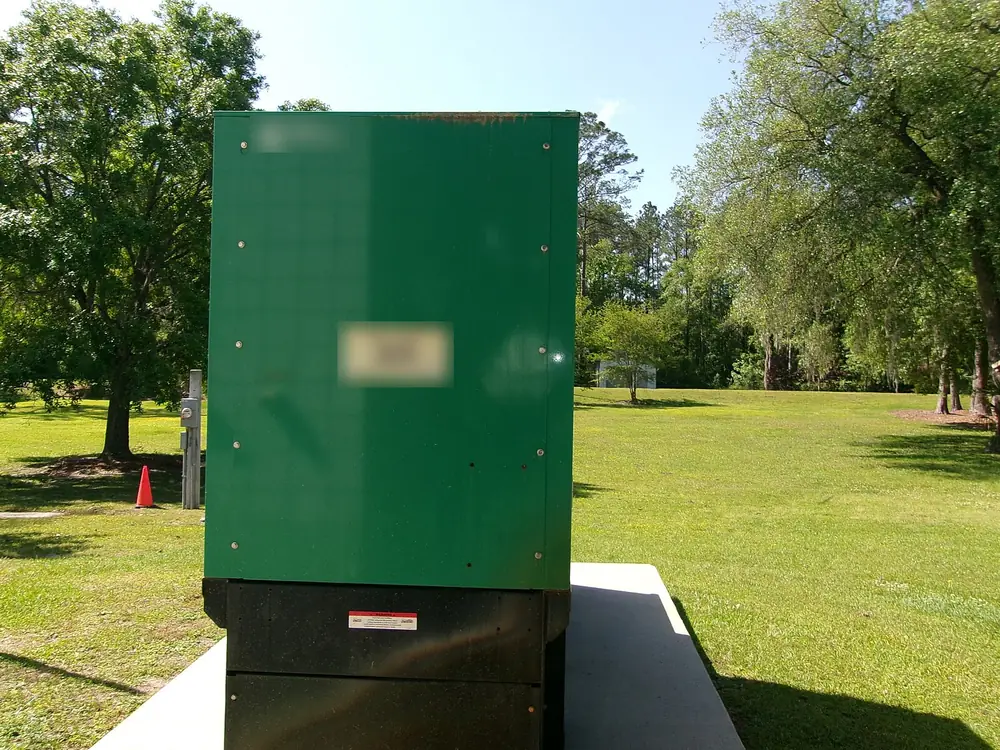
Natural gas or diesel: cheaper to buy is not cheaper to run.
Generac's white paper, Total Cost of Ownership: Diesel vs. Natural Gas Generators, splits the market at 150 kW. Below 150 kW, generators use automotive-style engines, and natural gas units are priced at or below diesel. Above 150 kW, natural gas units typically cost 60 to 100 percent more than diesel, which raises the whole project by 30 to 60 percent. Generator Source's 2026 table shows gas sets above diesel at every size where it lists both, for example $40,000 to $69,000 against $35,000 to $60,000 at 100 kW. The two sources disagree below 150 kW, so ask for both prices.
Running costs point the other way. Generac says diesel typically costs three to four times more for the energy gained. Its paper ran the numbers at $2.50 a gallon of diesel and 70 cents a therm of gas. New Jersey's latest public prices are higher on both: EIA lists Central Atlantic on-highway diesel at $6.412 a gallon for the week of November 9, 2026, and New Jersey's commercial natural gas price at $15.47 per thousand cubic feet for July 2026. That works out to about $46.67 per million Btu for diesel and $14.93 for gas, a ratio of about 3.1 (our arithmetic, using EIA's 137,381 Btu per gallon and 1,036 Btu per cubic foot).
| Load | Natural gas, ft³ an hour | Natural gas, cost an hour | Diesel, gallons an hour | Diesel, cost an hour |
|---|---|---|---|---|
| 50 percent | 768 | $11.88 | 4.2 | $26.93 |
| 75 percent | 1,017 | $15.73 | 5.9 | $37.83 |
| 100 percent | 1,280 | $19.80 | 7.3 | $46.81 |
Generac says load levels of 50 to 75 percent are common. At 75 percent, a 24-hour outage costs about $378 in natural gas or $908 in diesel for these two sets. EIA's diesel figure is an on-highway price that includes all taxes; the fuel dealer quotes the price for generator fuel.
- Diesel is bought before the first outage. Generac's paper assumes a 48-hour tank. At 75 percent load, 48 hours of the SD100 is about 283 gallons, roughly $1,816 at EIA's November 9 price (our arithmetic). Generac says diesel must be tested every year and polished every one to four years, at about $1.00 a gallon.
- Natural gas needs the gas company. PSE&G requires residential and commercial customers to apply to add or increase gas service for a generator. The application needs the generator's specification sheet, and PSE&G says gas generator projects can take up to six weeks. Generac adds that gas service capacity and pressure must be checked so every gas infrastructure cost is found.
- Emergency systems need fuel on site. For an Article 700 system, the 2-hour on-site fuel rule in section 02 applies unless the authority having jurisdiction approves the public gas system.
- Each fuel has its own NJDEP general permit. GP-005A covers diesel, No. 2 fuel oil and kerosene; GP-005B covers natural gas and propane.
- Weekly exercise burns little. Generac says a weekly 20-minute no-load exercise uses only about 5 percent of full-load fuel. For the SG100, that is about 21 cubic feet a run, or about $17 a year at $15.47 per thousand cubic feet (our arithmetic).
06 / The NJDEP air permit
Around 100 kW, New Jersey's air permit becomes part of the cost.
NJDEP's guidance for minor facilities says an emergency generator needs an air permit when its maximum rated heat input to the burning chamber is 1,000,000 Btu per hour or greater (N.J.A.C. 7:27-8.2(c)1). If the engine meets a general permit's conditions, the owner registers under GP-005A or GP-005B instead of applying case by case. NJDEP's general permits page lists the registration fee as $1,090.
Where 100 kW lands (our arithmetic on the spec sheets): Generac's SD100 diesel burns 7.3 gallons an hour at full standby load. At EIA's 137,381 Btu per gallon, that is about 1,002,900 Btu an hour, right at the line.
Generac's SG100 natural gas set burns 1,280 cubic feet an hour at full standby load. At EIA's 1,036 Btu per cubic foot, that is about 1,326,000 Btu an hour, over the line.
The engine's rated heat input on its own data sheet decides the question. These two sheets show that in New Jersey the air permit starts to matter at about 100 kW, not only for very large plants.
A general permit also sets running rules that belong in the budget:
- Testing and maintenance hours are capped at the number registered for each generator, never more than 100 hours a year (GP-005A).
- Hours are counted on a non-resettable hour meter, and each run is logged with its reason, dates, start and stop times, hours and operator. Records are kept for at least five years.
- A generator under a contract for emergency demand response, peak shaving or any similar financial agreement cannot use the general permit. Generac's white paper counts demand-response savings of about $50 per kW a year in some markets; in New Jersey that use rules out the general permit, and NJDEP's guidance sends an engine that cannot meet a general permit to a case-by-case permit.
MDL's generator repair and maintenance page covers the hour log and the yearly testing cap for generators already in place.
07 / Permits and the gas company
The construction permit, the inspection and the gas company, in the order they happen.
- The load list and the code article. What must stay on sets the size; the codes that require the system set the article (section 02).
- The construction permit. New Jersey's construction code makes it unlawful to install or alter regulated equipment without first obtaining a permit (N.J.A.C. 5:23-2.14). A building's annual construction permit does not cover it: modification work other than routine maintenance that affects stand-by generator systems is excluded from annual permits. Each town's construction office sets its own fees by ordinance (N.J.A.C. 5:23-4.17).
- The NJDEP registration, when the engine reaches 1,000,000 Btu an hour (section 06).
- The PSE&G application for a natural gas generator, with the specification sheet; up to six weeks.
- Two NFPA 110 details. DCA notes that NFPA 110 requires an additional remote stop outside the room or enclosure where the generator sits (5.6.5.6) and a remote alarm located away from it (5.6.6). Both are wiring lines on the proposal.
- The inspection and test. For Article 700 and 701 systems the local enforcing agency conducts or witnesses the test of the complete system. The equipment may not be used until the certificate of approval is issued (N.J.A.C. 5:23-2.8).
Electrical work in New Jersey must be done by people licensed to do it, apart from a homeowner working on his or her own single-family house (N.J.A.C. 5:23-2.15). A commercial generator's transfer switch and feeders are that work. For other commercial electrical jobs in the same building, see MDL's commercial electrician page; for the exit signs and emergency lights that an Article 700 system often feeds, see emergency lighting and exit signs.
08 / Yearly upkeep
Keeping it ready: what testing, service and load banks cost each year.
Generac's white paper describes the routine for a standby generator that runs less than 250 hours a year: an annual inspection and service, filters and oil changed every year, cranking batteries replaced every two to three years, and belts, hoses and coolant checked yearly and replaced as needed, typically every four to six years.
| Item | Published figure | 100 kW | 150 kW | Source |
|---|---|---|---|---|
| Yearly service | $500 fixed plus $1.00 per kW | $600 | $650 | Generac white paper (planning estimate) |
| Service plan | $500 to $1,500 a year | Same range | Same range | Generator Source, May 7, 2026 |
| Load bank test | $1,000 fixed plus $1.50 per kW | $1,150 | $1,225 | Generac white paper; diesel typically every 2 to 3 years, gas less often |
| Diesel fuel polishing | About $1.00 a gallon, every 1 to 4 years | About $283 for a 283-gallon fill | Depends on the tank | Generac white paper |
Load bank tests run the generator at full capacity. Generac says diesels need them more often because of wet stacking, a buildup of unburnt fuel in the exhaust when a diesel runs at no load or under 30 percent load. Natural gas engines do not wet stack, but still need a periodic load bank test to check engine and cooling health. Every test run counts toward the NJDEP hour cap in section 06.
09 / Comparing proposals
Ten things to compare across commercial generator proposals.
- The load list, with the kW of each item, and the resulting generator size.
- The generator's kW, fuel, enclosure and emissions certification for emergency standby.
- The transfer switch amperage, and whether the job needs one switch or several.
- The NEC article (700, 701 or 702) the system is designed to, and who confirmed it.
- For gas: the PSE&G application, the gas pressure and meter check, and the expected timeline.
- For diesel: the tank size, the hours of fuel it holds, and the first fill.
- The engine's rated heat input and whether it needs NJDEP registration under GP-005A or GP-005B.
- The pad, the location, the distance to the electrical service and how the set is placed.
- The construction permit, the inspection, the witnessed test where required, and who files each.
- The testing and service schedule after start-up, and who keeps the hour log.
Every item above is part of a commercial standby job, and MDL installs and services commercial standby generators. MDL looks at the building, the electrical service and the loads before it prices the job, and this guide quotes no MDL price.
Commercial generator request
Tell MDL what has to stay on, and start the scope from there.
Send the building's address and use, the equipment that must run in an outage, photos of the main panel labels and gas meter with the doors closed, and where a generator could sit outside. The request form is on MDL's commercial generator installation page.
10 / Questions answered
Commercial generator cost questions from New Jersey owners and facility managers.
How much does a commercial generator cost?
Generator Source's 2026 figures put a 22 to 60 kW small-commercial generator at $6,000 to $25,000 for the unit and $12,000 to $45,000 installed, and a 70 to 150 kW generator at $25,000 to $65,000 for the unit and $50,000 to $110,000 installed. A 200 to 500 kW system runs $150,000 to $300,000 or more installed. Kompareit's older 2023 average is $400 per kW installed.
How much does commercial generator installation cost, apart from the generator?
The published lines are an automatic transfer switch at $2,000 to $15,000 or more, electrical labor at $5,000 to $25,000, a fuel connection at $3,000 to $10,000 and a concrete pad at $50 to $75 a square foot (Generator Source, May 2026). Generac's planning figure for cabling, transfer and distribution equipment is about $150 per kW. In New Jersey, add the town's construction permit fee and, for larger engines, NJDEP's $1,090 general permit registration.
How much does a 100 kW or 150 kW generator cost?
Generator Source's September 2026 estimates for the generator alone are $35,000 to $60,000 for a 100 kW diesel set and $40,000 to $69,000 for natural gas; at 150 kW, $51,000 to $84,000 for diesel and $58,000 to $97,000 for gas. Kompareit's 2023 unit averages were $26,000 for 100 kW and $30,000 for 150 kW.
What is the cost of a big generator?
In Generator Source's 2026 table, a new 500 kW set alone is $150,000 to $225,000 in diesel and $172,000 to $259,000 in natural gas, and a 1,000 kW set $275,000 to $375,000 in diesel. Its installed band for 1,000 kW and up is $500,000 to $1 million or more.
Why do generators cost so much?
Three reasons appear in the sources. Above 150 kW, generators use specialized diesel-derivative engines (Generac). Installation is about as large as the generator: in Generator Source's bands the unit is about half of the installed total. And a diesel generator rated for non-emergency use needs Tier 4 exhaust aftertreatment, which Generac says adds 40 to 50 percent to the generator's cost.
Does a commercial generator need an air permit in New Jersey?
When the engine's maximum rated heat input is 1,000,000 Btu an hour or more (NJDEP). By Generac's spec sheets, a 100 kW diesel set burns about 1.0 million Btu an hour at full load and a 100 kW natural gas set about 1.3 million, so sizes from about 100 kW up should plan on registering under general permit GP-005A or GP-005B, at $1,090, unless the engine's rated heat input is lower.
Is natural gas or diesel cheaper for a business generator in New Jersey?
To run, natural gas: at New Jersey's latest EIA prices, a 100 kW set at 75 percent load costs about $15.73 an hour on gas and $37.83 on diesel. To buy, it depends on size: Generac says gas is priced at or below diesel under 150 kW and 60 to 100 percent above it over 150 kW, while Generator Source's 2026 table shows gas above diesel at 100 kW. An Article 700 emergency system also needs fuel on site unless the authority having jurisdiction approves the public gas system.
How long does a commercial generator project take?
The timeline depends on the permit, the NJDEP registration where needed and, for natural gas, the gas company. PSE&G says a gas generator project can take up to six weeks once the application, with the generator's specification sheet, is in. No source we read gives a single figure for the whole job.
Does MDL publish commercial generator prices?
No. MDL installs and services commercial standby generators, and it prices each job after it looks at the building, its electrical service and the loads that must stay on. Every dollar figure in this guide is a published market figure with its source beside it.
11 / About this guide
Who wrote this guide, and what it does not do.
MDL Electric Cooling & Heating wrote this guide. MDL is a licensed electrical contractor and master HVACR contractor at 4 Harrison Ave, West Orange (NJ Electrical Business Permit #34EB01606200; NJ Electrical Contractor #34EI01606200; NJ Master HVACR Contractor #19HC00308200), working across Essex, Morris and Union counties. It installs and services commercial standby generators. Brands appear here only because their published spec sheets and white paper supply the numbers; MDL makes no dealer or certification statement about any of them, and no figure here is an MDL price. Every figure was read from the sources below on November 16, 2026. The per-hour fuel costs, Btu figures, totals and upkeep columns are our arithmetic on those figures, shown so you can check them. For a home rather than a business, see MDL's whole house generator cost guide; for every commercial service MDL lists, see commercial services.
12 / Source record
Sources, read November 16, 2026
Prices, fuel costs and codes change. Where two sources disagree, both are shown. Nothing here is an MDL price. No company named here was asked or paid to appear, and their prices are quoted as market evidence only.
- Generator Source — Generac generator cost including installationPublished April 28, 2026, updated May 7, 2026: installed bands by kW and application; transfer switch $2,000 to $15,000 or more; pads $50 to $75 a square foot; electrical labor $5,000 to $25,000; fuel connection $3,000 to $10,000; service plans $500 to $1,500 a year.
- Generator Source — Generac industrial generators: models and 2026 pricesSeptember 29, 2026: estimated new prices by kW for diesel and gas sets, with enclosure, certified for emergency standby; installation and transfer switches separate.
- Kompareit — Cost and sizing of industrial generators for restaurantsDated May 3, 2023 in Google's results: $400 per kW for unit, installation, warranty and service agreement; unit averages for 50, 100, 150 and 400 kW; 50 kW plus 5 watts per square foot.
- Generac — Total Cost of Ownership: Diesel vs. Natural Gas Generators (PDF)White paper, undated, market data through 2016: the 150 kW split; installation about $150 per kW; gas piping $10 to $20 per kW; diesel three to four times the cost per Btu; maintenance and load bank estimates; Tier 4 adds 40 to 50 percent; demand response about $50 per kW a year.
- Generac — SG100 100 kW gaseous generator spec sheet (PDF)Natural gas at standby: 768, 1,017 and 1,280 cubic feet an hour at 50, 75 and 100 percent load.
- Generac — SD100 100 kW diesel generator spec sheet (PDF)Diesel at standby: 4.2, 5.9 and 7.3 gallons an hour at 50, 75 and 100 percent load.
- US EIA — New Jersey price of natural gas sold to commercial consumers$15.47 per thousand cubic feet, July 2026; released October 30, 2026.
- US EIA — Gasoline and diesel fuel updateCentral Atlantic (PADD 1B) on-highway diesel, $6.412 a gallon, week of November 9, 2026; prices include all taxes.
- US EIA — Units and calculators explained1 cubic foot of natural gas = 1,036 Btu; 1 gallon of diesel = 137,381 Btu.
- NJDEP — Engine: emergency generator or stationary engine, and permit applicability for minor facilities (PDF)July 12, 2024: 1,000,000 Btu per hour heat input; general permit or case-by-case permit.
- NJDEP — General permits and general operating permitsRegistration satisfies the permit requirement; fee $1,090.
- NJDEP — GP-005A, emergency generators burning distillate fuels (PDF)Testing and maintenance at most 100 hours a year; non-resettable hour meter; records five years; no demand response or peak shaving contracts.
- NJDEP — GP-005B, emergency generators burning gaseous fuels (PDF)The matching general permit for natural gas and propane.
- PSE&G — Gas generators and tankless water heatersResidential and commercial customers apply to add or increase gas service; specification sheet; up to six weeks.
- N.J.A.C. 5:23-2 — Uniform Construction Code, administration (PDF)2.8 use after a certificate of approval; 2.14 permits and the annual permit exclusion for stand-by generator systems; 2.15 licensed work.
- N.J.A.C. 5:23-3 — Subcodes (PDF)3.16: the National Electrical Code 2023 is the electrical subcode.
- N.J.A.C. 5:23-4 — Enforcing agencies and fees (PDF)4.17: municipal enforcing agency fees, set by ordinance.
- NJ DCA — Construction Code Communicator, Spring 2021 (PDF)"Generators in the NEC and NFPA 110": 700.3(A) and 701.3(A) witnessed testing, none for 702; NFPA 110 remote stop and remote alarm.
- ez-pdh — 2023 NEC significant code changes, part 3700.12(C), generator sets: on-site fuel for at least 2 hours; a separate paragraph bars sole dependence on a public utility gas system unless approved by the authority having jurisdiction.
- ICC — 2021 International Building Code, New Jersey edition, Chapter 27Effective March 2023: 2702.2.2 elevators; 2702.2.5 common exhaust in multistory buildings; 2702.2.11 high-rise buildings.