24/7 electrical, heating, and cooling help across North Jersey

Call 973.809.2339

Commercial EV charging · Essex, Morris and Union County

Commercial EV charger installation in New Jersey

For property managers, condo boards, workplaces and retail sites, the hard part of commercial EV charging is who pays for which piece. This page sets out what PSE&G, JCP&L, NJDEP and NJBPU offer, as read on November 2, 2026. MDL Electric, a licensed New Jersey electrical contractor in West Orange, handles the electrical side.

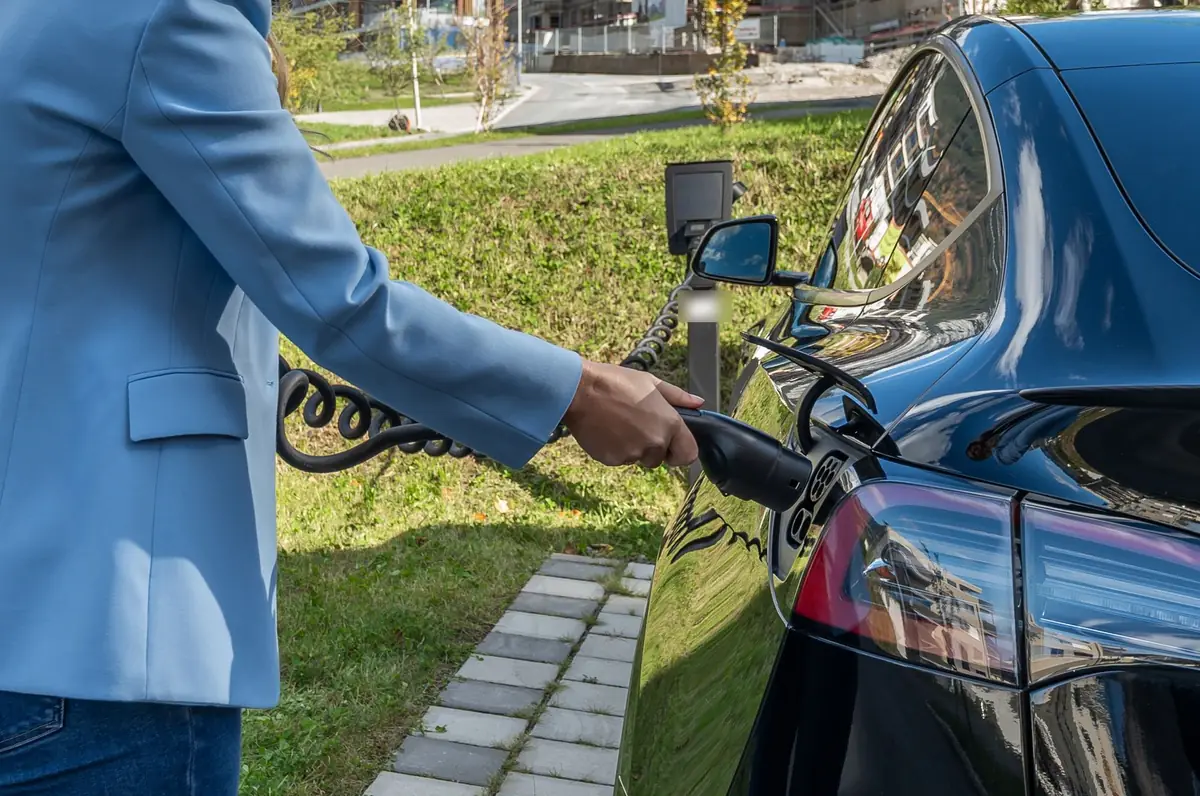
Person in a blue blazer plugging a coiled charging cable into a dark electric car parked beside a lawn, with a charging post behind

The short answer

Three programs can pay for different pieces of one job. One utility's program has closed, and the order you do things in can cost you the money.

The wiring side. PSE&G can credit up to $30,000 toward make-ready work on your side of the meter, at up to $7,500 per charger for up to four chargers per site. It does not pay for the charger.

The charger side. NJDEP's It Pay$ to Plug In reimburses up to $4,000 per Level 2 port, but not the installation. NJBPU's Multi-Unit Dwelling program pays up to $4,000 per dual-port station at buildings of five or more units.

What changed. JCP&L's commercial EV programs are closed, and the federal 30C credit ended for equipment placed in service after June 30, 2026. Older guides may still list both.

MDL Electric Cooling & Heating works from 4 Harrison Avenue in West Orange and holds New Jersey electrical contractor license 34EI01606200 and electrical business permit 34EB01606200. Call 973.809.2339 to review a property.

PSE&G customersMake-ready credit, while funding lasts. The charger is yours to buy.
JCP&L customersNo commercial program open. State programs may still fit.
Five or more unitsNJBPU, or NJDEP, for the station. Not both on one station.
Workplaces and retailNJDEP covers public and workplace locations, on a waitlist when funds run short.

Who pays for what

Commercial EV charging in New Jersey, piece by piece.

Read each column down for one program, or across for one bill. Every line was read on the program's own page on November 2, 2026. Funding changes, so confirm with the program before you rely on it.

Scroll sideways to see the whole table.

Sources, read November 2, 2026: PSE&G EV Commercial Charging Program, JCP&L New Jersey EV Driven, NJDEP It Pay$ to Plug In overview and FAQ, NJBPU Multi-Unit Dwelling program.
The piecePSE&G Level 2 Mixed-UseJCP&L EV DrivenNJDEP It Pay$ to Plug InNJBPU Multi-Unit
Status when readOpen. Program runs while funds last; see the note below.Closed to commercial applicants.New applications go to a waitlist, first come.Available. $6,532,472 of this year's funding unreserved (79%), as of October 1, 2026.
Who it is forCommercial accounts on GLP or LPL-S rates. Multi-family, government and public-access sites may be considered.No one new.Public, workplace and multi-unit locations. The applicant must own and operate the stations.Apartments, condos and mixed residential sites with five or more units and dedicated off-street parking.
Wiring, panels, conduit on your sideOn-bill credit up to $7,500 per charger, four per site, $30,000 total.Closed.Not eligible.Up to $5,000, only outside investor-owned utility territory.
Upgrades on the utility's sideUp to $10,000 off the deposit.Closed.Not eligible.Not listed.
The charger itselfNot covered. You pay.Closed.Up to $4,000 per Level 2 port, $750 per Level 1 port.Up to $4,000 per dual-port station; up to $6,000 in an Overburdened Municipality or at 100% affordable housing.
Installation laborNot listed as its own item. The credit goes toward upgrading make-ready assets.Closed.Not eligible.Not listed as its own item.
Network, warranty, maintenanceNot listed.Closed.Eligible, including network fees up to five years.Not listed. The station must be network capable.
Bollards, signs, paintNot listed.Closed.Not eligible.Not listed.
Size limitsFour chargers per site.Closed.At least 2 and at most 20 Level 2 ports per location; $500,000 per calendar year.3 stations at 5 to 40 units, 6 at 41 to 100, 12 at 101 to 200, 24 above 200.
How you get paidCredit on the bill within one to two billing cycles.Closed.Reimbursement after the work.Reserved at step one, claimed with proof of installation.
Who to call1-800-249-18371-888-352-0908(609) 292-7953877-426-2474

Funding notes. PSE&G's semiannual report for the first half of 2026 showed $34,510,210 left across its behind-the-meter sub-programs, not this one alone. The Board of Public Utilities' May 21, 2026 order keeps the program running as approved, which for PSE&G means until funds are exhausted, and PSE&G's petition on the end date is before the Board. Combined state, federal and PSE&G money cannot exceed 90% of project cost, and you must tell PSE&G and the other program. NJDEP's comparison sheet says one station cannot draw on both NJDEP and NJBPU money.

The order that protects the money

Buy the charger too early and the grant is gone.

NJDEP's first warning is in its own words: applicants must have their grant executed "before purchasing or installing any charging stations." Its FAQ draws a useful line: make-ready electrical infrastructure may be purchased and assembled before the work period, but no charging equipment may. PSE&G's process also starts before the install, so the paperwork comes first.

01

Measure the load

Find out what the service can spare before anyone picks a charger count. See capacity below.

02

Pick the money

Your utility, unit count and use decide which programs fit. Confirm each one's status by phone.

03

Apply, then wait

NJDEP needs three quotes and an executed grant. PSE&G says its review can take up to three months. NJBPU reserves funds at step one.

04

Utility and permit

For PSE&G, your electrician completes the service upgrade form, and engineers decide if utility work is needed. The town permit follows the scope.

05

Install and close out

NJDEP expects installation within nine months, then paid invoices and photos. PSE&G wants invoices, serial numbers and closed permits. NJBPU wants proof of installation.

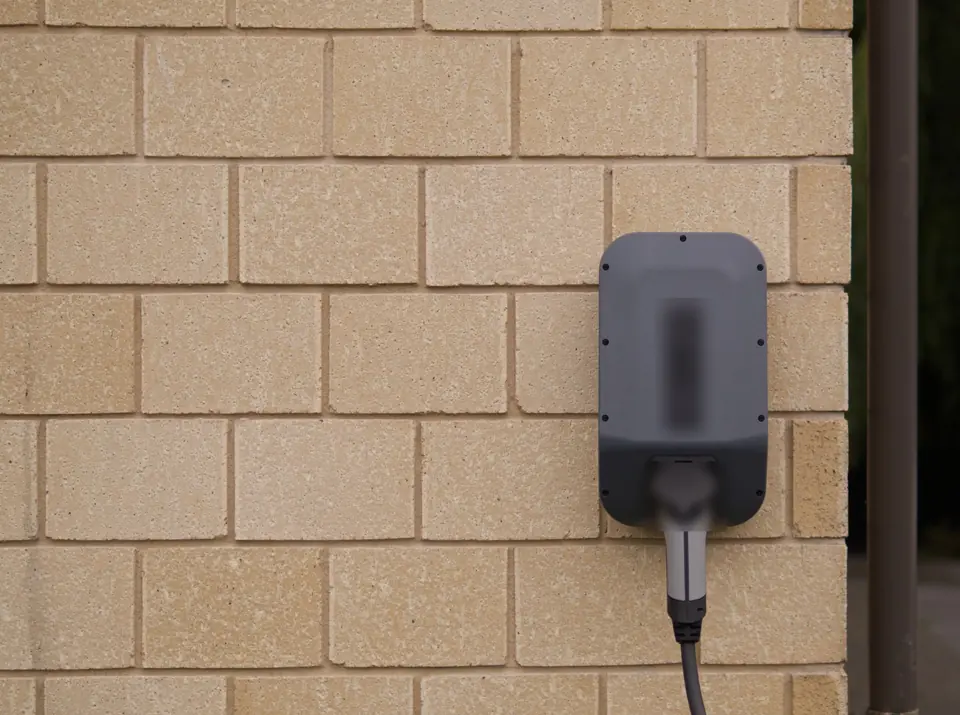
Dark grey wall-mounted EV charging station with its cable hanging down, fixed to a tan masonry wall
A networked wall station on masonry: stock photo with the maker's logo blurred, not an MDL job.

What the equipment has to be

  • ENERGY STAR. PSE&G and NJBPU both require it. New Jersey law also covers Level 1 and 2 equipment made after January 18, 2023 and sold or installed for pay in the state (NJDEP appliance standards).
  • Networked. PSE&G wants Wi-Fi or cellular and your agreement to share charging data. NJBPU wants a state-compliant network provider.
  • NJDEP's list. 7.2 kW minimum, OCPP, UL 2594 or an equivalent listing, 97% uptime and 24/7 phone support.
  • NJBPU's list. Dual port, UL 2594 listed, in spaces accessible to all residents.
  • Public access. PSE&G expects public chargers to be open at least reasonable business hours, typically eight or more a day.

Your property

What changes for a condo board, a landlord, a workplace and a store.

Condo and HOA boards

  • An owner has rights. Under P.L. 2020, c.108 an association cannot prohibit or unreasonably restrict a station in a designated space. No written denial within 60 days counts as approval, unless the delay comes from a reasonable request for more information.
  • Conditions. Licensed electrician, insurance, $100,000 liability coverage, and the owner pays electricity and costs.
  • The board's tools. It may deny for a life-safety risk, hold an application while infrastructure is upgraded, specially assess, and install stations on common elements.
  • Shared stations. NJBPU money requires spaces accessible to all residents, which a private deeded space may not meet.

Apartments and rentals

  • Unit count sets the size. NJBPU caps stations by units; NJDEP also uses a five-unit minimum.
  • New site plans. P.L. 2021, c.171 requires 15% of spaces as Make-Ready at multiple dwellings of five or more units, with chargers phased in over six years.
  • Who owns it. NJDEP's applicant must be the entity that will own and operate the stations, so ask before signing with an outside charging operator.

Workplaces

  • NJDEP names workplaces. Its grant covers chargers for employees and fleet vehicles, and it recommends an employee survey at firms above 50 staff to size the project.
  • Check PSE&G first. Its list names multi-family, government and public-access sites. An employees-only lot is not named, so ask before you count on the credit.
  • Long dwell. Cars parked all day suit Level 2, which keeps the load per port lower than fast charging.

Retail and hospitality

  • Access rules. PSE&G requires public chargers to be open during reasonable business hours, with any fee clearly displayed. NJDEP's public category means stations exclusively available to the public, where cars park four hours or more, and it names retail parking and hotels.
  • New site plans. P.L. 2021, c.171 sets tiers by lot size. Retailers with 25 or fewer spaces are exempt, and each EV space counts as at least two toward minimum parking, up to a 10% reduction.
  • Fast charging. Public DC fast charging runs through separate NJDEP solicitations. The state's EV Savings Hub showed Community DC fast charging not accepting applications when read.
  • New law, existing lot. P.L. 2021, c.171 applies to new site plans. It does not order an existing lot to add anything.
  • Other lots. One Make-Ready space at 50 spaces or fewer, two at 51 to 75, three at 76 to 100, four at 101 to 150, and 4% above 150.
  • Accessible spaces. The statute sets accessible shares for larger lots and multi-dwelling sites, so lay out accessible stalls with the first phase.
  • Zoning. The same law makes EV supply equipment a permitted accessory use. The Department of Community Affairs published a model statewide ordinance on September 1, 2021.
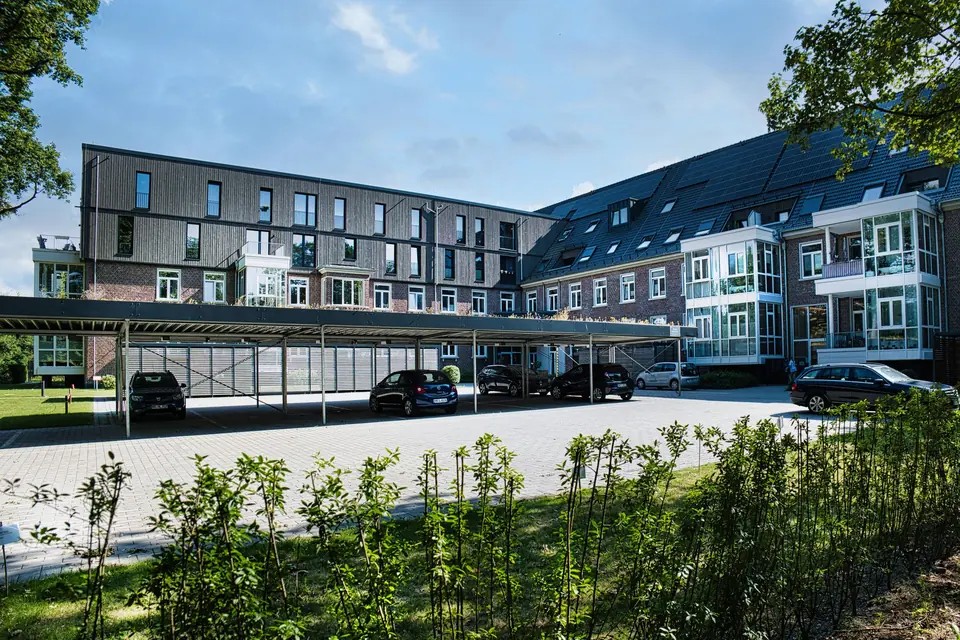
Three-story apartment buildings around a paved parking court with a long covered parking structure and young landscaping
Covered parking at a multi-unit building: stock photo, not an MDL job.

Capacity and cost

How many chargers can the building carry, and what does it cost?

Charger count comes from the service, not from the parking lot. The sums below are our arithmetic from the sources named.

One port on paper

  • NJDEP's minimum. 7.2 kW per port, which is 30 amps at 240 volts.
  • The 125% rule. The National Electrical Code treats EV charging as a continuous load (Article 625), so that port needs 37.5 amps of capacity.
  • Ten ports. On a 240-volt feed, that is 375 amps if every port can run at once.

Sharing the load

  • Energy management. The code lets a load management system limit what the chargers draw on a feeder or service (NEC 625.42).
  • The trade-off. Shared capacity means slower charging when many cars plug in at once, which is often fine for overnight or all-day parking.
  • Check first. Programs set their own minimums. Confirm that a shared-power design still counts for each port, because NJDEP treats a station that cuts power to each connector as one port.

Level 2 or DC fast

Published cost ranges

Scroll sideways to see the whole table.

Market ranges from GreenLancer's October 2026 guide, read November 2, 2026. These are market ranges, not MDL prices.
EquipmentPublished installed cost
Level 2, per port$3,000 to $12,000
Level 2, dual-port unit$6,000 to $20,000 or more
DC fast charging$80,000 to $250,000 or more

The federal 30C credit used to soften these numbers. The IRS instructions for Form 8911 say Public Law 119-21 ended it for property placed in service after June 30, 2026, and a July 10, 2026 IRS FAQ covers the census-tract rules for earlier projects. Treat any budget that still counts on it as out of date.

Permit and inspection

What New Jersey asks for on a commercial EV charging job.

The same rules as MDL's commercial electrician page, applied to charging. From the Uniform Construction Code, read November 2, 2026.

Scroll sideways to see the whole table.

Sources: N.J.A.C. 5:23-2.7, 2.14, 2.15, 2.18; N.J.A.C. 5:23-3.16; PSE&G.
QuestionWhat appliesSection
Is a permit needed?Yes. New circuits are not ordinary maintenance, and installing or altering regulated equipment without a permit is unlawful.5:23-2.7, 2.14(a)
Who may do the work?Persons licensed to do it. The single-family homeowner exception does not reach a commercial building, and PSE&G requires New Jersey licensed electricians for its incentive.5:23-2.15
What gets inspected?Rough wiring, panel and service installation, then a final inspection.5:23-2.18(b), (d)
Which code?The National Electrical Code 2023 as New Jersey's electrical subcode, including Article 625 for EV equipment.5:23-3.16(a)1
Paperwork for the incentivePSE&G lists an itemized paid invoice, the charger invoice and serial number, and closed municipal permits with UCC Form F-222A.PSE&G FAQ

Before you call

Seven details that make the first conversation useful.

  1. The address and your utility, from the electric bill, with the rate if you have it.
  2. Who decides: owner, manager, board or tenant, and who can sign a grant application.
  3. Who parks there: residents, staff, visitors or the public, and for how long.
  4. How many spaces, how many you want to equip now, and how many later.
  5. A photo of the electrical room, the main panel label and the meter bank.
  6. The distance from that room to the spaces, and what lies between: asphalt, landscaping or a garage slab.
  7. Any program paperwork already started, with its date.
Do notBuy or install a charger before you know which grant you are using.
Do notBudget on the federal 30C credit or a JCP&L commercial incentive.
DoPhone each program to confirm funding on the day you apply.

Why MDL

The electrical side of a commercial charging project, from a licensed New Jersey contractor.

MDL Electric Cooling & Heating works from 4 Harrison Avenue, West Orange, across Essex, Morris and Union County. For a charging project its part is the electrical work: the load review, panel and capacity, circuits, the permit and the inspection. The commercial electrician page explains how MDL handles commercial work, panel upgrades covers capacity, and EV charger installation covers a single home.

LicensedNJ electrical contractor 34EI01606200 and electrical business permit 34EB01606200.
Local4 Harrison Avenue, West Orange, NJ 07052.
One call973.809.2339 for a property review.

Commercial EV charging

Request a charging review.

Tell MDL the property, your utility, who parks there and how many spaces you have in mind.

Commercial EV charging questions

Straight answers on who pays, what changed and what New Jersey requires.

Program lines were read November 2, 2026 and can change. Costs are published market ranges, not MDL prices.

Who pays for commercial EV charger installation in New Jersey?

Usually more than one party, and it depends on the piece. As read on November 2, 2026: PSE&G can credit part of the wiring and panel work on your side of the meter, but not the charger. NJDEP's It Pay$ to Plug In can reimburse the charger and its network, but not the installation. NJBPU pays toward chargers at multi-unit buildings. JCP&L's commercial programs are closed. The property owner pays the rest.

Is JCP&L's EV Driven program still open for commercial properties?

No. As read on November 2, 2026, JCP&L's page says its Mixed-Use Commercial and DC fast charging sub-programs have reached maximum funding and are closed, and that applications for Public/Community-Based, Workplace and Multifamily programs and DC fast charging incentives are no longer accepted. NJDEP and NJBPU programs are separate and can still apply to a JCP&L customer's site. Confirm with JCP&L at 1-888-352-0908.

How much will PSE&G pay toward commercial EV chargers?

PSE&G's Level 2 Mixed-Use program lists an on-bill credit of up to $30,000 toward customer-side make-ready work, calculated at up to $7,500 per charger for up to four chargers per site, plus up to $10,000 off a deposit for utility-side work. Chargers must be ENERGY STAR certified and networked, and the installer must be New Jersey licensed. Confirm funding with PSE&G at 1-800-249-1837.

Does PSE&G pay for the charger itself?

No. PSE&G says customers are responsible for the cost of the charging unit. Its program helps with make-ready work, meaning panels, switchgear, conduit and wire up to the charger stub, plus service line upgrades.

Does the NJDEP It Pay$ to Plug In grant cover installation?

No. NJDEP's grant covers the station and items such as warranty, maintenance and network fees for up to five years. Make-ready work, installation, bollards, signage and paint are not eligible. It pays up to $4,000 per Level 2 port and $750 per Level 1 port, as a reimbursement.

Can I buy the chargers before NJDEP approves the grant?

No, if you want the grant. NJDEP says applicants must have the grant executed before purchasing or installing any charging stations, that costs incurred before the work period are not eligible, and that projects already begun cannot be selected. An approval letter is not the same as an executed grant.

Can a condo or apartment building get money for EV chargers?

Yes, if the program still has funding. NJBPU's Multi-Unit Dwelling program offers up to $4,000 for a dual-port networked Level 2 station, or up to $6,000 in a designated Overburdened Municipality or at deed-restricted 100% affordable housing. The building needs at least five units and dedicated off-street parking, and the spaces must be accessible to all residents.

Can I combine these incentives?

Partly. PSE&G allows other public funding if you notify everyone, but its incentive plus state or federal funding cannot exceed 90% of project cost. NJDEP's comparison sheet says one station cannot draw on both NJDEP and NJBPU money.

Can I still claim the federal 30C tax credit for EV chargers?

Not for equipment placed in service after June 30, 2026. The IRS instructions for Form 8911 say Public Law 119-21 ended the credit for property placed in service after that date. Ask your tax adviser about anything placed in service earlier.

Can a New Jersey condo association stop an owner from installing a charger?

Not by a blanket ban. P.L. 2020, c.108 says an association cannot prohibit or unreasonably restrict an owner installing a station in a designated parking space, and treats an application as approved if it is not denied in writing within 60 days, unless the delay comes from a reasonable request for more information. The owner must use a licensed electrician, carry $100,000 in liability coverage and pay the costs. The association may deny for a life-safety risk or hold an application while infrastructure is upgraded.

Does New Jersey require EV parking at new commercial or multifamily projects?

For new site plans, yes. P.L. 2021, c.171 requires 15% of spaces as Make-Ready at multiple dwellings with five or more units, and sets tiers for other lots, starting at one Make-Ready space for 50 spaces or fewer. Retailers with 25 or fewer spaces are exempt. It governs new applications, not an existing lot.

How much does a commercial EV charger cost to install?

GreenLancer's October 2026 guide puts Level 2 at $3,000 to $12,000 per port installed, a dual-port unit at $6,000 to $20,000 or more, and DC fast charging at $80,000 to $250,000 or more. These are market ranges, not MDL prices. The distance from the panel and whether the service has room move the number most.

Level 2 or DC fast charging for my property?

Level 2 suits places where cars sit for hours: homes, workplaces and long-stay parking. The US Department of Energy's multifamily guide describes it at 208 or 240 volts, adding about 20 to 30 miles of range an hour. DC fast charging suits quick stops, costs far more and is funded in New Jersey through separate competitive solicitations.

How many chargers can my building handle?

That depends on the spare capacity on your service. NJDEP says the most common Level 2 stations are 30 to 40 amps, and the National Electrical Code treats EV charging as a continuous load, sized at 125%. An energy management system can share capacity among ports, so a load review comes before a charger count.

Does a commercial EV charger need a permit in New Jersey?

Yes. New circuits are outside ordinary maintenance, so the work needs an electrical permit and the town's inspections, and only licensed contractors may do it in a commercial building. PSE&G also asks for closed municipal permits with its paperwork before it issues an incentive.

Next steps

Related services

EV

EV charger installation

One Level 2 charger at a house: panel capacity, circuit route, permits and PSE&G steps.

Learn more
Commercial

Commercial electrician

Commercial troubleshooting, circuits, panels and the New Jersey permit rules for a managed building.

Learn more
Panel

Panel upgrades

Load, capacity and service upgrades when the building cannot carry what you want to add.

Learn more
Commercial

Commercial services hub

Commercial electrical and HVAC requests in one place for the same building.

Learn more

Request service

Send MDL the service, town, and best callback number.

Use the form for planned service or call for urgent electrical, heating, or cooling help.