Why did all my parking lot lights go out at once?
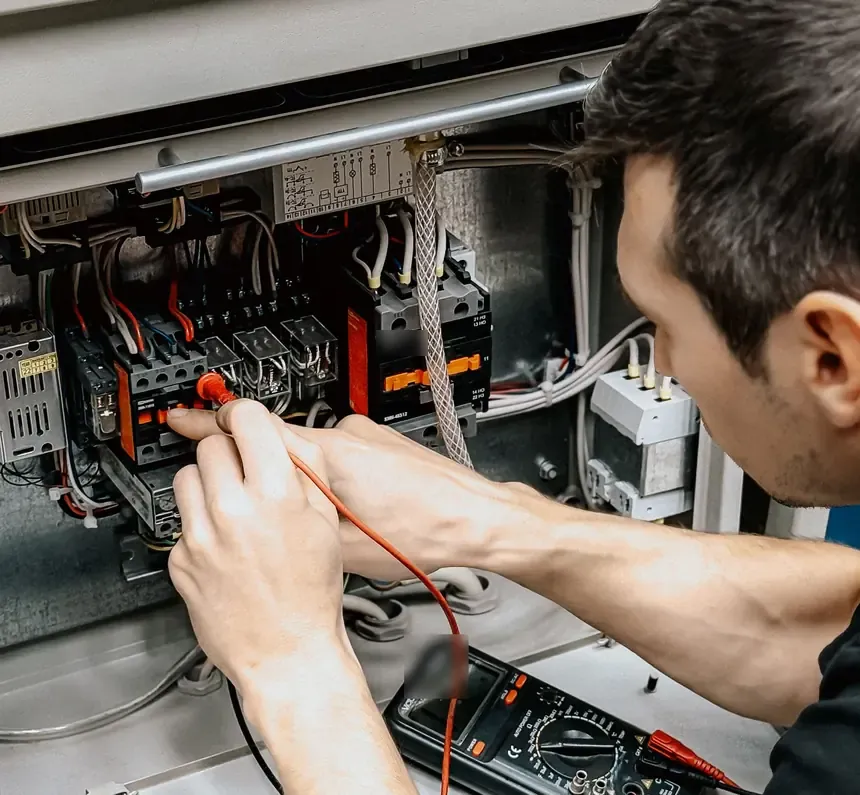
When a whole circuit is dead and the breaker is still closed, the Podacn field guide points first at a contactor, time clock or photocell that never turned the run on. That is why a repair starts at the panel with a voltage reading, not at the top of a pole.
Why do my parking lot lights stay on during the day?
A light burning day and night is the most common sign of a failed photocontrol, according to Howard Lighting's service guide. The contacts inside it can weld together from heat. The receptacle it plugs into should be checked for heat damage at the same time.
Why do my parking lot lights turn on and off all night?
The Podacn guide names a failing photocell or low voltage at the far end of the run. On older high-pressure sodium lamps, Howard's guide says cycling is the normal end-of-life failure, though a loose connection or a defective ballast can do the same. Logging voltage at the last pole through an evening separates the two.
Why does the breaker trip after it rains?
A breaker that trips only after rain or irrigation usually points to water in a handhole splice or standing in a pole base. The first test is an insulation test on the wet cable, then opening the handholes.
One pole is dark and the rest work. What failed?
Usually something at that pole: the driver, an in-pole fuse, or a shorted photocell on that head. Drivers are the most common field failure in LED lot lighting, according to the Podacn guide. A voltage reading at the fixture leads tells you whether power is reaching the head.
Half the lot is dark. Is that the fixtures?
Probably not. A run that is half lit and half dark usually means damaged cable between two poles or an open shared neutral. An electrician splits the circuit at the midpoint and retests until one span remains.
A car hit a light pole in my lot. What do I do?
Keep people away and treat any exposed or downed wire as live. PSE&G says to stay at least 30 feet from downed wires and call 911 or 1-800-436-7734. Do not touch the pole, stand it up or try to shut it off at the base. Once the area is safe, call an electrician and take photos for the insurance claim.
Do I need to call 811 before digging up a parking lot light feed?
Yes. N.J.A.C. 14:2-3.1 requires notice at least three business days and no more than 10 business days before excavating, and that notice lasts 45 business days. Remember that the utility usually marks only up to the meter. Your lot lighting feed is a private line, so it may not be marked for you.
Should I repair my old parking lot lights or switch to LED?
Repair when one part failed on an otherwise sound fixture. Consider LED when older metal halide or sodium fixtures keep failing, when several are out, or when a rebate covers part of the swap. Find and fix wiring faults first, because new fixtures will not cure a bad feed.
How much does parking lot lighting repair cost?
Published numbers cover the LED swap more than the repair. Grounded Electric lists $300 to $900 per fixture for LED retrofit kits and $700 to $1,800 per fixture for full replacement. These are market ranges, not MDL prices. A repair depends on what the fault turns out to be, which is why it is found first.
Are there New Jersey rebates for LED parking lot lights?
Yes, for eligible commercial customers. As read November 2, 2026, PSE&G and JCP&L business programs list $50 to $450 per DLC-listed outdoor pole fixture, depending on light output. JCP&L-owned pole lights are not eligible, and JCP&L requires an offer letter first. Confirm terms before you buy.
How bright does a parking lot have to be in New Jersey?
It depends on the town. West Orange's zoning text, in the 2012 copy on the township's site, sets minimums from 0.5 footcandle in residential zones to 2.0 in the B-1 and B-2 business zones. Nationally, the DOE guide cites RP-20-98 at 0.2 footcandle minimum for basic and 0.5 for enhanced security. Check your own town's current code.
Can a town make me fix my parking lot lights?
In West Orange, yes. Section 25-14 says that when less than 80% of the required light is reached, or a significant number of burnouts are evident, the owner is notified and has 30 days to correct it. That is the 2012 text, so confirm the current code.
Does parking lot light repair need a permit in New Jersey?
Often not for like-for-like work. Replacing a lighting fixture or part of one with a like or similar item, outside hazardous locations and without emergency battery packs, is ordinary maintenance under N.J.A.C. 5:23-2.7. New circuits and new poles are not. Emergency work needs a permit application within 72 hours.
Who is responsible for a parking lot light that is out?
Usually the property owner, but check first. Some pole lights belong to the utility, which is why JCP&L's program excludes its own. If the utility owns the light, report it to the utility. Your lease or management agreement decides who pays for private lights.